Category
page 1Bronze Age in China
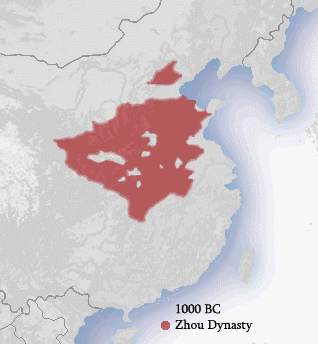
Zhou dynasty
dynasty of Ancient Chinese kings (王) lasting from c. 1046 to 256 BC
Erlitou culture
Bronze age culture found in the Yellow River valley
.jpg)
Sanxingdui
thumb|Sanxingdui bronze heads with gold foil masks
Sanxingdui () is an archaeological site and a major Bronze Age culture in modern Guanghan, Sichuan, China. Largely discovered in 1986, following a preliminary finding in 1927, archaeologists excavated artifacts that radiocarbon dating placed in the 12th–11th centuries BC. The archaeological site is the type site for the Sanxingdui culture that produced these artifacts, archeologists have identified the locale with the ancient kingdom of Shu, which suggests the presence of a unique civilization in this region before the state of Qin conquered t
Erligang culture
Bronze Age culture in China
Majiayao culture
archaeological culture
Chinese ritual bronzes
Chinese decorated bronzes deposited as grave goods in the tombs of royalty and the nobility
Qijia culture
archaeological culture
Xia–Shang–Zhou Chronology Project
a multi-disciplinary project commissioned by the People's Republic of China in 1996
Jinsha site
archaeological site in Sichuan
Xiaohe Cemetery
cemetery in Ruoqiang County, China
Upper Xiajiadian culture
bronze age archaeological culture in Northeast China
Wucheng culture
Bronze Age Chinese culture
Lower Xiajiadian culture
archaeological culture
Xinzhai
__NOTOC__
Xinzhai () is an early Bronze Age archaeological site that was found 1979 in Henan, China. It is located about southeast of Xinmi, Zhengzhou.
Zhukaigou culture
late Neolithic and early Bronze Age culture centered in the Ordos Plateau of Inner Mongolia, China
Dayangzhou
archaeological site
Xindian culture
Bronze Age culture in China

Tanheli site
Tanheli () is an archaeological site in Ningxiang, Hunan, one of major national historical and cultural sites in Hunan.
Erlitou
Erlitou (), also known as Yanshi Erlitou, is a Chinese archaeological site in the Yiluo Basin of Yanshi District, Luoyang, Henan. Discovered by survey teams led by archaeologist Xu Xusheng in 1959, it was initially identified as Bo, the first capital of the Shang dynasty, and some Chinese archaeologists later recognize it as the capital of the Xia—a dynasty whose existence is debated by scholars. A center of early Bronze Age China, it is the type site and largest settlement of the eponymous Erlitou culture, while more limited occupation has been found from the earlier Yangshao and Longshan cul
Siwa culture
archaeological culture
list of Bronze Age sites in China
Wikimedia list article
Baijinbao culture
archaeological site
Guandimiao
Guandimiao () is a Chinese archaeological site south of the Yellow River in Xingyang, Henan. It is the site of a small Late Shang village that was inhabited from roughly 1250 to 1100 BCE. Located from the site of the Shang dynasty capital at Yinxu in Anyang, the site was first studied as a part of excavations undertaken between 2006 and 2008 in preparation for the nearby South–North Water Transfer Project. Excavation and study at Guandimiao has significantly broadened scholars' understanding of rural Shang economies and rituals, as well as the layout of rural villages, which had received
Yueshi culture
archaeological culture