Category
page 1Buddhist gods

Shiva
Shiva (; , , , ), also known as Mahadeva (; , , [mɐɦaːd̪eːʋɐh], ) and Hara (, ), is one of the principal deities of Hinduism. He is the Supreme Being in Shaivism, one of the major traditions within Hinduism.

Ganesha
Ganesha or Ganesh (, , ), also known as Ganapati, Vinayaka and Pillaiyar, is one of the best-known and most revered and worshipped deities in the Hindu pantheon and is the Supreme god in the Ganapatya sect. His depictions are found throughout India. Hindu denominations worship him regardless of affiliations. Ganesha also holds the Title of "Pratham Pujya" (the god to be worshipped initially before the worship of any other Deity). Devotion to Ganesha is widely diffused and extends to Jains and Buddhists and beyond India.
.jpg)
Indra
Indra (; , ) is the Vedic god of weather, considered the king of the devas and svarga in Hinduism. He is associated with the sky, lightning, weather, thunder, storms, rains, river flows, and war.

Hanuman
Hanuman (; , ), also known as Maruti, Bajrangabali, and Anjaneya, is a deity in Hinduism, revered as a divine vanara, and a devoted companion of the deity Rama. Central to the Ramayana, Hanuman is celebrated for his unwavering devotion to Rama and is considered a chiranjivi. He is traditionally believed to be the spiritual offspring of the wind deity Vayu, who is said to have played a significant role in his birth. In Shaiva tradition, he is regarded as an incarnation of Shiva, while in most of the Vaishnava traditions he is the son and incarnation of Vayu. His tales are recounted not only in
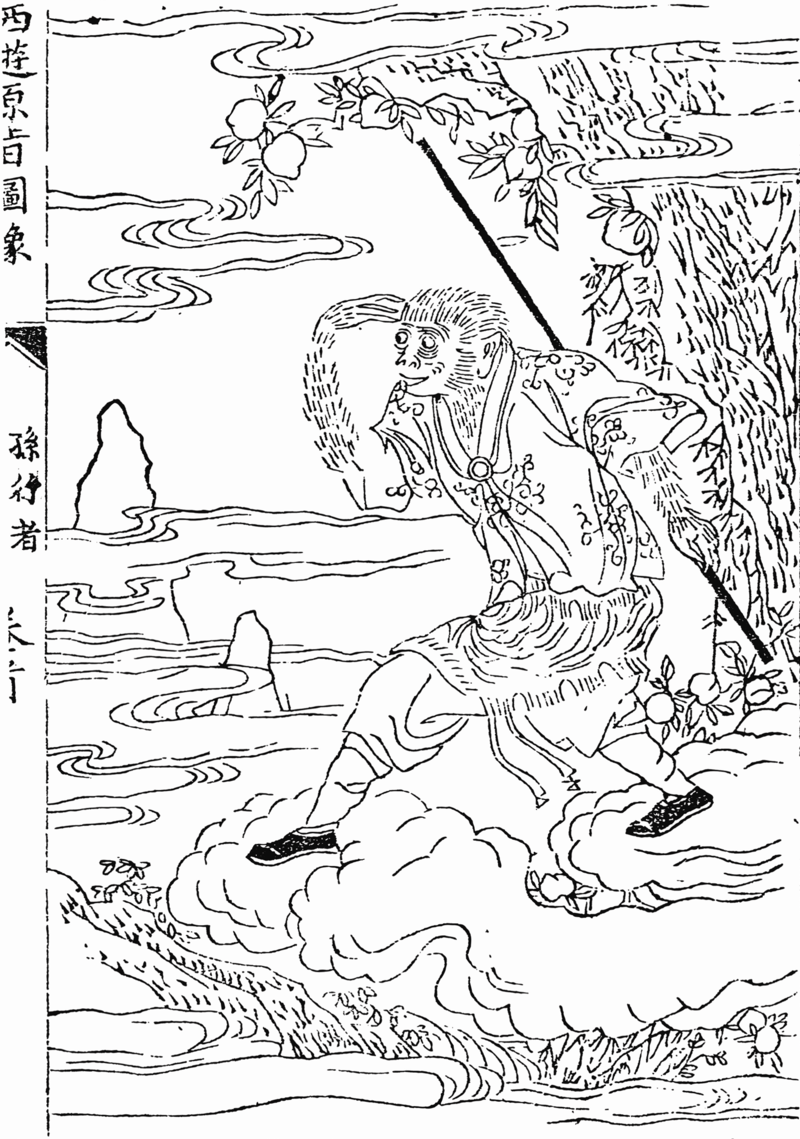
Sun Wukong
mythical character from Journey to the West

Navagraha
thumb|right|The Nine Devas, Khleang style of Angkor.
thumb|200px|Navagraha, Sun at the center
surrounded by the planets, Painting by Raja Ravi Varma
The navagraha (, Nine planets) are nine heavenly bodies and deities that influence human life on Earth according to Hinduism and Hindu mythology. The term is derived from nava ( "nine") and graha ( "planet, seizing, laying hold of, holding"). The nine parts of the navagraha are the Sun, Moon, planets Mercury, Venus, Mars, Jupiter, and Saturn, and the two nodes of the Moon.

Vishvakarma
Vishvakarma or Vishvakarman (, ) is a craftsman deity and the divine architect of the devas in contemporary Hinduism. In the early texts, the craftsman deity was known as Tvastar and the word "Vishvakarma" was originally used as an epithet for any powerful deity. However, in many later traditions, Vishvakarma became the name of the craftsman god.

Rahu
thumb|The Planet Rahu and other Astral Figures, painting by the Mahesh of Chamba (fl. c. 1730 - 1770). [[Rietberg Museum]]
Rāhu (Sanskrit: राहु, 16px|☊) is one of the nine major celestial bodies (navagraha) in Hindu texts and the king of meteors. It represents the ascension of the Moon in its precessional orbit around the Earth, also referred to as the north lunar node, and along with Ketu, is a "shadow planet" that causes eclipses. Despite having no physical existence, Rahu has been allocated the status of the planet by ancient seers owing to its strong influence in astrology.

Hachiman
thumb|300px|The Shinto deity Hachiman (Kamakura period 1326) at [[Tokyo National Museum (Lent by Akana Hachimangū), Important Cultural Property]]
, formerly known in Shinto as Yahata, is the syncretic divinity of archery and war, incorporating elements from both Shinto and Japanese Buddhism.

Kinnara
thumb|right|250px|Statue of a kinnara in Wat Phra Kaew|The Temple of the Emerald Buddha, [[Bangkok (Thailand).]]
thumb|Kinnara statue of Lý dynasty, Vietnam
Four Heavenly Kings
Buddhist gods
Śakra
deva and heavenly king in Buddhism; lord of the heavenly realm Trāyastriṃśa; regarded as king of the gods and wielder of the thunderbolt
Brahmā
deva and heavenly king in Buddhism; lord of the heavenly realm Brahmaloka; not regarded as a creator deity (unlike the deity of the same name in Hinduism)
Parjanya
Parjanya (, ) according to the Vedas is a deity of rain, thunder, lightning, and the one who fertilizes the earth. It is another epithet of Indra, the Vedic deity of the sky and heaven.
Ishana
Ishaan (Sanskrit: ईशान, IAST: Īśāna), is a Hindu god and the dikpala of the northeast direction. He is often considered to be one of the forms of the god Shiva, and is also often counted among the eleven Rudras. He is venerated in Hinduism, some schools of Buddhism and Jainism. In the Vastu Shastra, the north-eastern corner of a plot of land is referred to as "Ishana". Ishana also shares qualities with Samhara Bhairava and is therefore a part of the Ashta Bhairava.
Yama (Buddhism)
a Buddhist dharmapala (wrathful god) said to judge the dead, preside over the Narakas (Hells) and the cycle of afterlife saṃsāra

Chitragupta
Chitragupta (, 'rich in secrets' or 'hidden picture') is a Hindu deity who serves as the registrar of the dead. He is responsible for maintaining a record of the actions of human beings in a register called the Agrasandhanī. Upon the death of a human and their arrival at Yamaloka, Chitragupta reads out their deeds, allowing the god of death, Yama, to decide whether they go to Svarga or Naraka (heaven or hell), depending on their actions on earth. He is referred to as the Hindu God of Data and is the seventeenth manasaputra of Brahma. He is believed to have been created from Brahma's soul and m

Daikokuten
is a syncretic Japanese deity of fortune, luck and wealth. Daikokuten originated from Mahākāla, the Buddhist conflated with the native Shinto god Ōkuninushi. He is a patron of farmers, cooks and jobs related to money such as bankers.
Nio
two wrathful and muscular guardians of the Buddha standing at the entrance of Buddhist temples in East Asian Buddhism

Dhṛtarāṣṭra
Dhṛtarāṣṭra (Sanskrit: धृतराष्ट्र; Pali: Dhataraṭṭha) is one of the Four Heavenly Kings in Buddhism, the King of the Gandhabbas, known as the guardian of the eastern direction and a protector of the Dharma. He is also widely revered in East Asian Buddhist traditions.

Karura
thumb|A statue depicting a wingless Karura from Kōfuku-ji, Nara, 8th century.
thumb|An illustration from an 1866 Japanese book. Karura, who is an incarnation of Guanyin|Bodhisattva Kannon in this scene, gives a sermon to folks.
Skanda
Mahayana bodhisattva regarded as a devoted guardian of Buddhist monasteries who protects the teachings of Buddhism
%20-%20Google%20Art%20Project.jpg)
Nalakuvara
Nalakuvara, also known as Nalakubara (), appears in Hindu and Buddhist mythology as the brother of Manigriva (also known as Manibhadra), the son of the yaksha king Kubera (also known as Vaishravana), and husband of Rambha and Ratnamala. Nalakuvara often appears as a sexual trickster figure in Hindu and Buddhist literature.

Kangiten
Kangiten or Kankiten (, "god of bliss"; Sanskrit (IAST): ), also known as Binayaka (毘那夜迦; Skt. ), Ganabachi (誐那鉢底, alternatively Ganahachi or Ganahattei; Skt. ), or more commonly, Shōten or Shōden (聖天, lit. "sacred god" or "noble god"), is a deva (ten) venerated mainly in the Shingon and Tendai schools of Japanese Buddhism.
Sagaan Ubgen
Mongol mythology

Manibhadra
Maṇibhadra (Sanskrit: ) is one of the major yakshas. He was a popular deity in ancient India.
tennin
thumb|right|A depiction of a Tennin.
thumb|A man with an irezumi tattoo of a Tennyo.
Phra Phrom
Thai representation of the god Brahma
Maheśvara
figure in Buddhist Mythology
Pañcika
thumb|right|200px|Pañcika and Hariti
Myōken
Myōken (, ; Chinese: 妙見菩薩 (Traditional) / 妙见菩萨 (Simplified), ; Japanese: 妙見菩薩, Myōken Bosatsu), also known as Sonjō-Ō (尊星王, "Venerable Star King", also Sonsei-Ō or Sonshō-Ō), is a Buddhist deification of the North Star worshiped mainly in the Shingon, Tendai and Nichiren schools of Japanese Buddhism.
Twelve Heavenly Generals
yaksha of Bhaisajyaguru
Gozu Tennō
Japanese plague deity, historically conflated with Susanoo
Twelve Devas
12 Japanese Buddhist gods, associated with directions
Thagyamin
thumb|A statue of Thagyamin at the Kyauktan Yay-Le Pagoda.
Thagyamin (, ; from Sanskrit , ) is the highest-ranking nat (deity) in traditional Burmese Buddhist belief. Considered as the king of Heaven, he is the Burmese adaptation of the Hindu deity Indra.
Heng and Ha
Investiture of the Gods characters
Matarajin
Matarajin (摩多羅神) or Madarajin (摩怛哩神) is a Buddhist god chiefly venerated in the Tendai school of Japanese Buddhism. While originally regarded as a wrathful deity obstructing rebirth in the pure land, and thus a "god of obstacles", with time he also came to be seen as a protector of adherents of Tendai doctrine, capable of warding off demons, especially tengu, as well as epidemics. He also acquired other roles, including these of a protector of performing arts (for example noh and sarugaku) and of an astral god of destiny. He additionally came to be identified with a large number of other figur