Category
page 1Burmese amber

Oculudentavis
Oculudentavis is an extinct genus of lizard of uncertain taxonomic placement, originally but inaccurately identified as an avialan dinosaur (bird, in the broad sense). It contains two known species, O. khaungraae and O. naga. Each species is known from one partial fossil specimen in Burmese amber, which differ in several proportions. Their skulls measure in length, indicating that Oculudentavis would have been comparable in size with the modern bee hummingbird if it were an avialan. Both specimens were retrieved from 99-million-year-old deposits of the Hukawng Basin in Kachin State, northern M
Burmese amber
Late Cretaceous amber from Northern Myanmar
Aethiocarenus
Aethiocarenus is an extinct genus of insects which has a single species Aethiocarenus burmanicus described from a 98.79 ±0.62 million year old fossil found in Burmese amber from the Hukawng Valley of Myanmar. The insect is unusual due to the vertex of the triangular head being attached to the pronotum as opposed to the hypotenuse. When first described Aethiocarenus was placed as the sole member of the family Aethiocarenidae and order Aethiocarenodea. However, Aethiocarenus was later considered to be a nymph of Alienopterus. Vršanský et al. (2018) considered Aethiocarenus to be an alienopterid

Cascoplecia insolitis
Cascoplecia insolitis, rarely known as the unicorn fly, is an extinct dipteran that lived in the Cretaceous. The type specimen was found in Burmese amber. George Poinar Jr., who described the fossil, placed the genus into a new family Cascopleciidae. One of the defining characteristics of Cascoplecia is the presence of three ocelli raised on an extended, horn-like protuberance. The distinctiveness of the family was questioned by other authors, and the genus has been subsequently transferred to the family Bibionidae.
thumb|left|reconstruction
Zigrasimecia
Zigrasimecia, also known as iron-maiden ants, is an extinct genus of ants which existed in the Cretaceous period approximately 98 million years ago. The first specimens were collected from Burmese amber in Kachin State, west of Myitkyina town in Myanmar. In 2013, palaeoentomologists Phillip Barden and David Grimaldi published a paper describing and naming Zigrasimecia tonsora. They described a dealate female with unusual features, notably the highly specialized mandibles. Other features include large ocelli, short scapes, 12 antennomeres, small eyes, and a clypeal margin that has a row of peg-
Electrorana limoae
Electrorana is an extinct genus of frog that lived in what is now Myanmar during the mid-Cretaceous, around 99 million years ago. The type species and only species is Electrorana limoae. The generic name is derived from the Latin (amber) and (frog), while the specific epithet is given in honour of Mrs. Mo Li, who purchased and provided the specimens for study.
Myanmymar
Myanmymar is an extinct genus of fairyfly preserved in Burmese amber from Myanmar. It has only one species, Myanmymar aresconoides. It is dated to the earliest part of the Cenomanian stage of the Late Cretaceous, around 99 million years old. As of 2011, it is the oldest known fossil mymarid.
Deinocroton
Deinocroton is an extinct genus of tick. It is known from four species found in Burmese amber, dating to the earliest part of the Cenomanian stage of the Late Cretaceous, around 99 million years ago.
Chimerarachne
Chimerarachne is a genus of extinct arachnids, containing five known species. Fossils of Chimerarachne were discovered in Burmese amber from Myanmar which dates to the mid-Cretaceous, about 100 million years ago. It is thought to be closely related to spiders, but outside any living spider clade. The earliest spider fossils are from the Carboniferous, requiring at least a 170 myr ghost lineage with no fossil record. The size of the animal is quite small, being only in body length, with the tail being about in length. These fossils resemble spiders in having two of their key defining features:
Gerontoformica
Gerontoformica is an extinct genus of stem-group ants. The genus contains thirteen described species known from Late Cretaceous fossils found in Asia and Europe. The species were described between 2004 and 2016, with a number of the species formerly being placed into the junior synonym genus Sphecomyrmodes.
Linguamyrmex
Linguamyrmex is an extinct genus of ant in the formicid subfamily Haidomyrmecinae, and is one of only nine genera placed in the subfamily Haidomyrmecinae. The genus contains three described species, Linguamyrmex brevicornis, Linguamyrmex rhinocerus, and the type species Linguamyrmex vladi all known from Late Cretaceous fossils found in Asia.
Ceratomyrmex
Ceratomyrmex is an extinct genus of ant in the Formicidae subfamily Haidomyrmecinae. The genus contains a single described species Ceratomyrmex ellenbergeri and is known from several Late Cretaceous fossils which have been found in Asia.
Haidomyrmex
Haidomyrmex is an extinct genus of ants in the formicid subfamily Haidomyrmecinae, and is one of nine genera placed in the subfamily Haidomyrmecinae. The genus contains three described species Haidomyrmex cerberus, Haidomyrmex scimitarus, and Haidomyrmex zigrasi. All three are known from single Late Cretaceous fossils which have been found in Asia. H. cerberus is the type species and Haidomyrmex the type genus for the subfamily Haidomyrmecinae.
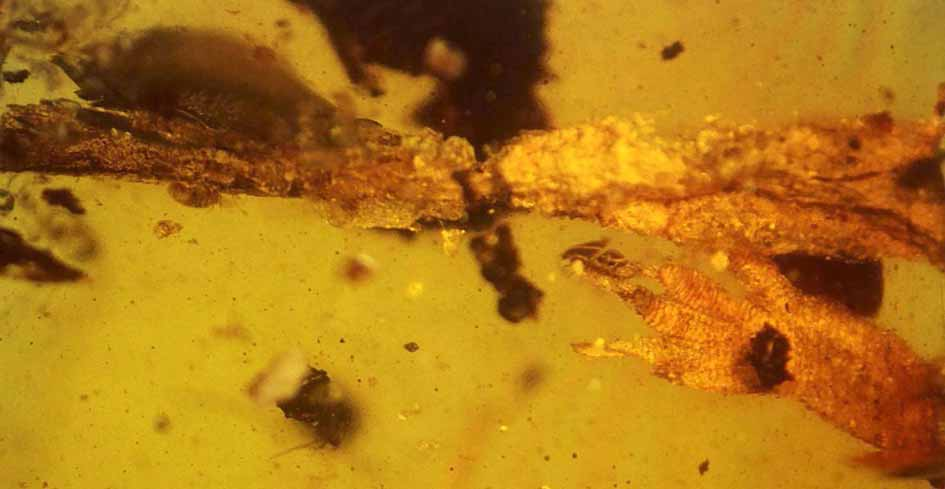
Cretaceogekko burmae
Cretaceogekko (meaning “Cretaceous gecko”) is an extinct monotypic genus of gecko (represented by the type species Cretaceogekko burmae) known from a single partial specimen preserved in Burmese amber from the Cenomanian of Myanmar. The specimen was found in the Hukawng Valley in 2001 and the genus and species were named by E. Nicholas Arnold and George Poinar in 2008. The specimen includes a foot and partial tail. Cretaceogekko is the oldest known gecko, predating the Late Cretaceous gecko Gobekko and the Paleogene gecko Yantarogecko, which has also been preserved in amber.
Manipulator modificaputis
extinct predatory cockroach species
Yaksha perettii
species of amphibian (fossil)
Aptenoperissus
Aptenoperissus is a genus of extinct wasp with eight described species, placed into the monotypic family Aptenoperissidae. The type species Aptenoperissus burmanicus resembles a mix between a grasshopper, an ant, and a wasp. It was described by a group of researchers from Oregon State University in a paper released online in October 2016. The piece of 100 million year old Burmese amber that it was preserved in was found in the Hukawng Valley of Myanmar in Southern Asia. A new family, Aptenoperissidae, was described to accommodate this insect. Species of Aptenoperissus were wingless, with a str
Paraodontomma
Paraodontomma is an extinct genus of ommatid beetle, it is known from three species, P. burmiticum described in 2017, P. szwedoi described in 2018. and P. leptocristatum in 2021. All 3 species are known from the Cenomanian aged Burmese amber.
Caradiophyodus
Caradiophyodus is an extinct genus of minute wasps in the superfamily Platygastroidea within the order Hymenoptera. The genus was described in 2023 by George Poinar Jr. and Fernando E. Vega and placed in the monotypic family Caradiophyodidae and is represented by a single species, Caradiophyodus saradae. The fossil was found in mid-Cretaceous Burmese amber from northern Myanmar and represents one of the earliest known records of platygastroid wasps.
Baeomorpha
Baeomorpha is an extinct genus of baeomorphid parasitic wasp, known from the Late Cretaceous (~99-72 ma) of Laurasia. The type species, B. dubitata was named by Charles Thomas Brues for a specimen found in 72 million year old Canadian Amber. The vast majority of species are known from the Russian Taimyr amber, of upper Santonian age but two species (including type) are known from the upper Campanian Canadian amber, while one species is known from the lower Cenomanian Burmese amber.
Burmomyrma rossi
Burmomyrma is an extinct genus of aculeate hymenopteran, suggested to be an ant. The genus contains a single described species, Burmomyrma rossi. Burmomyrma is known from a single Middle Cretaceous fossil which was found in Asia.