Category
page 1Byzantine law
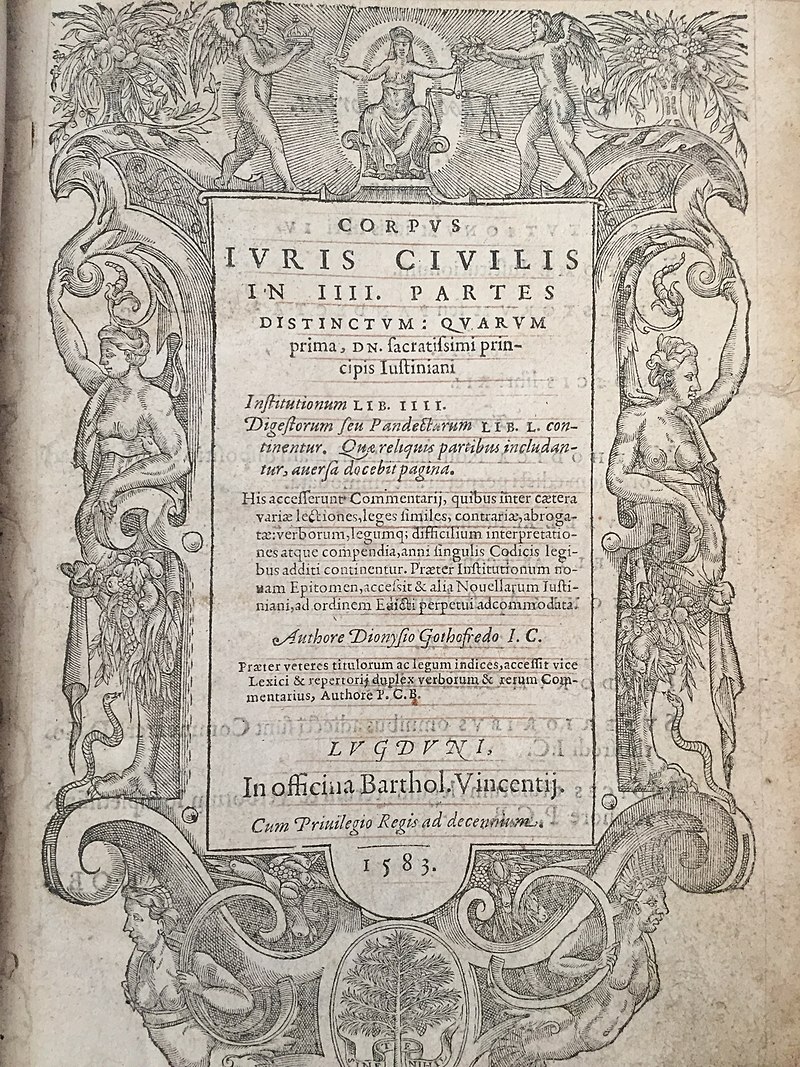
Corpus Juris Civilis
collection of fundamental works in jurisprudence as codified by Justinian

Basileus
Basileus () is a Greek term and title that has signified various types of monarchs throughout history. In the English-speaking world, it is perhaps most widely understood to mean , referring to either a or an . The title was used by sovereigns and other persons of authority in ancient Greece (especially during the Hellenistic period), the Byzantine emperors, and the kings of modern Greece. The name Basileios (Basil), deriving from the term basileus, is a common given name in the Eastern Orthodox Church and Syriac Orthodox Church for the Maphrian.
Codex Theodosianus
Compilation of laws of Roman Empire (438)
Digest
Roman law digest
Code of Justinian
part of the 6th century codification of Roman law
Strategikon of Maurice
manual of war by written in the late 6th century and usually attributed to Byzantine Emperor Maurice

Basilika
alt=|thumb|250x250px|Leo VI (right) and Basil I (left), from the 12th-century Madrid Skylitzes.
The Basilika (, "the imperial [laws]") was a collection of laws completed in Constantinople by order of the Byzantine emperor Leo VI the Wise during the Macedonian dynasty. This was a continuation of the efforts of his father, Basil I, to simplify and adapt the Emperor Justinian I's Corpus Juris Civilis code of law issued between 529 and 534 which had become outdated. The term comes from the Greek adjective Basilika meaning "Imperial (laws or enactments)" and not from the Emperor Basil's name; both
Dušan's Code
14th-century set of laws
Novellae Constitutiones
one of the four components of the “Corpus juris civilis” drafted under the Byzantine emperor Justinian
Byzantine law
Eastern European legal code written in Greek
Institutes of Justinian
sixth century codification of Roman law
Epanagoge
The Epanagoge (, "return to the point"), more properly the Eisagoge (, "Introduction [to the law]"), is a Byzantine law book promulgated in 886. Begun under Basil I the Macedonian (r. 867–886), it was only completed under his son and successor, Leo VI the Wise (r. 886–912). As its name suggests, it was meant to be an introduction to the legislation of the Basilika, published later during Leo's reign.
law school of Berytus
ancient school of Roman law, to 551 AD
Syntagma Canonum
medieval canonical collection
political mutilation in Byzantine culture
criminal punishment used against rivals
Allelengyon
The allelengyon () was a tax established in 1002 by the Byzantine Emperor Basil II, requiring the wealthiest landowners to pay the tax debts owed by their poorer neighbours. It relied on a concept long extant in Hellenistic and Byzantine law, but was abolished by Romanos III Argyros in 1028.
Littera Florentina
Book of the Prefect
byzantine commercial manual
Mitato
thumb|Nida Plateau - Mitata
Mitato (, archaic form: , from , "to measure off/to pitch camp") is a term meaning "shelter" or "lodging" in Greek.
Birger Persson
Swedish politician
Paroikoi
Paroikoi (plural of Greek πάροικος, paroikos, the etymological origin of parish and parochial) is the term that replaced "metic" in the Hellenistic and Roman period to designate foreign residents.
Syro-Roman law book
late 5th-century text for law schools
International Roman Law Moot Court