Category
page 1Byzantine military offices
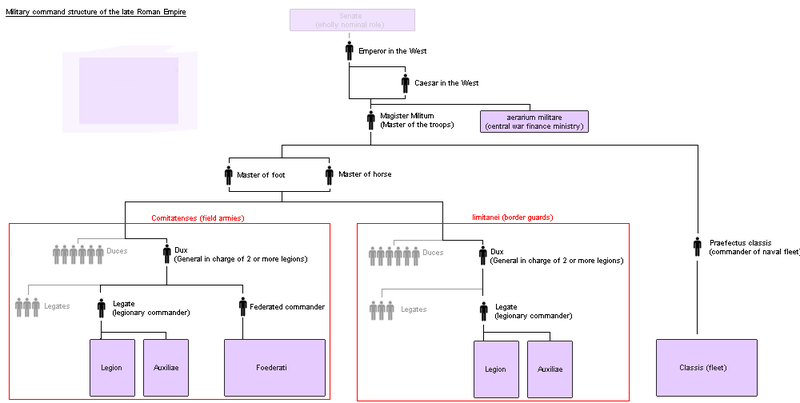
magister militum
Imperial Roman military office

strategos
thumb|Bust of Pericles, statesman and general during the Golden Age of Athens; [[Hadrianic Roman copy of a Greek sculpture of BC]]
Strategos (), also known by its Latinised form strategus, is a Greek term meaning 'military general'. In the Hellenistic world and in the Byzantine Empire, the term also described a military governor. In the modern Hellenic Army, it is the highest officer rank.
ethnarch
Ethnarch (pronounced , also ethnarches, ) is a term that refers generally to political leadership over a common ethnic group or homogeneous kingdom. The word is derived from the Greek words (ethnos, "tribe/nation") and (archon, "leader/ruler"). ''Strong's Concordance'' gives the definition of 'ethnarch' as "the governor (not king) of a district".
megas doux
title for the commander-in-chief of the Byzantine Navy

katepano
thumb|right|300px|Map of the administrative structure of the Byzantine Empire in 1025. The regional eastern commands, variously under doukes or katepano, are outlined. Southern Italy was under the authority of the katepano of Italy, while Bulgaria, Serbia and Paristrion were often under the authority of a single katepano.
The katepánō (, ) was a senior Byzantine military rank and office. The word was Latinized as capetanus/catepan, and its meaning seems to have merged with that of the Italian "capitaneus" (which derives from the Latin word "caput", meaning head). This hybridized term gave rise

Protostrator
Prōtostratōr () was a Byzantine court office, originating as the imperial stable master. Its proximity to the imperial person led to a highly visible role in imperial ceremonies, and served as a springboard for several capable individuals, like Manuel the Armenian or the future emperors Michael II and Basil I the Macedonian, to reach the highest offices. From the mid-11th century, the post rose in importance, becoming more an honorific dignity for senior members of the court, than an actual office. From the 13th century on, the post could be held by several persons, and ranked eighth in the ov
Chiliarch
Chiliarch is a military rank dating back to antiquity. Originally denoting the commander of a unit of about one thousand men (a chiliarchy) in the Macedonian army, it was subsequently used as a Greek translation of a Persian officer who functioned as a kind of vizier and of the Roman army's military tribunes. It has subsequently been used for other similar ranks and positions in other armed forces.
Domestic of the Schools
Military post of the Byzantine Empire, extant from the 8c
droungarios
A droungarios, also spelled drungarios (, ) and sometimes anglicized as Drungary, was a military rank of the late Roman and Byzantine empires, signifying the commander of a formation known as droungos.
Domestikos
Domestikos (; , from the ), in English sometimes [the] Domestic, was a civil, ecclesiastic and military office in the Late Roman Empire and the Byzantine Empire.
Logothetes tou stratiotikou
Byzantine imperial official
taxiarch
The word taxiarch ( ; ) is used in the Greek language to mean "brigadier". The term derives , in military context meaning 'an ordered formation'. It is cognate with the scientific term taxonomy. In turn, the rank has given rise to the Greek term for brigade, taxiarchia. In Greek Orthodox Church usage, the term is also applied to the archangels Michael and Gabriel, as leaders of the heavenly host, and several locations in Greece are named after them.
Grand Domestic
Supreme Byzantine military office
mandator
The mandatōr (), deriving from the Latin word for "messenger", was a subaltern official in the middle Byzantine Empire.
Droungarios of the Fleet
commander of the Imperial Fleet of the Byzantine navy
Stratopedarches
Stratopedarchēs (), sometimes Anglicized as Stratopedarch, was a Greek term used with regard to high-ranking military commanders from the 1st century BC on, becoming a proper office in the 10th-century Byzantine Empire. It continued to be employed as a designation, and a proper title, of commanders-in-chief until the 13th century, when the title of ' (μέγας στρατοπεδάρχης) or Grand Stratopedarch' appeared. This title was awarded to senior commanders and officials, while the ordinary stratopedarchai were henceforth low-ranking military officials.
Akolouthos
Akolouthos () was a Byzantine office with varying functions over time. Originally a subaltern officer of the imperial guard regiment (tagma) of the Vigla, it was associated with the command over the famed Varangian Guard in the 11th–12th centuries.
Count of the Stable
Roman military position
Stratelates
thumb|right|250px|Seal of the magistros, vestēs, and stratēlatēs of the East [[Hervé Frankopoulos]]
Stratēlatēs (, "driver/leader of the army") was a Greek term designating a general, which also became an honorary dignity in the Byzantine Empire. In the former sense, it was often applied to military saints, such as Theodore Stratelates.
Topoteretes
'''''' () was a Byzantine technical term, meaning deputy or lieutenant (). As such, it was used in different ways throughout the Empire's history. In the 9th-11th centuries, the was the deputy of senior military commanders of the , the and the Byzantine navy. The was usually placed in command of one half of the respective unit. In the early 12th century, are found as commanders of small regions and fortresses, while in the late Palaiologan period, the term was used for representatives of the Patriarch of Constantinople in sees that now lay outside the Byzantine Empire's borders.
Konostaulos
Konostaulos or konostablos ("constable", in Greek variously ), later corrupted to kontostaulos/kontostablos (κοντόσταυλος), was a late Byzantine title, adopted from the Normans. The derivative dignity of megas konostaulos (μέγας κονόσταυλος, "Grand Constable") became one of the highest court posts in the Palaiologan period (1261–1453) and was awarded to high-ranking generals.
Merarches
The merarchēs (), sometimes Anglicized as merarch, was a Byzantine military rank roughly equivalent to a divisional general.
Drungary of the Watch
originally a senior Byzantine military post
Logothetes ton agelon
administrative position in Byzantine Empire
hetaireiarches
The ' (), sometimes anglicized as Hetaeriarch, was a high-ranking Byzantine officer, in command of the imperial bodyguard, the . In the 9th–10th centuries there appear to have been several , each for one of the subdivisions of the , but in later times only the senior of them, the () or Great Hetaeriarch' survived, eventually becoming simply a high court rank in the 12th–15th centuries.
Tzaousios
The tzaousios () was a late Byzantine military office, whose exact functions and role are somewhat unclear.
Stratarches
'''''' (, : (archaic) or (modern)) means 'ruler of the army' in Greek, and is a title associated with successful generals. In modern Greek usage, it corresponds to the rank of Field Marshal.