Category
page 1Byzantine Rite

Easter Monday
day after Easter Sunday
Dormition of the Mother of God
Great Feast of the Eastern Orthodox, Oriental Orthodox, and Eastern Catholic Churches
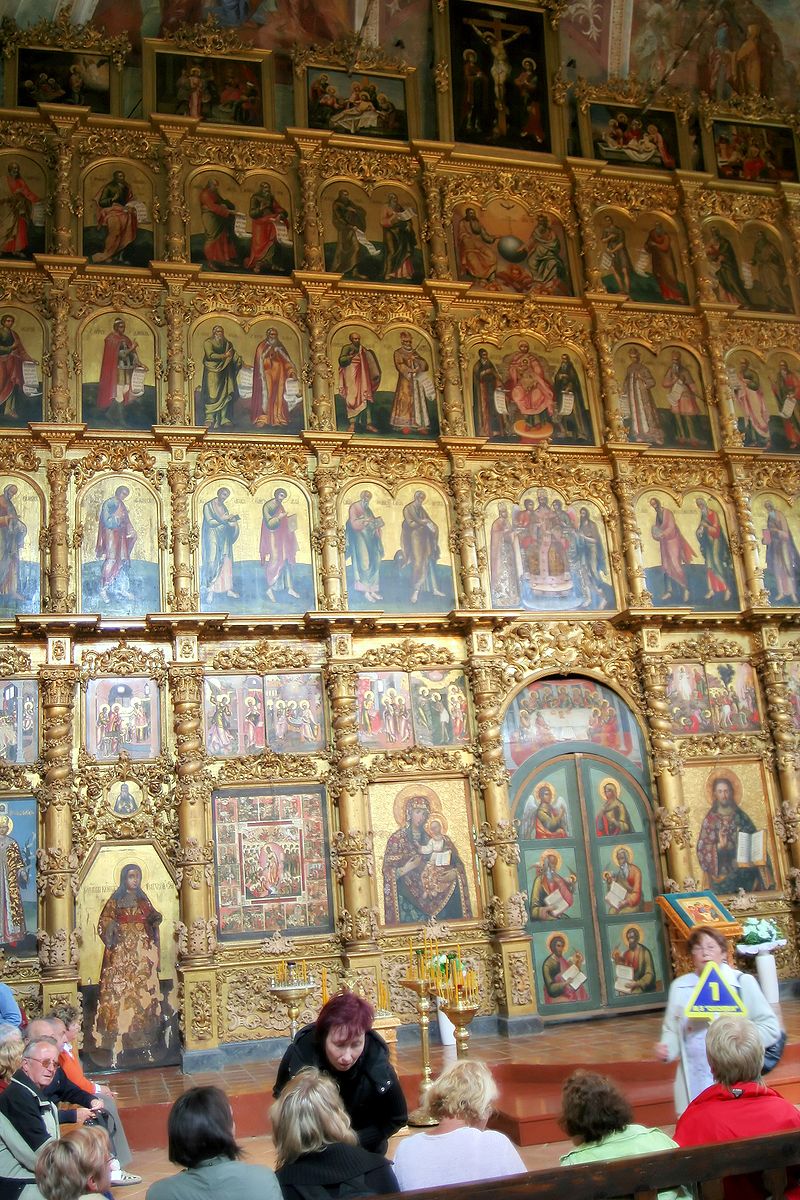
Byzantine Rite
liturgical rite of most Eastern Orthodox and Eastern Catholic churches

altar server
assistant to a member of the clergy
Russian Orthodox cross
three beam slanted cross
Great Lent
observance in Eastern Christianity
Lazarus Saturday
day before Palm Sunday in the Orthodox Church
Sub tuum praesidium
Christian hymn and prayer

prosphora
A prosphora (, offering, or in Demotic Greek πρόσφορον) is a small loaf of leavened bread used in Orthodox Christian, Eastern Lutheran and Greek Catholic (Byzantine) liturgies. The classical plural form is prosphorai (). The term originally meant any offering made to a temple, but in Orthodox Christianity, as well as Byzantine Rite Lutheranism and Catholicism, it has come to mean specifically the bread offered at the Eucharist during Divine Liturgy.

Typikon
thumb|Studenica typicon
memorial service in the Eastern Orthodox Church
service for the deceased in the Eastern Orthodox Church
Divine Liturgy of St. John Chrysostom
eucharistic liturgy of the Byzantine Rite

Ektenia
thumb|upright=1.2|Russian Orthodox [[deacon intoning an ektenia. Note the stole, or orarion, the end of which is raised by the Deacon after each petition. Painting by Andrei Ryabushkin, 1888]]
Feast of Orthodoxy
Feast observed in Orthodox Christianity
Octoechos
Oktōēchos (here transcribed "Octoechos"; Greek: ; from ὀκτώ "eight" and ἦχος "sound, mode" called echos; Slavonic: Осмогласие, Osmoglasie from о́смь "eight" and гласъ, Glagolitic: , "voice, sound") is the eight-mode system used for the composition of religious chant in Byzantine, Syriac, Armenian, Georgian, Latin and Slavic churches since the Middle Ages. In a modified form the octoechos is still regarded as the foundation of the tradition of monodic chant in the Byzantine Rite today.
churching of women
Christian blessing for mothers after birth to allow them to attend mass
Paschal troparion
song
Liturgy of Preparation
Easter Orthodox rite for the preparation of bread and wine for the Eucharist

Terce
thumb|Nederlandish book of the hours, opened at the hour of Terce
Terce is a canonical hour of the Divine Office. It consists mainly of psalms and is held around 9 a.m. Its name comes from Latin and refers to the third hour of the day after dawn. Along with Prime, Sext, None, and Compline, Terce belongs to the so-called "Little Hours".
Liturgy of the Presanctified Gifts
Byzantine Rite liturgical service on the weekdays of Great Lent
Song of Ascents
title given to fifteen of the Psalms (120–134)
Preface
liturgical term
All-night vigil
service of the Eastern Orthodox Church
Bright Week
Seven days beginning on Easter in Eastern Christianity
Nones
fixed time of prayer of the Divine Office of almost all the traditional Christian liturgies

Lausiac History
5th-century Christian texts

artos
thumb|250px|Paschal Artos, between services during bright Week, in front of opened [[royal doors.]]
Liturgy of Saint Basil
byzantine and Coptic Liturgy
Midnight Office
Canonical Hours

Paraklesis
thumb|250px|Receiving a blessing at the end of a Molieben at the Trinity-St. Sergius Lavra (Siege of Troise-Sergieva Lavra, by [[Vasily Petrovich Vereshchagin, 1891).]]
A Paraklesis () or Supplicatory Canon in the Byzantine Rite, is a service of supplication for the welfare of the living. It is addressed to a specific Saint or to the Most Holy Theotokos whose intercessions are sought through the chanting of the supplicatory canon together with psalms, hymns, and litanies.

Kathisma
A kathisma (Greek: κάθισμα; Church Slavonic: каѳисма, kafisma), literally, "seat", is a division of the Psalter, used in the Eastern Orthodox and Byzantine Rite Catholic churches. The word may also describe a hymn sung at Matins, a seat used in monastic churches, or a type of monastic establishment.

aër
thumb|300px|Aër covering a Chalice and Diskos on the Prothesis (altar)|Prothesis

Easter Tuesday
Tuesday following Easter
Sext
Sext is a canonical hour of the Divine Office in the liturgies of many Christian denominations. It consists mainly of psalms and is held around noon. Its name comes from Latin and refers to the sixth hour of the day after dawn. With Terce, None and Compline it belongs to the so-called Little Hours.
Irmos
The irmos (or heirmos from ) in the Byzantine liturgical tradition is the initial troparion of an ode of a canon. The meter and melody of an irmos is followed by the remaining troparia of the ode; when more than one canon is used (as is typical at matins), only the first canon's irmos is sung, but the irmoi of the subsequent canons must be known in order to determine an ode's melody and so, even in canons where it is known that the irmos is never sung, the irmos is nonetheless specified. Note that in the Russian tradition, often only the irmos is sung, the rest of the ode simply being read; in
Sticheron
A sticheron (Greek: "set in verses"; plural: stichera; Greek: ) is a hymn of a particular genre sung during the daily evening (Hesperinos/Vespers) and morning (Orthros) offices, and some other services, of the Eastern Orthodox and Byzantine Catholic churches.
Prokeimenon
In the liturgical practice of the Orthodox Church and Byzantine Rite, a prokeimenon (Greek , plural '; sometimes /'; lit. 'that which precedes') is a psalm or canticle refrain sung responsorially at certain specified points of the Divine Liturgy or the Divine Office, usually to introduce a scripture reading. It corresponds to the Gradual of the Roman Mass.

synaxis
thumb|Icon of the Synaxis of the [[Theotokos (Pskov, 17th century)]]
A synaxis ( "gathering"; Slavonic: собор, sobor) is a liturgical assembly in Eastern Christianity (the Eastern Orthodox Church and those Eastern Catholic Churches which follow the Byzantine Rite).
Memory Eternal
Eastern Orthodox exclamation at funerals
Archiereus
REDIRECT Diocesan bishop#Eastern Orthodox
Usual beginning
Polychronion
The Polychronion (Greek: Πολυχρόνιον, "many years"; , ; ) is a solemn encomium chanted in the liturgy of the Eastern Orthodox and Byzantine Catholic churches. In the Roman rite, it is the equivalent of the liturgical acclamation Ad multos annos.
Annunciation in Christian art
subject in art
Little Hours
Christian minor canonical hours
Exapostilarion
The Exapostilarion (, pl. ἐξαποστειλάρια Exapostilaria; Russian Ексапостила́рий) is a hymn or group of hymns chanted in the Eastern Orthodox and Greek-Catholic Churches at the conclusion of the Canon near the end of Matins. The Exapostilarion is chanted after the Little Litany that follows the Ninth Ode of the Canon.

Mid-Pentecost
Mid-Pentecost or Midfeast, also Meso-Pentecost (from ; ) is a feast day which occurs during the Paschal season in the Eastern Orthodox Church and those Eastern Catholic Churches and Eastern Lutheran Churches that follow the Byzantine Rite.
Lity
festive religious procession
Theotokion
thumb|300px|Russian icon of [[Our Lady of Vladimir.]]
A theotokion (; pl. ) is a hymn to Mary the Theotokos (), which is a troparion or sticheron read or chanted during the canonical hours and Divine Liturgy of the Eastern Orthodox and Eastern Catholic churches, as well as in the praises of the Oriental Orthodox churches.
Great Hours
Religious celebration
Eastern Lutheranism
Byzantine-rite expression of Lutheran Christianity
Polyeleos
The Polyeleos is a festive portion of the Matins or All-Night Vigil service as observed on higher-ranking feast days in the Eastern Orthodox, Eastern Lutheran, and Byzantine Rite Catholic Churches. The Polyeleos is considered to be the high point of the service, and contains the reading of the Matins Gospel. Because of its liturgical importance, settings for the Polyeleos have been composed by Sergei Rachmaninoff and others.
Katabasia
thumb|A Romanian Orthodox [[Horologion opened to the Katabasiae of the Nativity of the Lord.]]
Megalynarion
The Megalynarion (Greek , "magnification", "that which magnifies"; also called Velichaniye in Church Slavonic) is a special hymn used in the Eastern Orthodox Church and those Eastern Catholic Churches that follow the Byzantine Rite. Depending on the local liturgical tradition, this hymn can be one of several.

Spiritual Meadow
7th-century book by John Moschus
Easter Saturday
Saturday 6 days after Easter Sunday. Sometimes confused with Holy Saturday