Category
page 1Cambrian echinoderms

Stylophora
The Stylophora are an extinct class of paleozoic echinoderms, comprising the cornutes, the mitrates, and the basal ceratocystids. It is synonymous with the subphylum Calcichordata. Their unusual appearances have led to a variety of very different reconstructions of their anatomy, how they lived, and their relationships to other organisms.
Eocrinoidea
The Eocrinoidea were an extinct class of echinoderms that lived between the Early Cambrian and Late Silurian periods. They are the earliest known group of stalked, brachiole-bearing echinoderms, and were the most common echinoderms during the Cambrian.
Blastozoa
Blastozoa is a subphylum of extinct echinoderms characterized by the presence of specialized respiratory structures and brachiole plates used for feeding. It ranged from the Cambrian to the Permian. Biserial, triradiate, and pentaradiate ambulacral patterns have been identified in blastozoa specimens. The pentaradiate pattern in particular has been associated with several different classes.
Helicoplacoidea
Helicoplacoidea is an extinct class within the Echinodermata. All known taxa were discovered in sediments dating back to the Cambrian.
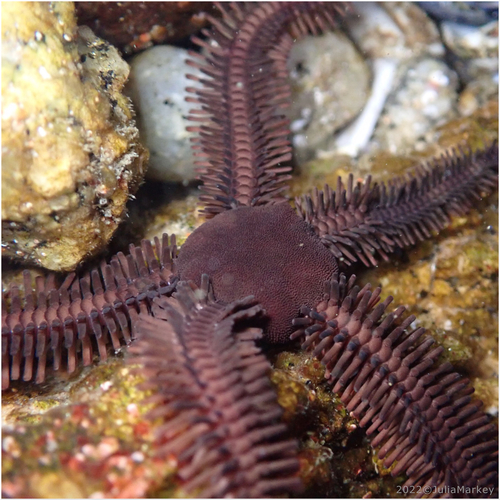
Ophiopteris
Ophiopteris is a genus of brittle stars. The genus was first described in 1877 from a specimen collected in New Zealand.