Category
page 1Caprinae

musk ox
The muskox (Ovibos moschatus) is a hoofed mammal of the family Bovidae. Native to the Arctic, it is noted for its thick coat and for the strong odor emitted by males during the seasonal rut, from which its name derives. This musky odor has the effect of attracting females during mating season. Its Inuktitut name translates to "the bearded one".

chamois
The chamois (; ; Rupicapra rupicapra), or Alpine chamois, is a species of goat-antelope native to mountainous parts of Europe and Western Asia, from the Pyrenees, the Alps, the Apennines, the Dinarides, the Tatra to the Carpathian Mountains, the Balkan Mountains, the Rila–Rhodope massif, Pindus, the northeastern mountains of Turkey, and the Caucasus. It has also been introduced to the South Island of New Zealand. Some subspecies of chamois are strictly protected in the EU under the European Habitats Directive.

Caprinae
The subfamily Caprinae, also sometimes referred to as the tribe Caprini, is part of the ruminant family Bovidae, and consists of mostly medium-sized bovids. A member of this subfamily is called a caprine.
Budorcas taxicolor
The takin (Budorcas taxicolor); is a large species of ungulate of the subfamily Caprinae found in the eastern Himalayas. It includes four subspecies, the Mishmi takin (B. t. taxicolor), the golden takin (B. t. bedfordi), the Tibetan (or Sichuan) takin (B. t. tibetana), and the Bhutan takin (B. t. whitei).

Oreamnos americanus
species of mammal

Barbary sheep
species of mammal

Himalayan Goral
species of mammal

bharal
The bharal (Pseudois nayaur), also called the blue sheep, is a caprine native to the high Himalayas. It inhabits the Himalayan alpine meadows and rocky slopes across Bhutan, China, India, Myanmar, Nepal, and Pakistan, typically at altitudes of .

Himalayan tahr
species of large ungulate

goral
The gorals are four species in the genus Naemorhedus. They are small ungulates with a goat-like or antelope-like appearance. Until recently, this genus also contained the serow species (now in genus Capricornis).

Rupicapra
Rupicapra is a genus of two species of goat-antelope called chamois. They belong to the bovine family of hoofed mammals, the Bovidae.

Rupicapra pyrenaica
species of mammal

Red goral
species of mammal

Long-tailed goral
species of mammal

Arabitragus jayakari
species of mammal

Chinese goral
species of mammal
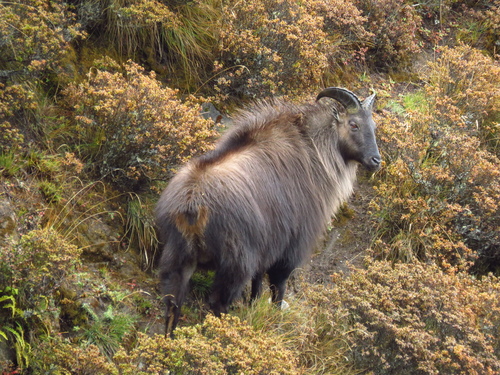
Hemitragus
Hemitragus is a genus of bovids that currently contains a single living species, the Himalayan tahr. Two extinct species are also known from the Pleistocene.
Tahr
Tahrs ( , ) or tehrs ( ) are large artiodactyl ungulates related to goats and sheep. There are three species, all native to Asia. Previously thought to be closely related to each other and placed in a single genus, Hemitragus, genetic studies have since proven that they are not so closely related and they are now considered as members of three separate monotypic genera: Hemitragus is now reserved for the Himalayan tahr, Nilgiritragus for the Nilgiri tahr, and Arabitragus for the Arabian tahr.

Oreamnos
Oreamnos is a genus of North American caprines. The mountain goat (Oreamnos americanus) is the only living species. Until the end of the Pleistocene, another species, Oreamnos harringtoni, was distributed to the south of the recent form.

Tatra chamois
subspecies of mammal

Nilgiri tahr
species of mammal
Radical 123
Chinese character radical
Budorcas
Budorcas is a genus of bovid that contains a single living species, the takin (Budorcas taxicolor). Two extinct species are known from the Pliocene, B. teilhardi from China and B. churcheri from Ethiopia. The presence of the genus in Africa indicates that it was far more widespread in the past.
Rupicapra pyrenaica ornata
subspecies of mammal
Ammotragus
REDIRECT Barbary sheep
Cantabrian chamois
subspecies of mammal