Category
page 1Carbon

carbon
Carbon () is a chemical element; it has symbol C and atomic number 6. It is nonmetallic and tetravalent—meaning that its atoms are able to form up to four covalent bonds due to its valence shell exhibiting 4 electrons. It belongs to group 14 of the periodic table. Carbon makes up about 0.025 percent of Earth's crust. Three isotopes occur naturally, C and C being stable, while C is a radionuclide, decaying with a half-life of 5,700 years. Carbon is one of the few elements known since antiquity.

radiocarbon dating
technique based on carbon-14 decay to determine the age of organic materials
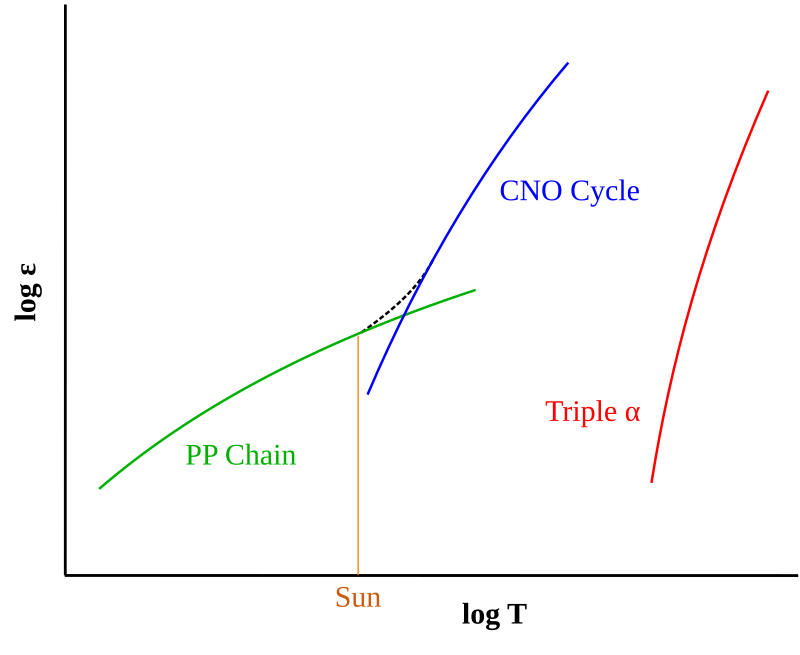
CNO cycle
set of fusion reactions by which stars convert hydrogen to helium: 4¹H+2e⁻→⁴He+2e⁺+2e⁻+2νₑ+3γ+24.7 MeV→⁴He+2νₑ+3γ+26.7 MeV
ocean acidification
climate change-induced decline of pH levels in the ocean

triple-alpha process
nuclear fusion reaction chain converting helium to carbon

carbon black
chemical substance
carbon planet
extrasolar terrestrial planet
carbon fixation
conversion of carbon from CO2 to organic compounds
C3 carbon fixation
metabolic pathway for carbon fixation in photosynthesis
activated charcoal
medication used to treat ingested poisonings
glassy carbon
allotrope of carbon
carbon chauvinism
assumption that the chemical processes of hypothetical extraterrestrial life must be constructed primarily from carbon
Total organic carbon
concentration of organic carbon in a sample
coke plant
production facility where coke and raw gas is produced
Carbon-13 NMR spectroscopy
analytical method
δ13C
In geochemistry, paleoclimatology, archaeology, and paleoceanography '''δC''' (pronounced "delta carbon thirteen") is a normalized ratio of the two stable isotopes of carbon—C and C—reported in parts per thousand (per mille, ‰).

Methylotroph
Methylotrophs are a diverse group of microorganisms that can use reduced one-carbon compounds, such as methanol or methane, as the carbon source for their growth; and multi-carbon compounds that contain no carbon-carbon bonds, such as dimethyl ether and dimethylamine. This group of microorganisms also includes those capable of assimilating reduced one-carbon compounds by way of carbon dioxide using the ribulose bisphosphate pathway. These organisms should not be confused with methanogens which on the contrary produce methane as a by-product from various one-carbon compounds such as carbon diox

carbon-based life
life whose primary component is carbon
Swan band
Emission spectra characteristic of burning hydrocarbon fuels
palladium on carbon
chemical compound
Deep Carbon Observatory
global research program designed to transform understanding of carbon's role in Earth
Impacts of ocean acidification on the Great Barrier Reef
threat to the reef which reduces the viability and strength of reef-building corals
embedded emissions
measure of greenhouse gas emissions
soil carbon
solid carbon stored in global soils