Category
page 1Celestial mechanics

astronomical unit
mean distance between Earth and the Sun, common length reference in astronomy

orbit
right|thumb|Variation of orbital eccentricity

dark matter
mysterious non-luminous matter (and/or radiation) comprising most of the matter in our observable universe
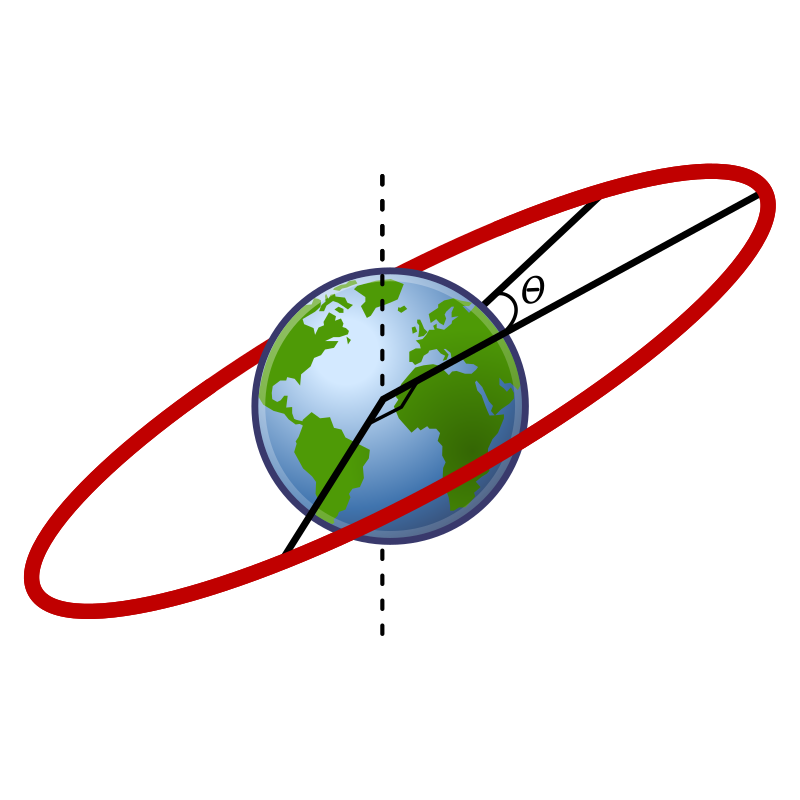
celestial mechanics
branch of astronomy

tidal locking
situation in which an astronomical object's orbital period matches its rotational period

orbital mechanics
field of classical mechanics concerned with the motion of spacecraft

accretion
astrophysical process in which matter gravitationally collects into a massive object
Julian day
days since the beginning of the Julian Period

elongation
in astronomy, angular separation between the Sun and a planet, with the Earth as a reference point

culmination
thumb| Upper (oK) and lower culmination (uk)
thumb|Method of observation of culminations in ancient Egypt
In observational astronomy, culmination is the passage of a celestial object (such as the Sun, the Moon, a planet, a star, constellation or a deep-sky object) across the observer's local meridian. These events are also known as meridian transits, used in timekeeping and navigation, and measured precisely using a transit telescope.
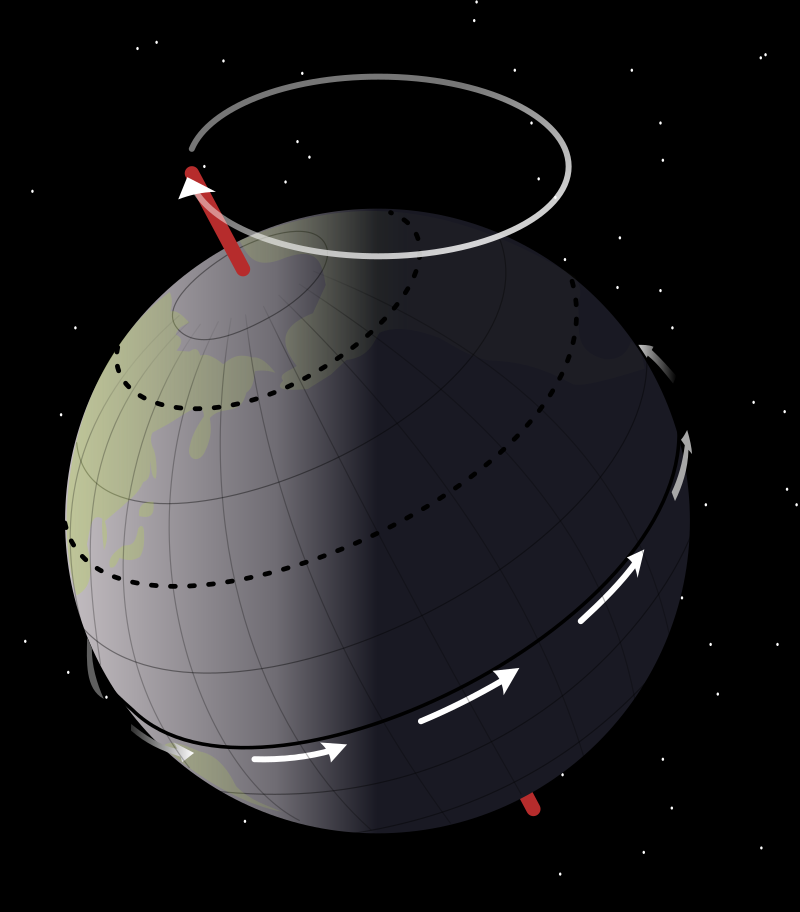
stellar precession
gravity-induced, slow, and continuous change in the orientation of an astronomical body's rotational axis
perturbation
complex motion of a massive astronomical body

flatness
thumb|right|200px |A circle of radius compressed to an ellipse.
thumb|right|200px |A sphere of radius compressed to an oblate ellipsoid of revolution.
radiation pressure
pressure exerted upon any surface exposed to electromagnetic radiation
shepherd moon
small natural satellite associated with a planetary ring
barycenter
center of mass of two or more bodies that are orbiting each other, or the point around which they both or all orbit
rotation around a fixed axis
motion in space when there is fixed line of points
Modified Newtonian dynamics
alternative explanation of the non-Newtonian rotation of galaxies
quadrature
aspect of a heavenly body in which it makes a right angle with the direction of the Sun
planetary migration
astronomical phenomenon when a planet or other stellar satellite interacts with a disk of gas or planetesimals, resulting in the alteration of the satellite's orbital parameters, especially its semi-major axis
dark flow
possible non-random component of the peculiar velocity of galaxy clusters
binary system
system of two astronomical bodies which orbit each other
electrically powered spacecraft propulsion
spacecraft propulsion system which uses electricity
relaxation
return of a perturbed system into equilibrium
clearing the neighbourhood
criterion for a celestial body to be considered a planet
strangelet
A strangelet (pronounced ) is a hypothetical particle consisting of a bound state of roughly equal numbers of up, down, and strange quarks. An equivalent description is that a strangelet is a small fragment of strange matter, small enough to be considered a particle. The size of an object composed of strange matter could, theoretically, range from a few femtometers across (with the mass of a light nucleus) to arbitrarily large. Once the size becomes macroscopic (on the order of meters across), such an object is usually called a strange star. The term "strangelet" originates with Edward Farhi a
velocity dispersion
in astronomy, the statistical dispersion of velocities about the mean velocity for a cluster of stars or galaxies
ring system
cosmic dust and debris orbiting an astronomical body
Free-fall time
Concept in astrophysics
Commensurability (astronomy)
proportionality of orbital periods for two celestial bodies
mass distribution
spatial distribution of mass within a solid body
Dynamic method
Procedure to determine asteroid masses
Variation (astronomy)
periodic perturbation of the lunar orbit