Category
page 1Cell communication
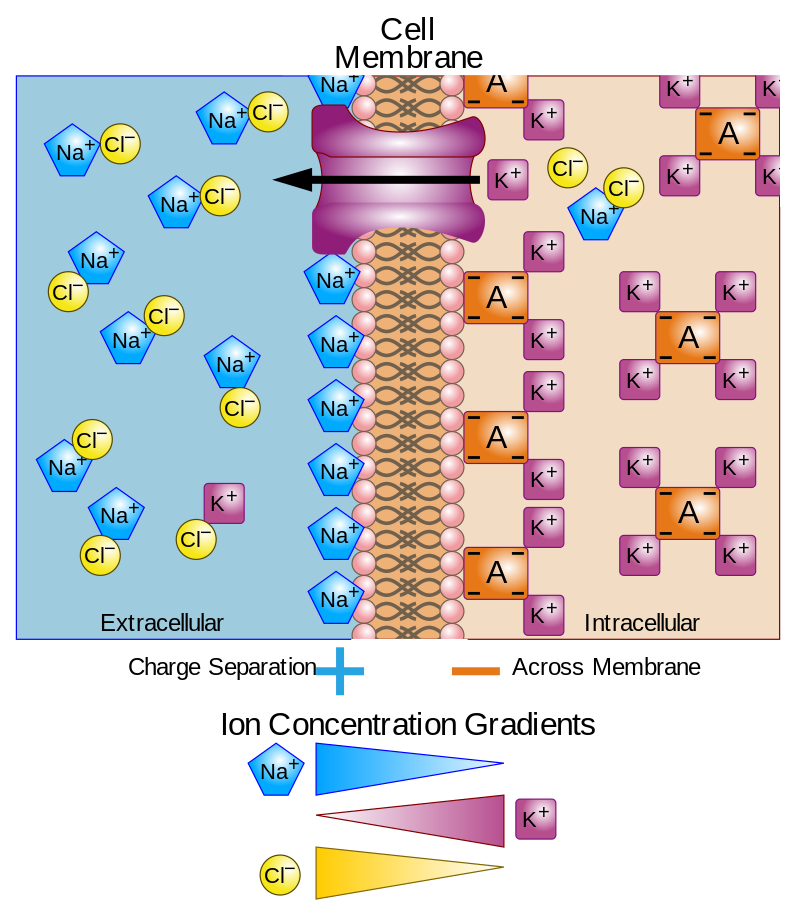
membrane potential
type of physical quantity
ion channel complex
pore-forming membrane protein that allows the passage of ions through a membrane
cell signaling
complex system of communication that governs basic cellular activities and coordinates cell actions
cell junction
a cellular component that forms a specialized region of connection between two or more cells, or between a cell and the extracellular matrix, or between two membrane-bound components of a cell, such as flagella
quorum sensing
process in which single-celled organisms monitor their population density by detecting the concentration of small, diffusible signal molecules produced by the cells themselves.
gap junction
cell-cell junction comprised of innexins or connexins, two different families of channel-forming proteins. Other proteins may also be present.
retinoic acid
group of chemical compounds
electrical synapse
type of connection between neurons
penitrem A
chemical compound
myokine
A myokine is one of several hundred cytokines or other small proteins (~5–20 kDa) and proteoglycan peptides that are produced and released by skeletal muscle cells (muscle fibers) in response to muscular contractions. They have autocrine, paracrine and/or endocrine effects; their systemic effects occur at picomolar concentrations.
autoinducer-2
Autoinducer-2 (AI-2) is a furanosyl borate diester or tetrahydroxy furan (species dependent) that—as the name suggests—is an autoinducer, a member of a family of signaling molecules used in quorum sensing. AI-2 is one of only a few known biomolecules incorporating boron. First identified in the marine bacterium Vibrio harveyi, AI-2 is produced and recognized by many Gram-negative and Gram-positive bacteria. AI-2 arises by the reaction of 4,5-dihydroxy-2,3-pentanedione, which is produced enzymatically, with boric acid and is recognized by the two-component sensor kinase LuxPQ in Vibrionaceae.
membrane vesicle trafficking
movement of molecules across a plasma membrane in membrane vesicles