Category
page 1Cellular neuroscience

action potential
process by which neurons communicate with each other by changes in their membrane potentials.
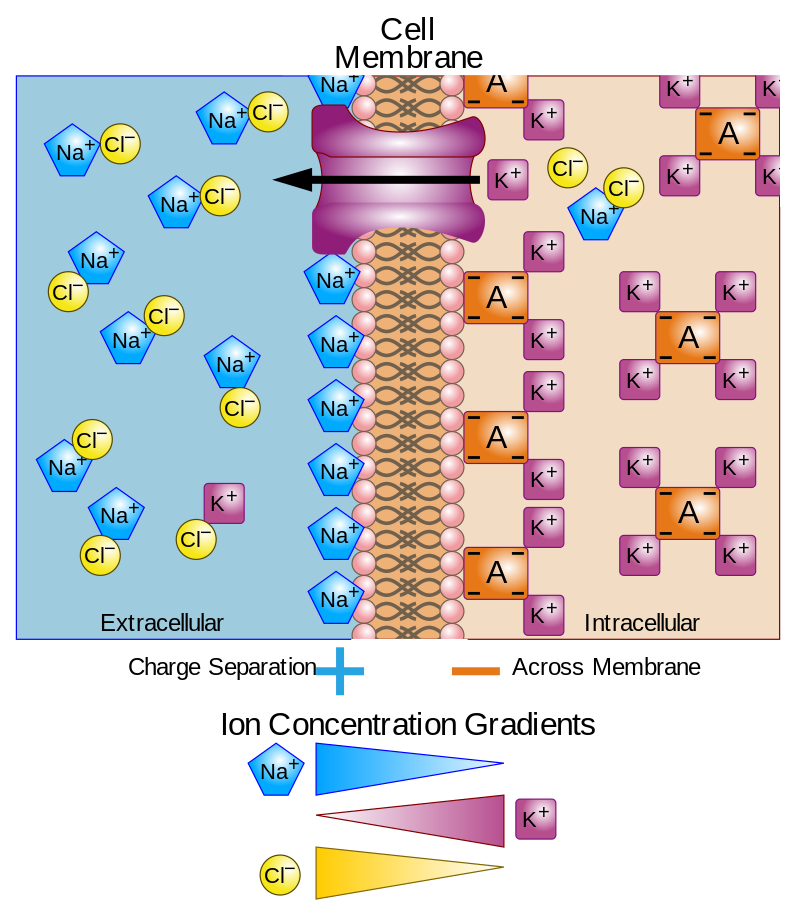
membrane potential
type of physical quantity

depolarization
In biology, depolarization or hypopolarization is a change within a cell, during which the cell undergoes a shift in electric charge distribution, resulting in less negative charge inside the cell compared to the outside. Depolarization is essential to the function of many cells, communication between cells, and the overall physiology of an organism.
thumb|right|Action potential in a [[neuron, showing depolarization, in which the cell's internal charge becomes less negative (more positive), and repolarization, where the internal charge returns to a more negative value.]]
Most cells in higher o
hyperpolarization
change in a cell membrane potential causing it to become more negative
repolarization
thumb|A labeled diagram of an action potential. As seen above, repolarization takes place just after the peak of the action potential, when K+ ions rush out of the cell.
In neuroscience, repolarization refers to the change in membrane potential that returns it to a negative value just after the depolarization phase of an action potential which has changed the membrane potential to a positive value. The repolarization phase usually returns the membrane potential back to the resting membrane potential. The efflux of potassium (K+) ions results in the falling phase of an action potential. The ion
ephaptic coupling
form of nervous system communication
glia limitans
thin astrocyte membrane surrounding the brain and spinal cord