Category
page 1Celtic mythology
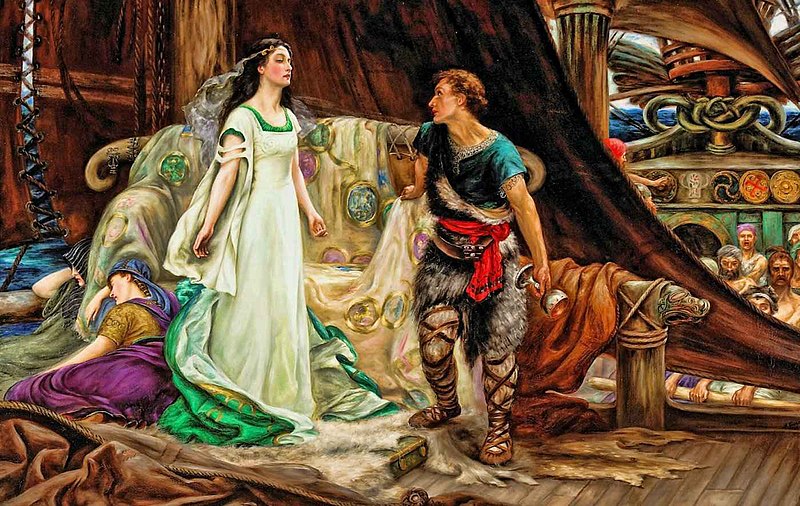
Tristan and Iseult
medieval romance told in numerous variations

Samhain
Samhain ( , ; ; ) or '''' () is a Gaelic festival on 1 November marking the end of the harvest season in autumn and beginning of winter or the "darker half" of the year. It is also the Irish and Scottish Gaelic name for November. Celebrations begin on the evening of 31 October, since the Celtic day began and ended at sunset. This is about halfway between the autumnal equinox and winter solstice. It is one of the four Gaelic seasonal festivals along with Imbolc, Bealtaine, and Lughnasa. Historically it originated in Ireland and it was widely observed throughout Ireland, Scotland, and the Isle o

Celtic mythology
collective term for all the fabulous profane and religious narratives of the Celts
Irish mythology
body of myths indigenous to the island of Ireland

Ossian
thumb|upright=1.2|Ossian Singing, Nicolai Abildgaard, 1787

Bedivere
Bedivere ( or ; ; ; , also Bedevere and other spellings) is one of the earliest characters to be featured in the legend of King Arthur, originally described in several Welsh texts as the one-handed great warrior named Bedwyr Bedrydant. Arthurian chivalric romances, inspired by his portrayal in the chronicle Historia Regum Britanniae, portray Bedivere as a Knight of the Round Table of King Arthur who serves as Arthur's marshal and is frequently associated with his brother Lucan and his cousin Griflet as well as with Kay. In the English versions, Bedivere notably assumes Griflet's hitherto tradi
Samson
largest uninhabited island of the Isles of Scilly, in Cornwall, England, UK
wicker man
effigy for burning in pagan ritual
Branwen ferch Llŷr
Branwen, Daughter of Llŷr is a major character in the medieval Welsh story known as the Second Branch of the Mabinogi, which is sometimes called the "Mabinogi of Branwen" after her.
Celtic calendar
compilation of pre-Christian Celtic systems of timekeeping
Breton mythology
mythological beliefs of the Bretons
Pyrene
mythical princess, daughter of Bebryx
Paps of Anu
mountain
Les Lavandières
three old washerwomen from Celtic mythology
Glashtyn
thumb|300px|A glashan featured in an Irish folktale retelling.
Glashtyn (Manx English: glashtin, glashtan or glashan; or ) is a legendary creature from Manx folklore.
Loucetios
right|300px|thumb|An altar to Mars Loucetios at The Rhine in the Musée archéologique (Strasbourg)|Musée archéologique de Strasbourg.
In Gallo-Roman religion, Loucetios (Latinized as Leucetius) was a Gallic god known from the Rhine-Moselle region, where he was identified with the Roman Mars. Scholars have interpreted his name to mean ‘lightning’. Mars Loucetius was worshipped alongside the goddess Nemetona.
Emain Ablach
mythical island in Irish mythology
Danilo Pennone
Italian writer
bullaun
thumb|250px|Bullaun at St John's Point Church, County Down, [[Ulster, Ireland, October 2009]]
thumb|250px|
A bullaun (; from a word cognate with "bowl" and French bol) is the term used for the depression in a stone which is often water filled. Natural rounded boulders or pebbles may sit in the bullaun. The size of the bullaun is highly variable and these hemispherical cups hollowed out of a rock may come as singles or multiples with the same rock.
Cornish mythology
mythology of the Cornish people in England
loathly lady
motif in folklore and stock character; woman who appears to be hideous, often cursed