Category
page 1Cestoda genera
Taenia
genus of tapeworm

Echinococcus
thumb|400px|right|schematic representation of the life cycle of Echinococcus
thumb|General description of the egg and oncosphere of Echinococcus spp.

Diphyllobothrium
Diphyllobothrium is a genus of tapeworms which can cause diphyllobothriasis in humans through consumption of raw or undercooked fish. The principal species causing diphyllobothriasis is Diphyllobothrium latum, commonly known as the broad or fish tapeworm, or broad fish tapeworm. D. latum is a pseudophyllid cestode that infects fish and mammals. D. latum is native to Scandinavia, western Russia, and the Baltics, though it is now also present in North America, especially the Pacific Northwest. In Far East Russia, D. klebanovskii, having Pacific salmon as its second intermediate ho

Hymenolepis
genus of worms

Raillietina
Raillietina is a genus of tapeworms that includes helminth parasites of vertebrates, mostly of birds. The genus was named in 1920 in honour of a French veterinarian and helminthologist, Louis-Joseph Alcide Railliet. Of the 37 species recorded under the genus, Raillietina demerariensis, R. asiatica, and R. formsana are the only species reported from humans, while the rest are found in birds. R. echinobothrida, R. tetragona, and R. cesticillus are the most important species in terms of prevalence and pathogenicity among wild and domestic birds.

Bothriocephalus
Bothriocephalus is a genus of flatworms belonging to the family Bothriocephalidae.
Ligula
genus of flatworms
Anoplocephala
Anoplocephala is a genus of tapeworms in the family Anoplocephalidae named in 1848 by Émile Blanchard. The type species is Anoplocephala perfoliata, which was originally described as Taenia perfoliata. Anoplocephala is a cestode, belonging to the Cestoda class, meaning that it is a Flatworm parasite. They can be found in fifty-six percent of the wild rhino population in Assam, India.

Spirometra
Spirometra is a genus of pseudophyllid cestodes that reproduce in canines and felines, but can also cause pathology in humans if infected. As an adult, this tapeworm lives in the small intestine of its definitive host and produces eggs that pass with the animal's feces. When the eggs reach water, the eggs hatch into coracidia which are eaten by copepods. The copepods are eaten by a second intermediate host to continue the life cycle. Humans can become infected if they accidentally eat frog legs or fish with the plerocercoid stage encysted in the muscle. In humans, an infection of Spirometra is
Triaenophorus
genus of worms

Calliobothrium
Calliobothrium is a genus of cestodes in the order Tetraphyllidea.
Most, or possibly all, of the known species are parasites found within the intestines of members of the shark family Triakidae. It is known that in some instances at least two different species of Calliobothrium can parasitise the same species of shark.
Schistocephalus
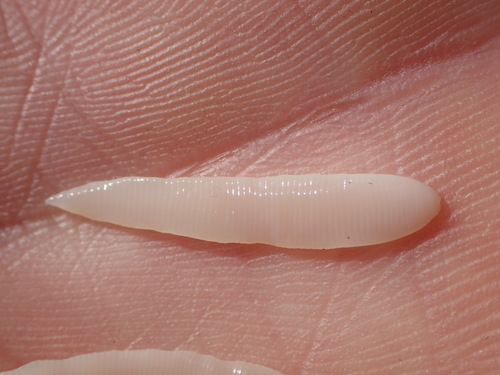
Schistocephalus is a genus of tapeworm of fish, fish-eating birds and rodents.

Cittotaenia
Cittotaenia is a genus of tapeworms belonging to the family Anoplocephalidae.
Cladotaenia
Cladotaenia is a genus of flatworms belonging to the family Taeniidae.
Prosobothrium
Prosobothrium is a genus of flatworms belonging to the monotypic family Prosobothriidae.

Moniezia
Moniezia a genus of tapeworms that are parasitic in mammals, including sheep, goat and cattle. It comprises four known species such as M. expansa, M. benedeni, M. autumnalis and M. baeri. M. expansa is the most well known species within the genus because of its high prevalence. Members of the genus are among the largest cestodes reaching up to 10 m in length. They inhabit the small intestine of mammalian host. Their life cycle is indirect requiring intermediate host, which are oribatid mites. They are characterized by the presence of interproglottid glands.