Category
page 1Characters in the Odyssey

Aphrodite
Aphrodite (, ) is an ancient Greek goddess associated with love, lust, beauty, pleasure, passion, procreation, and as her syncretised Roman counterpart , desire, sex, fertility, prosperity, and victory. Aphrodite's major symbols include seashells, myrtles, roses, doves, sparrows, and swans. The cult of Aphrodite was largely derived from that of the Phoenician goddess Astarte, a cognate of the East Semitic goddess Ishtar, whose cult was based on the Sumerian cult of Inanna. Aphrodite's main cult centers were Cythera, Cyprus, Corinth, and Athens. Her main festival was the Aphrodisia, which was c

Athena

Apollo

Achilles
In Greek mythology, Achilles ( ) or Achilleus () was a hero of the Trojan War who was known as being the greatest of all the Greek warriors. The central character in Homer's Iliad, he was the son of the Nereid Thetis and Peleus, king of Phthia and famous Argonaut. Achilles was raised in Phthia along with his childhood companion Patroclus and received his education by the centaur Chiron. In the Iliad, he is presented as the commander of the mythical tribe of the Myrmidons.

Ares
Ares (; , Árēs ) is the Greek god of war and courage. He is one of the Twelve Olympians, and the son of Zeus and Hera. Many Greeks were ambivalent towards him. He embodies the physical valor necessary for success in war but can also personify sheer brutality and bloodlust, in contrast to his sister Athena, whose martial functions include military strategy and generalship. An association with Ares endows places, objects, and other deities with a savage, dangerous, or militarized quality.

Hera
thumb|right|360px|Iris (on the left) with Zeus and Hera, east frieze of the Parthenon, [[British Museum.]]

Hades
Hades (; , , later ), in the ancient Greek religion and mythology, is the god of the dead and riches and the King of the underworld, with which his name became synonymous. Hades was the eldest son of Cronus and Rhea, although this also made him the last son to be regurgitated by his father. He and his brothers, Zeus and Poseidon, defeated, overthrew, and replaced their father's generation of gods, the Titans, and claimed joint sovereignty over the cosmos. Hades received the underworld, Zeus the sky, and Poseidon the sea, with the solid earth, which was long the domain of Gaia, available to all

Odysseus
In Greek and Roman mythology, Odysseus (; , ), also known by the Latin variant Ulysses (, ; ), is a legendary Greek king of Ithaca and the hero of Homer's epic poem, the Odyssey. Odysseus also plays a key role in Homer's Iliad and other works in that same epic cycle.

Hephaestus
Hephaestus ( , ; eight spellings; ) is the Greek god of artisans, blacksmiths, carpenters, craftsmen, fire, metallurgy, metalworking, sculpture, and volcanoes. In Greek mythology, Hephaestus was the son of Hera, either on her own or by her husband Zeus. He was cast off Mount Olympus by his mother Hera because of his lameness, the result of a congenital impairment; or in another account, by Zeus for protecting Hera from his advances.

Helen of Troy
daughter of Zeus in Greek mythology

Agamemnon
In Greek mythology, Agamemnon (; Agamémnōn) was a king of Mycenae who commanded the Achaeans during the Trojan War. He was the son (or grandson) of King Atreus and Queen Aerope, the brother of Menelaus, the husband of Clytemnestra, and the father of Iphigenia, Iphianassa, Electra, Laodike, Orestes and Chrysothemis. Legends make him the king of Mycenae or Argos, thought to be different names for the same area. Agamemnon was killed upon his return from Troy by Clytemnestra, or in an older version of the story, by Clytemnestra's lover Aegisthus.
.JPG)
Persephone
In ancient Greek mythology and religion, Persephone ( ; , classical pronunciation: ), also called Kore () or Cora, is the daughter of Zeus and Demeter. She became the queen of the underworld after her abduction by her uncle Hades, the king of the underworld, who later took her into marriage. The myth of her abduction, her sojourn in the underworld, and her cyclical return to the surface represents her functions as the embodiment of spring and the personification of vegetation, especially grain crops, which disappear into the earth when sown, remain hidden for a period, sprout from the earth, a

cyclops
thumb|A first century AD head of a Cyclops from the Roman Colosseum

Oceanus
In Greek mythology, Oceanus or Okeanos was one of the Titans, the children of Uranus (Sky) and Gaia (Earth), and the god of great river which encircled the entire world. He was the brother and husband of the Titaness Tethys, and by her was the father of the river gods and the Oceanids.

Eos
In ancient Greek mythology and religion, Eos (; Ionic and Homeric Greek Ēṓs, Attic Héōs, "dawn", or ; Aeolic Aúōs, Doric Āṓs) is the goddess and personification of the dawn, who rose each morning from her home at the edge of the river Oceanus to deliver light and disperse the night. In Greek tradition and poetry, she is characterized as a goddess with a great sexual appetite, who took numerous human lovers for her own satisfaction and bore them several children. Like her Roman counterpart Aurora and Rigvedic Ushas, Eos continues the name of an earlier Indo-European dawn goddess, Hausos. Eos, o
.jpg)
Menelaus
In Greek mythology, Menelaus (; , Menélaos) was a Greek king of Mycenaean (pre-Dorian) Sparta. According to the Iliad, the Trojan War began as a result of Menelaus's wife, Helen, fleeing to Troy with the Trojan prince Paris. Menelaus was a central figure in the Trojan War, leading the Spartan contingent of the Greek army, under his elder brother Agamemnon, king of Mycenae. Prominent in both the Iliad and Odyssey, Menelaus was also popular in Greek vase painting and Greek tragedy, the latter more as a hero of the Trojan War than as a member of the doomed House of Atreus.

siren
creatures half bird and half woman who lured sailors by the sweetness of her song

Erinyes
thumb|upright=1.2|Clytemnestra tries to awaken the sleeping Erinyes. Detail from an [[Apulian red-figure bell-krater, 380–370 BC.]]

Ajax the Great
son of Telamon in Greek mythology

Penelope
thumb|Penelope. Drawing after Attic pottery figure.
thumb|Penelope encounters the returned Odysseus posing as a beggar. From a mural in the Macellum of Pompeii

Telemachus
Telemachus ( ; ) is the son of Odysseus and Penelope in Greek mythology, and a central character in Homer's Odyssey. When Telemachus reached manhood, he visited Pylos and Sparta in search of his wandering father. On his return to Ithaca, he found that Odysseus had reached home before him. Then father and son slayed the suitors who had gathered around to woo Penelope. According to later tradition, Telemachus married Nausicaa after Odysseus's death.

Scylla
thumb|Scylla as a maiden with a Cetus (mythology)|kētos tail and dog heads sprouting from her body. Detail from a red-figure bell-crater in the Louvre, 450–425 BC. This form of Scylla was prevalent in ancient depictions, though very different from the description in Homer, where she is land-based and more dragon-like.

Charybdis
thumb|Henry Fuseli's painting of Odysseus facing the choice between Scylla and Charybdis, 1794–1796
Charybdis (; , ; , ) is a sea monster in Greek mythology. Charybdis, along with the sea monster Scylla, appears as a challenge to epic characters such as Odysseus, Jason, and Aeneas. The descriptions of Greek mythical chroniclers and Greek historians locates her in the Strait of Messina.

Polyphemus
Polyphemus (; , ; ) is the one-eyed giant son of Poseidon and Thoosa in Greek mythology, one of the Cyclopes described in Homer's Odyssey. His name means "abounding in songs and legends", "many-voiced" or "very famous". Polyphemus first appeared as a savage man-eating giant in the ninth book of the Odyssey. The satyr play Cyclops by Euripides is dependent on this episode with some differences in the story and while also being more comedic in nature. Later Classical writers that presented him in their poems linked his name with the nymph Galatea as he tried to seduce her. Often he was portrayed
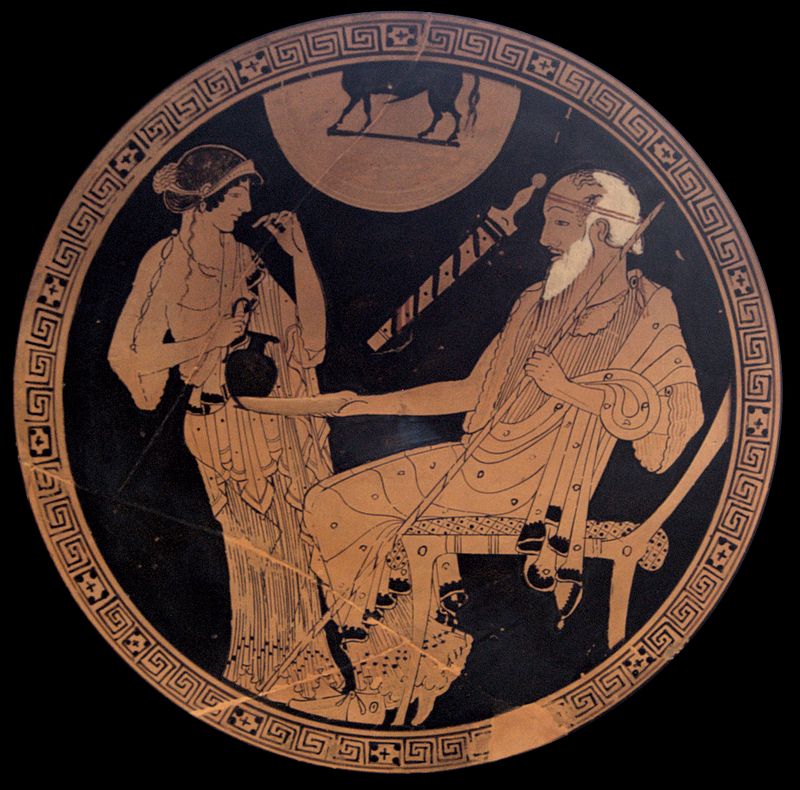
Nestor
wise ruler of Pylos in Greek mythology, son of Neleus

Eileithyia
Eileithyia or Ilithyia (; , ; (Eleuthyia, ) in Crete, also (Eleuthia, ) or (Elysia, ) in Laconia and Messene, and (Eleuthō) in literature) was the Greek goddess of childbirth and midwifery, and the daughter of Zeus and Hera.

Aeolus
god of winds, son of Hippotes in Greek mythology
%20cropped%20glare%20reduced%20white%20bg.png)
Nausicaa
thumb|Nausicaa (second from right) with Athena and Odysseus. Detail of an Attic red-figured amphora from Vulci ()
Mentor
mythical son of Alcimus, in the Odyssey

Memnon
thumb|Attic neck-amphora featuring [[Heracles and Memnon (detail), BC]]
thumb|Eos retrieving the body of her son Memnon from the battlefield (detail); Etruscan bronze mirror, BC

Alcinous
thumb|300px|Odysseus at the Court of Alcinous by [[Francesco Hayez. The blind minstrel Demodocus is playing the harp.]]

Anemoi
thumb|Wind rose of ancient Greece, created by the scholar [[Adamantios Korais around 1796]]
Laertes
legendary king of Ithaca

Anticlea
thumb|A painting of Anticlea in the underworld by Henry Fuseli.
In Greek mythology, Anticlea or Anticlia (; ) was a queen of Ithaca as the wife of King Laërtes.

Lotus-eaters
thumb|Odysseus removing his men from the company of the lotus-eaters
Perse
Oceanid (one of the three thousand daughters of the Titans Oceanus and Tethys), and the wife of the Sun god, Helios

Eumaeus
right|300px|thumb|Bonaventura Genelli, Odysseus sits by the fire as Eumaeus discovers Telemachus at the entrance of his hut.
In Greek mythology, Eumaeus (; Ancient Greek: Εὔμαιος Eumaios meaning 'searching well') was Odysseus' doulos, swineherd, and friend. His father, Ctesius, son of Ormenus, was king of an island called Syra (present-day Syros in the Greek islands of the Cyclades).
== Mythology ==
When he was a young child, a Phoenician sailor seduced his nurse, a slave, who agreed to bring the child among other treasures in exchange for their help in her escape. The nurse was killed by Arte
Argos
mythological dog of Odysseus
.jpeg)
Leucothea
thumb|Leucothea, an Etruscan sculpture from Pyrgi, c. 350 BC (Museo Nazionale Etrusco di Villa Giulia, Rome)
In Greek mythology, Leucothea (; , ), sometimes also called Leucothoe (, ), was a sea goddess. Myths surrounding Leucothea typically concern her original identity, either as Ino or Halia, and her transformation into a goddess.

Eurylochus
In Greek mythology, Eurylochus (; Ancient Greek: Εὐρύλοχος Eurúlokhos) appears in Homer's Odyssey as second-in-command of Odysseus' ship during the return to Ithaca after the Trojan War. He is portrayed as an unpleasant, cowardly individual who undermines Odysseus and stirs up trouble.
Eurycleia
wet-nurse of Odysseus
.jpg)
Procris
thumb|right|The Death of Procris by Joachim Wtewael (circa 1595–1600)
In Greek mythology, Procris (, gen.: Πρόκριδος) was an Athenian princess, the third daughter of Erechtheus, king of Athens and his wife, Praxithea. Homer mentions her in the Odyssey as one of the many dead spirits Odysseus saw in the Underworld. Sophocles wrote a tragedy called Procris that has been lost, as has a version contained in the Greek Cycle, but at least six different accounts of her story still exist.
Demodocus
mythical minstrel of Alcinous

Elpenor
thumb|upright=1.35|Odysseus cremating the body of Elpenor (Theodoor van Thulden, c. 1630)
Elpenor (; Ancient Greek: Ἐλπήνωρ, gen.: Ἐλπήνορος), also spelled Elpinor , was the youngest comrade of Odysseus in Greek mythology. While on the island of Circe, he became drunk and decided to spend the night on the roof. In the morning he slipped on the ladder, fell, and broke his neck, dying quickly.
Arete
person in Greek mythology, wife of Alcinous
Antinous son of Eupeithes
mythical suitor of Penelope in the Odyssey
Maron
mythical son of Euanthes
Deucalion of Crete
King of Crete in Greek mythology
Iphimedeia
In Greek mythology, Iphimedeia (; Ancient Greek: Ἰφιμέδεια) or Iphimede (Ἰφιμέδη) was a Thessalian princess. She was attested in Homer's Odyssey in the Catalogue of Women as being a mortal.
Peisistratus
son of Nestor in Greek mythology
Thrasymedes
mythical son of Nestor
Melanthius
Odyssey character
Medon
list of mythical and historical people
Ctimene
In Greek mythology, Ctimene ( ; , ) was an Ithacan princess as the daughter of King Laertes and Anticlea, and wife of Eurylochus.
Melantho
daughter of Dolius in Greek mythology

Telemus
Telemus () was a figure of Greek mythology, a prophet, son of Eurymus or of Proteus and Psamathe. Telemus warned the Cyclops Polyphemus that he would lose his sight to a man named Odysseus.
Dolius
In Greek mythology, more precisely in the epic tradition recounted in Homer's Odyssey, Dolius or Dolios () was a slave of Penelope whom she had received from her father Icarius on occasion of her marriage to Odysseus. He served as a gardener.

Phemius
thumb|The singer Phemius sings to the suitors. – Homer, Odyssey I. 325. Schwab, Legends of Classical Antiquity II. 208.|283x283pxIn Homer's epic poem the Odyssey, Phemius (; ), son of Terpes/Terpius, is an Ithacan poet who performs narrative songs in the house of the absent Odysseus.
Polites
mythological Greek character, Trojan prince, son of Priam
Arnaeus
Arnaeus (; ) is a character in Greek mythology.