Category
page 1Chattian genus first appearances

Narcissus
genus of plants in family Amaryllidaceae

Mugil
Mugil is a genus of mullet in the family Mugilidae found worldwide in tropical and temperate coastal marine waters, but also entering estuaries and rivers.
Proailurus
Proailurus is an extinct felid genus that lived in Europe and Asia approximately 25–30.8 million years ago in the Late Oligocene and Miocene. Fossils have been found in Mongolia, Germany, and Spain.

Daeodon
thumb|Daeodon shoshonensis life restoration
thumb|Daeodon (Dinohyus) hollandi, complete skeleton from the Agate Fossil Beds National Monument|Agate Springs Fossil Quarry in Nebraska. See text for nomenclature history

Puijila darwini
Puijila darwini is an extinct species of stem-pinniped (seal) which lived during the Miocene about 21 to 24 million years ago. About a metre (3 feet) long, the animal had only minimal physical adaptations for swimming. Unlike modern pinnipeds, it did not have flippers and its shape was otter-like, albeit more specialized; its skull and teeth are the features that most clearly indicate that it is a seal.

Pelagornis
Pelagornis is an extinct genus of prehistoric pseudotooth birds, a group of extinct seabirds. Species span from the Oligocene to the Early Pleistocene. Members of Pelagornis represent among the largest pseudotooth birds, with one species, P. sandersi, having the widest wingspan of any bird known.

Syndyoceras
Syndyoceras is a small extinct genus of Artiodactyla, of the family Protoceratidae, endemic to central North America from the Miocene epoch (23.1—18.5 Ma), existing for approximately .

Enaliarctos
Enaliarctos is an extinct genus of pinnipedimorph, and may represent the ancestor to all pinnipeds. The five species in the genus Enaliarctos have been recovered from late Oligocene and early Miocene (ca. 28-17 million years ago) strata of California and Oregon.

Desmostylus
Desmostylus is an extinct genus of herbivorous mammal of the family Desmostylidae living from the Chattian stage of the Late Oligocene subepoch through the Late Miocene subepoch (28.4 mya–7.250 Mya) and in existence for approximately .
Hypomesus
Hypomesus is a genus of smelts (Osmeridae), consisting of five species found in the northern hemisphere.

Diceratherium
Diceratherium (meaning "two horned beast") is an extinct genus of rhinocerotid native to North America during the Oligocene through Miocene living from 33.9 to 11.6 mya, existing for approximately . Mass estimates for the type species, D. armatum average around

Oxydactylus
Oxydactylus is an extinct genus of camelid endemic to North America. It lived from the Late Oligocene to the Middle Miocene (28.4–13.7 mya), existing for approximately . The name is from the Ancient Greek οξύς (oxys, "sharp")and δάκτυλος (daktylos, "finger").
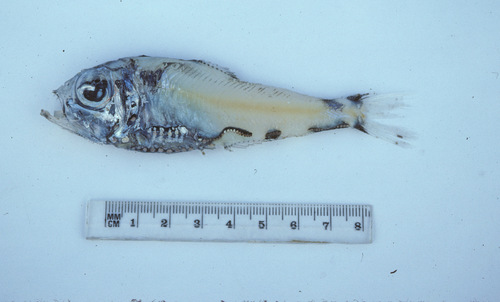
Argyripnus
Argyripnus is an oceanic ray-finned fish genus in the marine hatchetfish family Sternoptychidae. They are commonly known as bristle-mouth fishes, but that may also refer to the related bristlemouth family (Gonostomatidae). A. iridescens is called "pearlside", which usually refers to the closely related genus Maurolicus.

Archaeohippus
left|thumb|Life restoration
Archaeohippus (Greek: "ancient" (archaios), "horse" (hippos)) is an extinct three-toed member of the family Equidae known from fossils of early Oligocene to middle Miocene age. The genus is noted for several distinct skeletal features. The skull possesses deeply pocketed fossa in a notably long preorbital region. The genus is considered an example of phyletic dwarfism with adults estimated at being on average 20 kilograms in weight. This is in contrast to the most common equid of the period, Miohippus. Characters of the teeth show a mix of both primitive and advance

Prosqualodon
Prosqualodon is an extinct genus of Early to Middle Miocene cetacean from Argentina, Australia, New Zealand, and Venezuela.

Ysengrinia
Ysengrinia is an extinct genus of carnivoran in the family Amphicyonidae, that lived during the Late Oligocene to Early Miocene. Fossil remains have been discovered in Western Europe, the United States and possibly China. The European species are among the earliest known members of the Thaumastocyoninae, a group of aberrant amphicyonids showcasing hypercarnivorous adations, but are only known from fragmentary remains. The American species is much better preserved and shows a robust, black-bear sized predator. These fossils play an important role in our understanding of the biotic interchange b
Eporeodon
Eporeodon is an extinct genus of oreodont belonging to the family Merycoidontidae. It lived from the Oligocene epoch 30.8—24.8 mya) existing for approximately .
Nambaroo
Nambaroo is an extinct genus of macropod marsupial from the late Oligocene to the early Miocene of Australia.

Kuphus
Kuphus is a genus of shipworms, marine bivalve molluscs in the family Teredinidae. While there are four extinct species in the genus, the only extant species is Kuphus polythalamius (also incorrectly spelled as Kuphus polythalamia). It is the longest bivalve mollusc in the world, where the only known permanent natural habitat is Kalamansig, Sultan Kudarat in the Philippines.