Category
page 1Chemical mixtures

petroleum
Petroleum, also known as crude oil or simply oil, is a naturally occurring, yellowish-black liquid chemical mixture found in geological formations, consisting mainly of hydrocarbons. The term petroleum refers both to naturally occurring unprocessed crude oil, as well as to petroleum products that consist of refined crude oil.

mixture
In chemistry, a mixture is a material made up of two or more different chemical substances which can be separated by physical method. It is an impure substance made up of two or more elements or compounds mechanically mixed together in any proportion. A mixture is the physical combination of two or more substances in which the identities are retained and are mixed in the form of solutions, suspensions or colloids.

tar
right|thumb|One can produce a tar-like substance from corn stalks by heating them in a microwave oven. This process is known as pyrolysis.
Tar is a dark brown or black viscous liquid of hydrocarbons and free carbon, obtained from a wide variety of organic materials through destructive distillation. Tar can be produced from carbon-rich materials such as coal, wood, petroleum, peat, and other organic matter.

colloid
A colloid is a mixture in which one substance, consisting of microscopically dispersed insoluble particles, is suspended throughout another substance. Some definitions specify that the particles must be dispersed in a liquid, while others extend the definition to include substances like aerosols and gels. The term colloidal suspension refers unambiguously to the overall mixture (although a narrower sense of the word suspension is distinguished from colloids by larger particle size). A colloid has a dispersed phase (the suspended particles) and a continuous phase (the medium of suspension).
thu

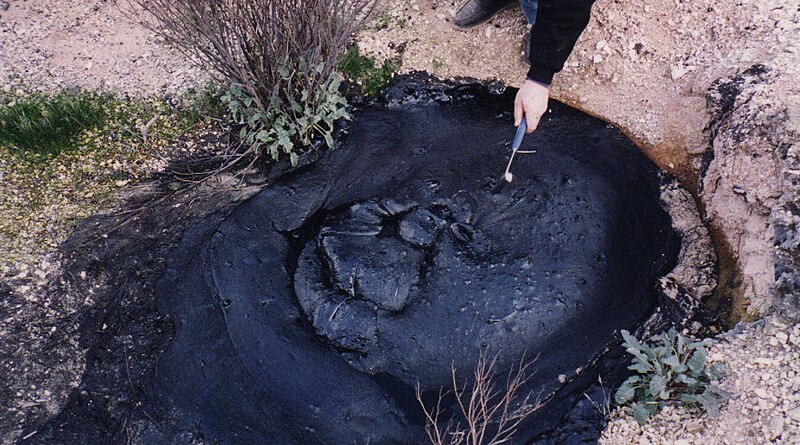
bitumen
thumb|Natural bitumen from the Dead Sea
thumb|Refined bitumen
thumb|upright|The University of Queensland [[pitch drop experiment, demonstrating the viscosity of bitumen]]

emulsion
frame|right|
pitch
mixture of aromatic organic compounds, black, tar-like, super viscous liquid
dispersion
mixture in which components are dispersed in a continuous phase of different composition, where at least one of the phases consists of finely divided phase domains

creosote
thumb|upright=1.8|Wood railroad ties before (right) and after (left) infusion with creosote, being transported by railcar at a facility of the [[Santa Fe Railroad, in Albuquerque, New Mexico, in March 1943. This U.S. wartime governmental photo reports that "The steaming black ties in the [left of photo]... have just come from the retort where they have been infused with creosote for eight hours." Ties are "made of pine and fir... seasoned for eight months" [as seen in the untreated railcar load at right].]]

oxyhydrogen
thumb|right|Nineteenth-century electrolytic cell for producing oxyhydrogen
Oxyhydrogen is a mixture of hydrogen (H2) and oxygen (O2) gases. This gaseous mixture is used for torches to process refractory materials and was the first

mauveine
thumb|right|Letter from Perkin's son, with a sample of dyed silk
Mauveine, also known as aniline purple and '''Perkin's mauve''', was one of the first synthetic dyes. It was discovered serendipitously by William Henry Perkin in 1856 while he was attempting to synthesise the phytochemical quinine for the treatment of malaria. It is also among the first chemical dyes to have been mass-produced.
interface and colloid science
branch of chemistry and physics
double layer
layer enriched with ions of opposite charge to that carried by a solid surface to maintain electroneutrality in solution
hash oil
resinous matrix of cannabinoids derived from cannabis
ouzo effect
cloudy emulsion resulting from adding water to ouzo

imbibition
Imbibition is a special type of diffusion that takes place when liquid is absorbed by solids-colloids causing an increase in volume. Water surface potential movement takes place along a concentration gradient; some dry materials absorb water. A gradient between the absorbent and the liquid is essential for imbibition. For a substance to imbibe a liquid, there must first be some attraction between them. Imbibition occurs when a wetting fluid displaces a non-wetting fluid, the opposite of drainage in which a non-wetting phase displaces the wetting fluid. The two processes are governed by differe
particle-size distribution
function representing relative sizes of particles in a system
homogeneous mixture
type of mixture in which the composition is uniform, such that every part of the solution has the same properties
syneresis
extraction or expulsion of a liquid from a gel
black oxide
coating for metals
Cadet's fuming liquid
chemical compound
concrete
term in fragrance extraction for the mass remaining after solvent extraction
dry water
water-air emulsion, consisting of 95% liquid water, in which tiny water droplets, each the size of a grain of sand, are surrounded by a sandy silica coating; the silica coating prevents the water droplets from combining into a bulk liquid
peptization
The peptization of a liquid mixture is the process of converting the mixture into a colloid by shaking it with a suitable electrolyte called a peptizing agent. That is, the insoluble solid particles which have settled out of the mixture (i.e. the precipitate) are reformed into microscopic particles suspended in the mixture. Peptization is the reverse of flocculation, the aggregation of colloidal particles into precipitate; as such, it is also known as deflocculation.
Pickering emulsion
an emulsion that is stabilized by solid particles (for example colloidal silica) which adsorb onto the interface between the two phases
liver of sulfur
chemical mixture used for quickly oxidizing metal surfaces, often to give new work the appearance of being old
heterogeneous mixture
not uniform in composition, but proportions of its components vary throughout the sample
mond gas
cheap form of Coal gas
Bioasphalt
Bioasphalt is an asphalt alternative made from non-petroleum based renewable resources.
mixed oxides of nitrogen
solution of nitric oxide in dinitrogen tetroxide/nitrogen dioxide
BTX
mixtures of benzene, toluene, and the three xylene isomers
Dukhin number
dimensionless quantity that characterizes the contribution of the surface conductivity to various electrokinetic and electroacoustic effects, as well as to electrical conductivity and permittivity of fluid heterogeneous systems