Category
page 1China–Soviet Union relations

Dalian
Dalian ( ) is a major prefecture-level, sub-provincial port city in Liaoning province, People's Republic of China, and is Liaoning's second largest city (after the provincial capital Shenyang) and the third-most populous city of Northeast China (after Shenyang and Harbin). Located on the southern tip of the Liaodong peninsula, it is the southernmost city in both Liaoning and the entire Northeast. Dalian borders the prefectural cities of Yingkou and Anshan to the north and Dandong to the northeast, and also shares maritime boundaries with Qinhuangdao and Huludao across the Liaodong Bay to the w

Sino-Soviet split
the breaking of political relations between the People's Republic of China (PRC) and the Union of Soviet Socialist Republics (USSR)

Tuvan People's Republic
1921–1944 people's republic in Asia

Sino-Soviet border conflict
1969 undeclared conflict between USSR and People's Republic of China
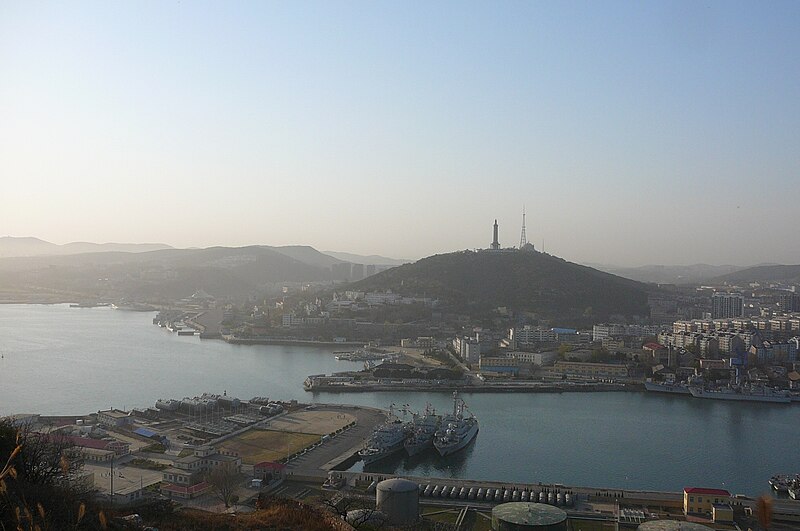
Lüshunkou District
district of Liaoning Province, China
Type 59
1958 main battle tank built by China
Second East Turkestan Republic
1944–1946 unrecognized state in Central Asia
Type 56
assault rifle
Chengdu J-7
Chinese license built version of Soviet Mikoyan-Gurevich MIG-21 fighter-interceptor
Xian H-6
Chinese strategic bomber aircraft
Chinese Eastern Railway
historical railroad system in northeast China
China's final warning
Russian proverb about a warning with no consequences
Shenyang J-6
Chinese air superiority fighter aircraft
Sino-Soviet conflict
Border conflict between China and the Soviet Union in 1929
Trans-Mongolian Railway
railway line
Siberian Intervention
1918 war
Shanghai massacre of 1927
mass arrests and executions of members of the Chinese Communist Party and some leftists of the Kuomintang by the Nationalist government (1927-1928)
Bolshoy Ussuriysky Island
sedimentary island at the confluence of the Ussuri and Amur rivers
1980 Summer Olympics boycott
NATO's soft opposition to the Soviet Union intervention in Afghanistan
Type 63
1963 light tank developed by China
Shaanxi Y-8
military transport aircraft
Tannu Uriankhai
historic region of the Mongol Empire
Romeo-class submarine
diesel-electric attack submarines
K-5
air-to-air missile
1984 Summer Olympics boycott
sport boycott
Xian Y-7
transport aircraft family by Xian
Sanmenxia Dam
dam in China
Shenyang J-5
fighter aircraft family
Sino-Soviet Treaty of Friendship, Alliance and Mutual Assistance
former military alliance treaty
social imperialism
governments that engage in imperialism meant to preserve the domestic social peace
Occupation of Mongolia
1919–1921 Chinese Republican occupation of Outer Mongolia
HY-2
series of Chinese anti-ship missiles
Ili Rebellion
1940's Soviet-backed uprising in China
Moscow Sun Yat-sen University
former university in Moscow
Sino-Soviet Treaty of Friendship and Alliance
treaty signed by the Nationalist Government of the Republic of China and the Union of Soviet Socialist Republics on 14 August 1945
Type 69 RPG
rocket propelled grenade
Soviet invasion of Xinjiang
1934 military campaign of the Soviet Union
Port Lüshun
naval station on the Liaodong peninsula, China, now in Lüshunkou District
Shanghai Exhibition Centre
Convention and exhibition centre in central Shanghai, and city landmark
Soviet occupation of Manchuria
1945–46 military occupation
Kumul Rebellion
conflict in Xinjiang (1931–1934)
Beijing Exhibition Center
convention center
September 13 incident
crash of a Hawker Siddeley Trident

Sino-Soviet Non-Aggression Pact
treaty between the ROC and USSR
Sixty-Four Villages East of the River
human-geographic territorial entity
Kronshtadt-class submarine chaser
submarine chaser class by the Soviet Union
Jiefang CA-30
automobile model
Soviet intervention in Mongolia
1921 event during the Russian Civil War
Type 54 semi-automatic pistol
Chinese semi-automatic pistol
Northeast Anti-Japanese United Army
guerrilla armies in Japanese-occupied Manchuria

HN-5
The HN-5 (; NATO reporting name: CH-SA-3) is a family of first generation Chinese man-portable air-defense systems (MANPAD) based on Soviet technology. The HN abbreviation is used to avoid confusion with the HY (Hai Ying, or Sea Eagle) series anti-ship missiles of the Silkworm missile family. The HN-5 series in Chinese hands has been phased out in front-line and first line reserve units by QW series MANPAD, but still being used by militia units.
Dalelkhan Sugirbayev
Kazakh leader in Xinjiang (1906–1949)
Xinjiang clique
military unit
Moscow-Peking
thumb|220px|alt=A Chinese postage stamp, printed with red-tinted ink, depicting Stalin (left) and Mao (right) shaking hands with a map showing both the Soviet Union and China, as well as both countries' flags and iconic buildings in the background.|A 1950 Chinese postage stamp depicting Joseph Stalin|Stalin and Mao shaking hands, representing friendly [[Sino-Soviet relations at the time the song was written.]]
"Moscow–Peking" () or "Moscow–Beijing", also known as "The Russian and the Chinese are brothers forever" (), is a Soviet mass song composed in 1949 by Vano Muradeli to lyrics by Mikhail
Z-5
1959 helicopter family by Harbin
Type 053 frigate
1974 class of Chinese frigates
PL-2
The PL-2 () is an infrared homing (IRH) air-to-air missiles (AAM) developed in the People's Republic of China (PRC). It was a reverse-engineered Soviet Vympel K-13, which in turn was a reverse-engineered American AIM-9B Sidewinder.
Soviet Volunteer Group
military unit
Kyrgyz Rebellion
1932 civil conflict in China
Sun–Joffe Manifesto
agreement signed between Sun Yat-sen and Adolph Joffe on January 26, 1923 for the cooperation of Republic of China Kuomintang and Soviet Union