Category
page 1Christian symbols

cross
thumb|A Greece|Greek cross (all arms of equal length) above a [[saltire, a cross whose limbs are slanted]]

pentagram
thumb|upright=1.2|Pentagram
A pentagram (sometimes known as a pentalpha, pentangle, or star pentagon) is a regular five-pointed star polygon, formed from the diagonal line segments of a convex (or simple, or non-self-intersecting) regular pentagon. Drawing a circle around the five points creates a similar symbol referred to as the pentacle, which is used widely by Wiccans and in paganism, or as a sign of life and connections, but there is also a inverted version.

stations of the Cross
series of artistic representations, depicting Christ carrying the Cross to his crucifixion

Christian cross
symbol of Christianity

ichthys
thumb|237px|Ichthys was adopted as a Christian symbolism|Christian symbol.
The ichthys or ichthus (; from ancient Greek , "fish") is, in its modern rendition, a symbol consisting of two intersecting arcs, the right ends extending beyond the meeting point so as to resemble the profile of a fish. It has been speculated that the symbol was used by early Christians as a secret symbol: a shibboleth to determine if another was indeed Christian. It is now known colloquially as the "Jesus fish". This symbol is widely used by Christians as a sign of their faith, often being found on vehicles, necklaces

khachkar
thumb|upright|Khachkar at Goshavank, carved in 1291 by Poghos

Alpha and Omega
Christian symbol, first and last letters of the Greek alphabet

crucifix
thumb|Crucifixion of Jesus at the winged triptych at the Church of the Teutonic Order, Vienna|Church of the Teutonic Order in Vienna, Austria. Woodcarvings by an anonymous master; polychromy by [[Jan van Wavere, Mechelen, signed 1520. This altarpiece was originally made for St. Mary's Church, Gdańsk, and came to Vienna in 1864.]]

fleur-de-lis
thumb|Fleur-de-lis
thumb|Arms of the Kings of France blazoned Azure, three fleurs-de-lis or
The fleur-de-lis, also spelled fleur-de-lys (plural fleurs-de-lis or fleurs-de-lys), is a common heraldic charge in the (stylized) shape of a lily (in French, and mean and respectively). Most notably, the fleur-de-lis is depicted on multiple flags of Quebec and on the traditional coat of arms of France that was used from the High Middle Ages until the French Revolution in 1792, and then again in brief periods in the 19th century. This design still represents France and the House of Bourbon in the form o

wreath
thumb|A Christmas wreath on a house door in England.
thumb|upright|A golden wreath and ring from the burial of an Odrysian Aristocrat at the Golyamata Mogila in the [[Yambol region of Bulgaria. Mid 4th century BC.]]

hamsa
upright|thumb|A hanging hamsa in a car in Tunisia.
The hamsa (Arabic ), also romanized khamsa, and known as the hand of Fatima, is a palm-shaped amulet popular throughout North Africa and in the Middle East and commonly used in jewellery and wall hangings. Depicting the open hand, an image recognized and used as a sign of protection in many times throughout history, the hamsa is believed to provide defense against the evil eye.
papal tiara
crown worn by popes of the Roman Catholic Church

Eye of Providence
symbol of the all-seeing eye (usually shown surrounded by rays of glory and/or in a triangle)
Chi Rho
symbol with X and P together, representing Christ

manger
__NOTOC__
thumb|Modern livestock trough near Empire Ranch, [[Arizona.]]
A manger or trough is a rack for fodder, or a structure or feeder used to hold food for animals. The word comes from the Old French mangier (meaning "to eat"), from Latin mandere (meaning "to chew").
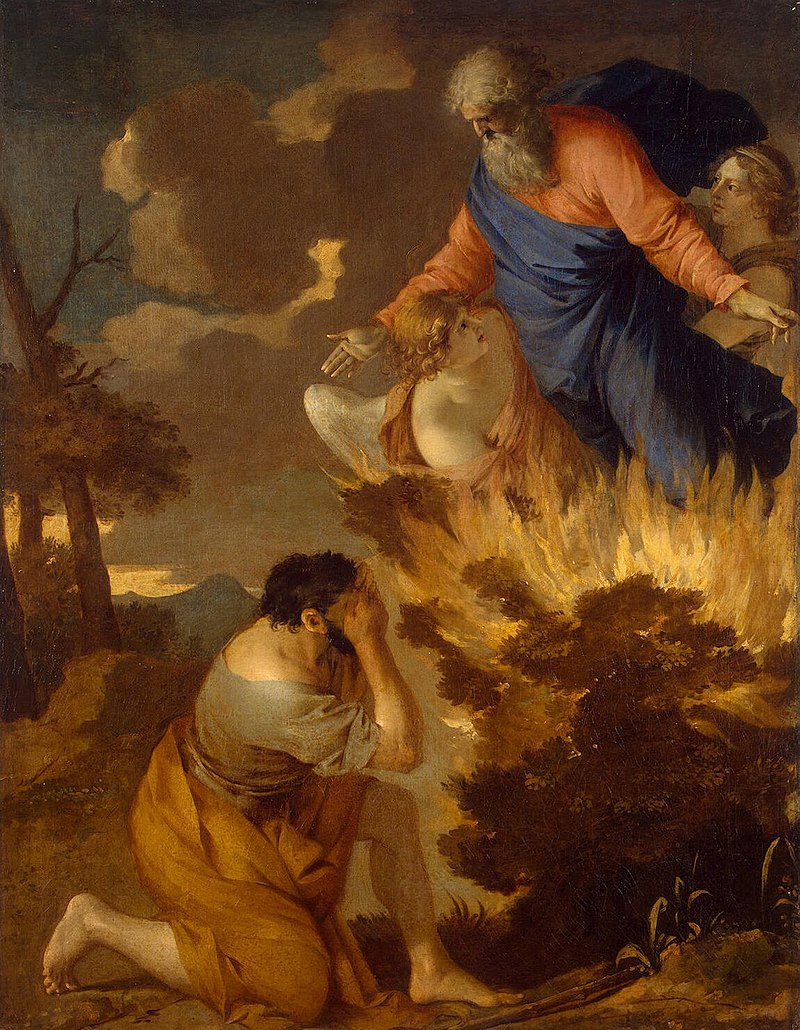
Burning bush
biblical episode where Moses was appointed by God to lead the Israelites into Canaan
Sator Square
word square containing a five-word Latin palindrome
orb
globular object sometimes topped with a cross; Christian symbol of authority

labarum
thumb|The Labarum of Constantine I, reconstructed from the depiction on a follis minted . The three dots represent "medallions" which are said to have shown portraits of Constantine and his sons.
The labarum ( or λάβουρον) was a vexillum (military standard) that displayed the "Chi-Rho" symbol ☧, a christogram formed from the first two Greek letters of the word "Christ" (, or Χριστός) – Chi (χ) and Rho (ρ). It was first used by the Roman emperor Constantine the Great.
Immaculate Heart of Mary
title of Mary, the mother of Jesus, signifying her purity and freedom from sin
Cross of St. Peter
inverted Latin cross traditionally used as a Christian symbol

shamrock
thumb|A wood sorrel, often called a shamrock, especially in the United States
candy cane
cane-shaped stick candy
Luther rose
widely recognized symbol for Lutheranism
Christian symbolism
use of symbols, such as the ichthys by Christianity
Lion of Judah
national and cultural symbol
Tau cross
Christian cross in the shape of a capital T

tetramorph
thumb|300px|A composition of the Four Living Creatures into one tetramorph. Matthew the man, Mark the lion, Luke the ox, and John the eagle.
A tetramorph is a symbolic arrangement of four differing elements, or the combination of four disparate elements in one unit. The term is derived from the Greek tetra, meaning four, and morph, shape.
papal coat of arms
personal coat of arms of popes

triquetra
right|thumb|Interlaced triquetra which is a trefoil knot
The triquetra ( ; from the Latin adjective triquetrus "three-cornered") is a triangular figure composed of three interlaced arcs, or (equivalently) three overlapping vesicae piscis lens shapes. It is used as an ornamental design in architecture, and in medieval manuscript illumination (particularly in the Insular tradition). Its depiction as interlaced is common in Insular ornaments from about the 7th century. In this interpretation, the triquetra represents the topologically simplest possible knot.
thumb|Comparison of associated Reuleau
tree of Jesse
artistic theme, depiction of the ancestors of Christ

Christogram
thumb|Chrismon
thumb| Chi-Rho symbol with [[Alpha and Omega on a 4th-century sarcophagus (Vatican Museums)]]
ecclesiastical heraldry
use of heraldry in Christian churches
nomina sacra
the abbreviation of several frequently occurring divine names or titles, especially in Greek manuscripts of Holy Scripture
kiss of peace
traditional Christian greeting
Sanctuary lamp
Lamps used in churches or temples located close to Holy Tabernacle, representing the real presence of Jesus Christ.

umbraculum
thumb|Coat of arms during the sede vacante – featuring an umbraculum
thumb|upright|Umbraculum in the Basilica of St. Louis, King of France
The umbraculum ( in Latin, "umbrella"; , "big umbrella", in basilicas also conopaeum) is a historic piece of the papal regalia and insignia, once used on a daily basis to provide shade for the pope. Also known as the pavilion, in modern usage the umbraculum is a symbol of the Catholic Church and the authority of the pope over it. It is found in the contemporary Church at all the basilicas throughout the world, placed prominently at the right of their main a
Arma Christi
objects associated with the Passion of Jesus Christ in Christian symbolism and art
Holy Wounds
the five piercing wounds Jesus suffered during the crucifixion, i.e. those in his hands and feet and the lance wound on his side
Holy Nail
relics that are claimed to be the Holy Nails with which Christ was crucified
crossed fingers
hand gesture
Keys of Heaven
metaphorical keys of the office of Saint Peter
crosses in heraldry
geometric charge in heraldry

quatrefoil
thumb|Quatrefoil above the west door of Croyland Abbey showing in [[relief scenes from the life of Saint Guthlac]]
thumb|Quatrefoil window at the St. Petrus parish church in Peterslahr, Germany
A quatrefoil (anciently caterfoil) is a decorative element consisting of a symmetrical shape which forms the overall outline of four partially overlapping circles of the same diameter. It is found in art, architecture, heraldry and traditional Christian symbolism. The word 'quatrefoil' means "four leaves", from the Latin , "four", plus , "leaf"; the term refers specifically to a four-leafed clover, but
Angel Moroni
angel who allegedly visited Joseph Smith many times
padma
religious symbol

trefoil
150px|thumb|right|Architectural trefoil
Shield of the Trinity
medieval triangular diagram of the Christian Trinity; summarizes the first half of the Athanasian Creed

Hetoimasia
thumb|250px|The empty throne with cushion, crux gemmata and cloth, flanked by Saints Peter and Paul. [[Arian Baptistery, Ravenna, early 6th century.]]
wayside shrine
religious image, usually in some sort of small shelter, placed by a road or pathway
flags of the Holy Roman Empire
Imperial banners used by Holy Roman Emperor
Cross and Crown
Christian symbol
Heraldry of the Holy Roman Empire
Coat of Arms
Christian laying on of hands
symbolic and formal method of invoking the Holy Spirit
Christus
statue by Bertel Thorvaldsen in Church of Our Lady in Copenhagen
cross moline
heraldic cross
pilgrim's staff
tall walking stick used by pilgrims
IX monogram
Christian monogram
Pine Tree Flag
Revolutionary-era flag
cruciform
Cruciform describes objects resembling a common cross or Christian cross. These include architectural shapes, biology, art, and design.