Category
page 1Christianity and death

Halloween
Halloween is a celebration observed in many countries on 31 October, the eve of the Western Christian feast of All Hallows' Day. It is at the beginning of the observance of Allhallowtide, the time in the Christian liturgical year dedicated to remembering the dead, including saints (hallows), martyrs, and all the faithful departed. In popular culture, Halloween has become a celebration of horror and is associated with the macabre and the supernatural.

purgatory
thumb|upright=0.9|right|Image of a fiery purgatory by Ludovico Carracci. Top: Christ directing, with Mary and interceding saints. Middle: Angel showing a soul the intercessors. Bottom: souls being purged with various attitudes.

All Souls' Day
feast day in some Christian denominations
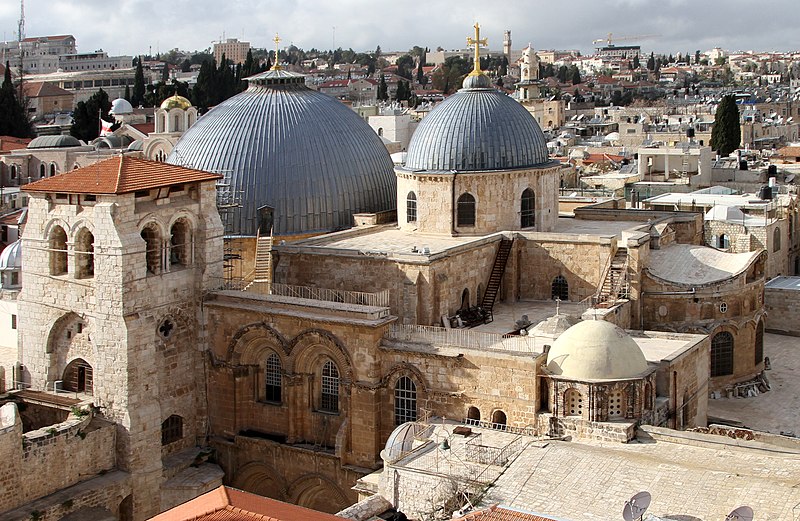
Church of the Holy Sepulchre
church in Jerusalem, containing the two holiest sites in Christianity

Shroud of Turin
The Shroud of Turin, also known as the Holy Shroud, is a length of linen cloth that bears a faint image of the front and back of a naked man. Because details of the image are consistent with traditional depictions of Jesus of Nazareth after his death by crucifixion, the shroud has been venerated by Christians for centuries, especially by members of the Catholic Church, as Jesus's shroud upon which his image was miraculously imprinted. The human image on the shroud can be discerned more clearly in a black-and-white photographic negative than in its natural sepia colour, an effect discovered in 1898 by Secondo Pia, who produced the first photographs of the shroud. This negative image is associated with a popular Catholic devotion to the Holy Face of Jesus.

crypt
thumb|Visigoths|Visigothic crypt of Saint Antoninus [[Palencia Cathedral in Spain]]
thumb|A crypt in Wola Gułowska in [[Lublin Province, Poland]]
A crypt () is a stone chamber beneath the floor of a church, above ground within a cemetery’s mausoleum or a free-standing outdoor memorial tomb. It typically contains coffins, sarcophagi, or religious relics and sometimes cremation urns.

mass for the dead
thumb|Requiem for Cirilo Almario|Bishop Cirilo Almario, in the [[Mass of Paul VI at Minor Basilica and Cathedral of the Immaculate Conception, Malolos, Bulacan, 2016]]
thumb|The Requiem, in the Tridentine Mass, celebrated annually for [[Louis XVI and victims of the French Revolution, in the crypt of Strasbourg Cathedral, 2013]]
thumb|270px|Requiem Mass for Archduke Franz Ferdinand of Austria at St. Catherine's Cathedral, [[St. Petersburg, published in a Russian newspaper, 1914]]

danse macabre
artistic motif on the universality of death
Cadaver Synod
posthumous ecclesiastical trial of Pope Formosus
Harrowing of Hell
In Christianity, the period of time between Christ’s crucifixion and resurrection, during which he saved souls held captive in the underworld
wake
vigil held over the dead before burial
Santa Muerte
Mexican cult image, female deity, and folk saint
entombment of Christ
event in the New Testament

koliva
Koliva, also spelled, depending on the language, kollyva, kollyba, kolyvo, or colivă, is a dish based on boiled wheat that is used liturgically in the Eastern Orthodox Church for commemorations of the dead.
ablution
both 'baptism' and 'footwashing' are forms of ablution
memorial service in the Eastern Orthodox Church
service for the deceased in the Eastern Orthodox Church

Viaticum
Viaticum is a term used – especially in the Catholic Church – for the Eucharist (also called Holy Communion), administered, with or without Anointing of the Sick (also called Extreme Unction), to a person who is dying; viaticum is thus a part of the Last Rites.

churchyard
thumb|The churchyard of Straßwalchen, [[Austria]]
In Christian countries, a churchyard is a patch of land adjoining or surrounding a church, which is usually owned by the relevant church or local parish itself. In the Scots language and in both Scottish English and Ulster Scots, this can also be known as a kirkyard.
burial vault
structural underground tomb
Eternal Rest
Introit, Western Christian prayer for the dead
Four last things
in Christian eschatology, Death, Judgment, Heaven, and Hell, the four last stages of the soul in life and the afterlife, often commended as a collective topic for pious meditation

pallbearer
thumb|Pallbearers carrying the casket of Major Douglas A. Zembiec of the [[United States Marine Corps]]
A pallbearer is one of several participants who help carry the casket at a funeral. They may wear white gloves in order to prevent damaging the casket and to show respect to the deceased person.
Universal resurrection
all the dead who have ever lived will be resurrected
Totensonntag
Totensonntag (, Sunday of the Dead), also called Ewigkeitssonntag (Eternity Sunday) or Totenfest, is a Protestant religious holiday in Germany and Switzerland, commemorating the faithful departed. It falls on the last Sunday of the liturgical year in the Protestant Church in Germany and the Protestant Church in the Netherlands.

Lantern of the Dead
architectural name for small stone tower found chiefly in the centre and west of France
castrum doloris
decorative material for funerals

Maximón
Maximón () is a Maya deity and folk saint, represented in various forms by the Maya peoples of several towns in the Guatemalan Highlands. Oral tradition of his creation and purpose in these communities is complex, diverse, and born of the ancient Maya traditions centuries ago.
Memory Eternal
Eastern Orthodox exclamation at funerals
Office of the Dead
prayer cycle
grave candle
candle lit in memory of the dead
Absolution of the dead
prayer for or a declaration of absolution of a dead person's sins that takes place at the person's religious funeral
emergency baptism
baptism administered to a person in imminent danger of death
soul cake
religious cake to commemorate the dead
memorial cross
cross erected to commemorate a person or event, sometimes as a grave marker
Kollyvades Movement
thumb
The Kollyvades () were the members of a movement within the Eastern Orthodox Church that began in the second half of the eighteenth century among the monastic community of Mount Athos, which was concerned with the restoration of traditional practices and opposition to unwarranted innovations, and which turned unexpectedly into a movement of spiritual regeneration. As Metropolitan Kallistos Ware succinctly points out:
funeral pall
cloth which covers a casket or coffin during the funeral, often of rich materials
Saturday of Souls
Day for commemoration of the dead
Roman Catholic funeral
service of the Church that accompanies a deceased person and his entourage
Dryhthelm
Dryhthelm (fl. c. 700), also known as Drithelm or Drythelm, was a monk associated with the monastery of Melrose known from the Historia Ecclesiastica gentis Anglorum of Bede. According to the latter, before entering the religious life he lived with his family in "a district of Northumbria which is called Incuneningum". Incuneningum is thought by some modern scholars to refer to Cunninghame, now part of Ayrshire.
Christian views on suicide
Christian theological perspectives on suicide
mortuary roll
medieval document to commemorate prominent persons
chapelle ardente
chapel or room
Christian burial
Funeral in Christian traditions