Category
page 1Christians in the Sasanian Empire

Mesrop Mashtots
Armenian theologian and linguist (362–440)
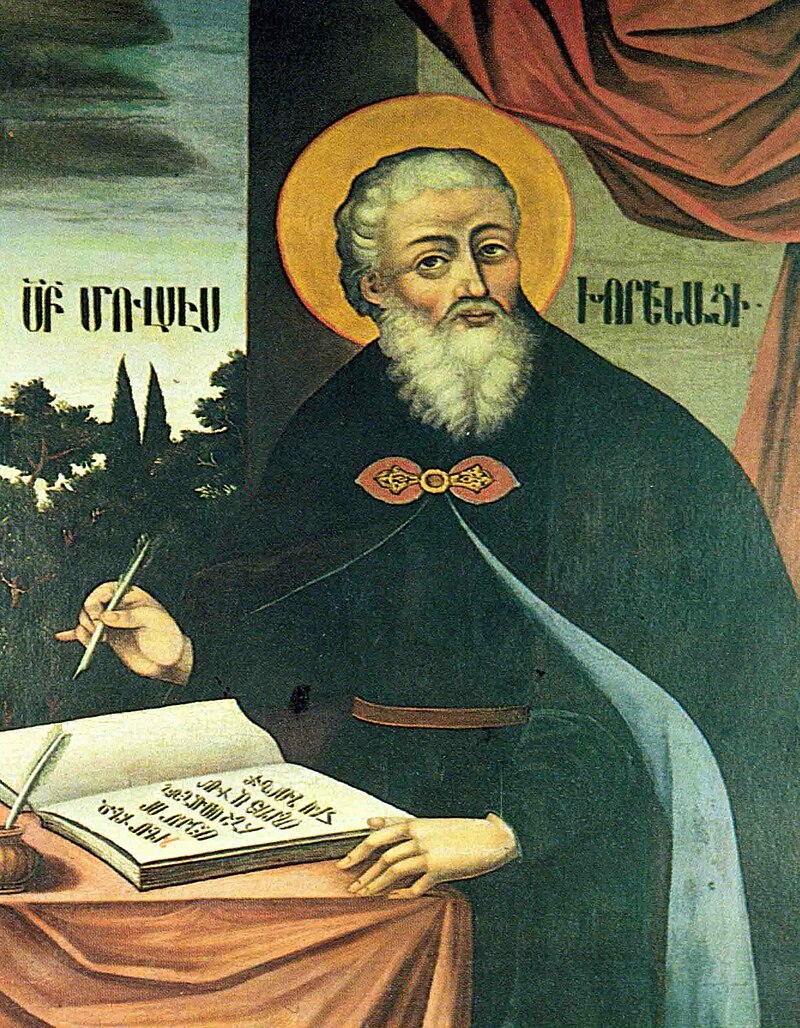
Moses of Chorene
5th-century Armenian historian

Vakhtang I of Iberia
King of Iberia (440-502)
Aphrahat
Aphrahat (c. 280–c. 345; , Ap̄rahaṭ, , , , and Latin Aphraates), venerated as Saint Aphrahat the Persian, was a third-century Syriac Christian author of Iranian descent from the Sasanian Empire, who composed a series of twenty-three expositions or homilies on points of Christian doctrine and practice. All his known works, the Demonstrations, come from later on in his life. He was an ascetic and celibate, and was almost definitely a son of the covenant (an early Syriac form of communal monasticism). He may have been a bishop, and later Syriac tradition places him at the head of Mar Mattai Monas

Mirian III of Iberia
first Iberian king from the Chosroid dynasty
Isaac of Armenia
Armenian saint
Anastasius of Persia
Christian martyr
Shemon Bar Sabbae
Patriarch of the Church of the East

Shirin
Shirin (; died 628) was wife of the Sasanian emperor Khosrow II (). In the revolution after the death of Khosrow's father Hormizd IV, the General Bahram Chobin took power over the Persian empire. Shirin fled with Khosrow to Syria, where they lived under the protection of Byzantine emperor Maurice.
Shushanik
Shushanik (; ; 440 – 475), also known as Shushanika or Vardandukht, was a Christian Armenian woman who was tortured to death by her husband Varsken in the town of Tsurtavi, Georgia. Since she died defending her right to profess Christianity, she is regarded as a martyr. Her martyrdom is described in her confessor Jacob’s hagiographic work, the oldest extant work of Georgian language literature. The hagiography details Shushanik's extensive resistance to imprisonment, isolation, torture and cruelty.
Philoxenus of Mabbug
Assyrian writer and theologian (died 523)
Abdon and Sennen
Christian martyrs of the 3rd century

Juansher
Juansher was the Mihranid prince of Caucasian Albania, ruling the principality from 637 to 669. He was the son and successor of Varaz Grigor ().
Adi ibn Zayd
Arab poet (550-600)
Al-Nu'man III ibn al-Mundhir
Lakhmid king of al-Hirah (582 – c. 602)
Aba I
Patriarch of the Church of the East at Seleucia-Ctesiphon
Babai the Great
Assyrian writer
Abdas of Susa
Iranian catholic priest (0400-0418)
Saint Sarkis the Warrior
Armenian form of Sergius
Barsauma of Nisibis
Bishop of the Church of the East
Abraham the Great of Kashkar
Doctor, saint
Yacoub M’fasquo
Persian saint
Narsai
Narsai (sometimes spelt Narsay, Narseh or Narses; , name derived from Pahlavi Narsēh from Avestan Nairyō.saȵhō, meaning 'potent utterance'; ) was one of the foremost of the poet-theologians of the early Church of the East, perhaps equal in stature to Jacob of Serugh, both second only to Ephrem the Syrian. He is venerated as a saint in all the modern descendants of the Church of the East; the Chaldean Catholic Church, Assyrian Church of the East, Ancient Church of the East, and Syro-Malabar Catholic Church. Saint Narsai is known as the 'Flute of the Holy Spirit.'
Vahan I Mamikonian
Armenian rebel
Saint Benjamin the Deacon and Martyr
Persian saint
Saint Christina of Persia
Sasanian Persian noblewoman and Christian martyr
Bademus
Bademus (also known as Bademe and Vadim) was a rich, noble citizen of Bethlapeta in Persia, who founded a monastery nearby. He and some of his disciples were arrested and Bademus was martyred in the year 376; he was subsequently recognized as a saint.
Ifra Hormizd
Persian noblewoman
Razhden the Protomartyr
saint
Rabban Hormizd
Assyrian saint
Sabrisho I
Patriarch of the Church of the East
Babowai
Babowai (also Babaeus or Mar Babwahi) (died 484) was Catholicos of Seleucia-Ctesiphon and Patriarch of the Church of the East from 457 to 484, during the reign of the Sassanid King Peroz I. Babowai was known for his pro-Byzantine leanings, for which he was often in conflict with other members of the anti-Byzantine Church of the East. He was executed in 484.
Acacius
patriarch in the 5th century
Shahdost
Shahdost, also Sadoc, Sadoth () () was Bishop of Seleucia-Ctesiphon and primate of the Church of the East from 341 to 343 who resided in the Sasanian Empire. He was martyred during the great persecution of Shapur II. Like several other early bishops of Seleucia-Ctesiphon, he is included in the traditional list of patriarchs of the Church of the East. He is considered a saint in several Eastern Christian denominations.
Isaac
Primate of the Church of the East from 399 to 410
Varaz Grigor
king of Caucasian Albania
Ishoyahb II
patriach of the Church of the East
Ahudemmeh
Ahudemmeh was the Grand Metropolitan of the East in the Syriac Orthodox Church from 559 until his execution in 575. He was known as the Apostle of the Arabs, and is commemorated as a saint by the Syriac Orthodox Church.

Yahballaha I
Patriarch of the Church of the East from 415 to 420
Babai
Patriarch of the Church of the East
Farbokht
Farbokht (or Marabokht) served briefly as bishop of Seleucia-Ctesiphon, grand metropolitan and primate of the Church of the East in 421. He is included in the traditional list of patriarchs of the Church of the East.
Papa
Bishop of Seleucia-Ctesiphon

Demetrius of Antioch
bishop of Antiochia, 3rd century
Golinduch
Golindouch, Golindukht, Golindokht, or Dolindokht () (died 591) was a noble Persian lady who converted to Christianity, took the name Maria, and became a saint and martyr.
Peroz (Mihranid)
Paul the Persian
Persian philosopher

Eustathius of Mtskheta
Iranian saint
Marutha of Tikrit
Syriac Orthodox Maphrian and Theologian
Thomas of Cana
Syriac Christian
Henana of Adiabene
Syrian theologian and writer, leader of the theological school in Nisibis in the second half of the 6th century
Mana
patriarch
Saint Behnam
Syriac saint
Mar Qardagh
Iranian martyr
Piran Gushnasp
Iranian commander and Marzban of wiruzān and Arān
Joseph
Patriarch of the Church of the East

Gregory
Nestorian patriarch
Ishoyahb I