Category
page 1Chromatiales
Chromatiales
The Chromatiales are an order of Gammaproteobacteria within Pseudomonadota. Like other Proteobacteria, the Chromatiales are Gram-negative and can be spherical, vibrioid, spiral or rod-shaped.

Chromatiaceae
The Chromatiaceae are one of the two families of purple sulfur bacteria, together with the Ectothiorhodospiraceae. They belong to the order Chromatiales of the class Gammaproteobacteria, which is composed of gram-negative bacteria. Most of the species are photolithoautotrophs and conduct an anoxygenic photosynthesis, but there are also representatives capable of growing under dark and/or microaerobic conditions as either chemolithoautotrophs or chemoorganoheterotrophs.
Chromatium
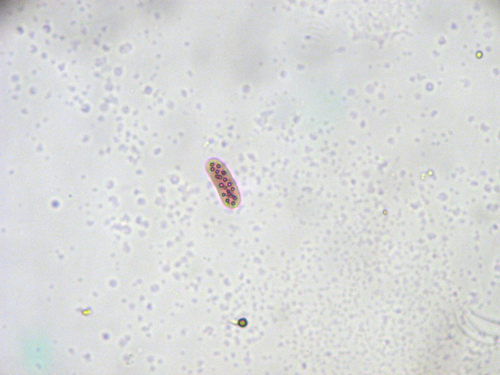
Chromatium is a genus of photoautotrophic Gram-negative bacteria which are found in water. The cells are straight rod-shaped or slightly curved. They belong to the purple sulfur bacteria and oxidize sulfide to produce sulfur which is deposited in intracellular granules of the cytoplasm.
Nitrosococcus
Nitrosococcus is a genus of Gram-negative bacteria. It is an ammonia-oxidizing bacterium which oxidizes ammonia into nitrite. Nitrosococcus can be found in marine environments and salt lakes.
Ectothiorhodospiraceae
The Ectothiorhodospiraceae are a family of purple sulfur bacteria, distinguished by producing sulfur globules outside of their cells. The cells are rod-shaped, vibrioid, or spirilla, and they are able to move using flagella. In general, they are marine and prefer anaerobic conditions. Ectothiorhodospiraceae are a vibrio bacteria that require salty living conditions to survive and grow: classifying them as slightly halophilic. Like all purple sulfur bacteria, they are capable of photosynthesis. To complete this energy process, Sulfur compounds are used as electron donors for carbon fixation in