Category
page 1Circles

circle
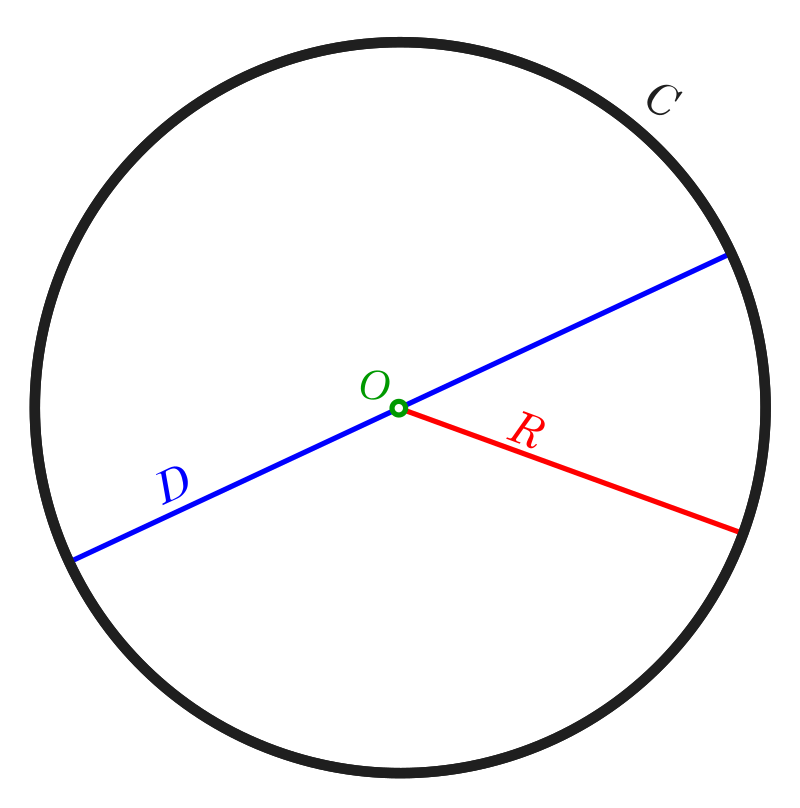
A circle is a shape consisting of all points in a plane that are at a given distance from a given point, the centre. The distance between any point of the circle and the centre is called the radius. The length of a line segment connecting two points on the circle and passing through the centre is called the diameter. A circle bounds a region of the plane called a disc.

diameter
[[File:Circle-withsegments.svg|thumb|right|Circle with

celestial equator
projection of the Earth's equator out into space
disk
plane figure, bounded by circle

chord
geometric line segment whose endpoints both lie on the curve

great circle
intersection of the sphere and a plane which passes through the center point of the sphere

unit circle
circle with radius one
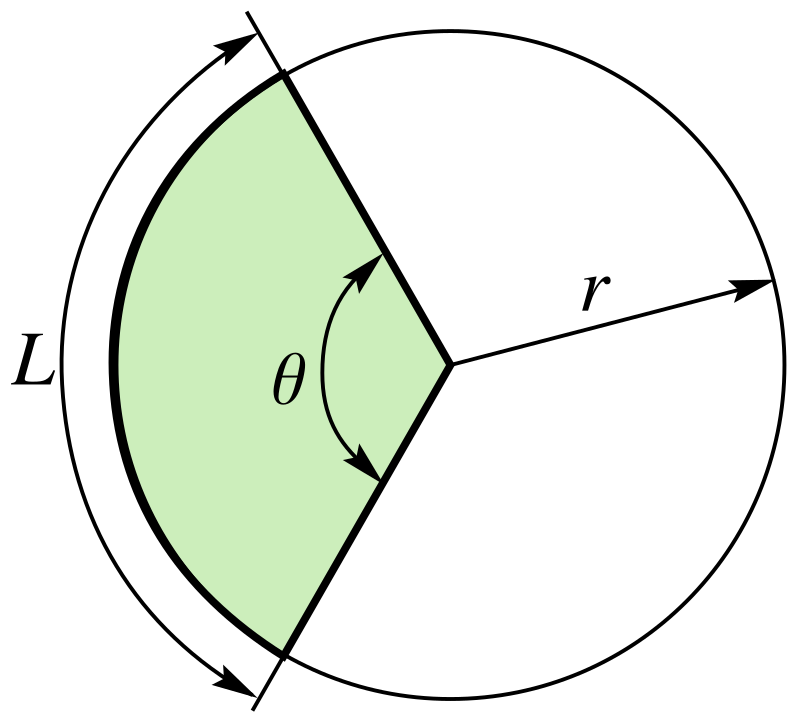
circular sector
portion of a disk enclosed by two radii and an arc

circular motion
object movement along a circular path

crop circle
pattern in a crop field

circumference
[[File:Circle-withsegments.svg|thumb|
celestial meridian
great circle passing through the celestial poles, the zenith, and the nadir of a particular location
circular segment
slice of a circle cut perpendicular to the radius
annulus
geometric surface defined by two concentric circles

flatness
thumb|right|200px |A circle of radius compressed to an ellipse.
thumb|right|200px |A sphere of radius compressed to an oblate ellipsoid of revolution.
color wheel
abstract illustrative organization of color hues
central angle
measure of two radii meeting
tondo
circular work of art
Mohr's circle
geometric engineering calculation technique
circular arc
segment of a circle

ensō
thumb| () by Kanjuro Shibata XX. Some artists draw with an opening in the circle, while others close the circle.
In Zen art, an is a circle hand-drawn in one or two uninhibited brushstrokes to express the Zen mind, which is associated with enlightenment, emptiness, freedom, and the state of no-mind.
lune of Hippocrates
shape bounded by arcs of two circles whose area is a rational multiple of the circles' radii
radical axis
line determined by two circles
circles of Apollonius
a family of circles where every one intersects every circle in a second family of circles orthogonally
Valeriepieris circle
region on world map with more people inside than outside
pole and polar
construction in geometry, which, given to a conic, associates a line (“polar”) to a point and a point (“pole”) to a line
unit disk
set of points at distance less than one from a given point
osculating circle
circle of immediate corresponding curvature of a curve at a point
Hour circle
Part of celestial coordinate system

roundel
thumb|right|The Flag of France|Tricolore cockade of the [[French Air Force was first used on military aircraft before the First World War]]
area of a disk
area enclosed by a circle
center pivot irrigation
method of crop irrigation
Tangent lines to circles
line which touches a circle at exactly one point
Gauss circle problem
problem of counting integer points within a circle of given radius centered at the origin

unknot
right|150px|thumb|Two simple diagrams of the unknot
In the mathematical theory of knots, the unknot, not knot, or trivial knot, is the least knotted of all knots. Intuitively, the unknot is a closed loop of rope without a knot tied into it, unknotted. To a knot theorist, an unknot is any embedded topological circle in the 3-sphere that is ambient isotopic (that is, deformable) to a geometrically round circle, the standard unknot.
Aristotle's wheel paradox
paradox
Steiner chain
cyclic sequence of circles, each tangent to its two neighbors in the sequence and to two fixed circles
coin rotation paradox
apparent absurdity in rolling a coin along its edge

ice disc
big circular ice floe (ca 1 m ... 50 m diameter) rotating on a river
Villarceau circles
Shape produced by intersection of a torus

Vertical circle
great circle perpendicular to the mathematical horizon
circular knitting
knitting of tubular shapes using knitting needles or a circular knitting machine
homothetic center
point from which at least two geometrically similar figures can be seen as a dilation/contraction of one another
Johnson circles
geometric theorem regarding 3 circles intersecting at a point
extouch triangle
cyclic order
ternary relation that is cyclic (if [𝑥,𝑦,𝑧] then [𝑧,𝑥,𝑦]), asymmetric (if [𝑥,𝑦,𝑧] then not [𝑧,𝑦,𝑥]), transitive (if [𝑤,𝑥,𝑦] and [𝑤,𝑦,𝑧] then [𝑤,𝑥,𝑧]) and connected (for distinct 𝑥,𝑦,𝑧, either [𝑥,𝑦,𝑧] or [𝑧,𝑥,𝑦])
smallest-circle problem
mathematical problem of computing the smallest circle that contains all of a given set of points in the Euclidean plane
Circles of Apollonius
Circles of Apollonius
orthogonal circles
goat problem
mathematical problem
Regiomontanus' angle maximization problem
famous mathematical optimization problem
tangent circles
two circles with only one common point
roundness
Roundness is the measure of how closely the shape of an object approaches that of a mathematically perfect circle. Roundness applies in two dimensions, such as the cross sectional circles along a cylindrical object such as a shaft or a cylindrical roller for a bearing. In geometric dimensioning and tolerancing, control of a cylinder can also include its fidelity to the longitudinal axis, yielding cylindricity. The analogue of roundness in three dimensions (that is, for spheres) is sphericity.
◌
dotted circle (U+25CC); note that the reference glyph is intentionally larger than the glyph used in the UCS standard to indicate combining characters
circle graph
a type of node-link graph in which vertices represent chords of a circle and edges represent crossings
generalised circle
curve that is a circle or a straight line
Robbins pentagon
cyclic pentagon whose side lengths and area are all rational numbers
Hexafoil
thumb|A geometrical hexafoil
circle bundle
fiber bundle whose fibers are circles