Category
page 1Cities in ancient Attica

Piraeus
Piraeus ( ; ; , Ancient: , Katharevousa: ) is a port city within the Athens urban area ("Greater Athens"), in the Attica region of Greece. It is located southwest of Athens city centre along the east coast of the Saronic Gulf in the Athens Riviera.

Elefsina
thumb|250px|Plan of ancient Eleusis

Megara
Megara (; , ) is a historic town and a municipality in West Attica, Greece. It lies in the northern section of the Isthmus of Corinth opposite the island of Salamis, which belonged to Megara in archaic times, before being taken by Athens. Megara was one of the four districts of Attica, embodied in the four mythic sons of King Pandion II, of whom Nisos was the ruler of Megara. Megara was also a trade port, its people using their ships and wealth as a way to gain leverage on armies of neighboring poleis. Megara specialized in the exportation of wool and other animal products including livestock
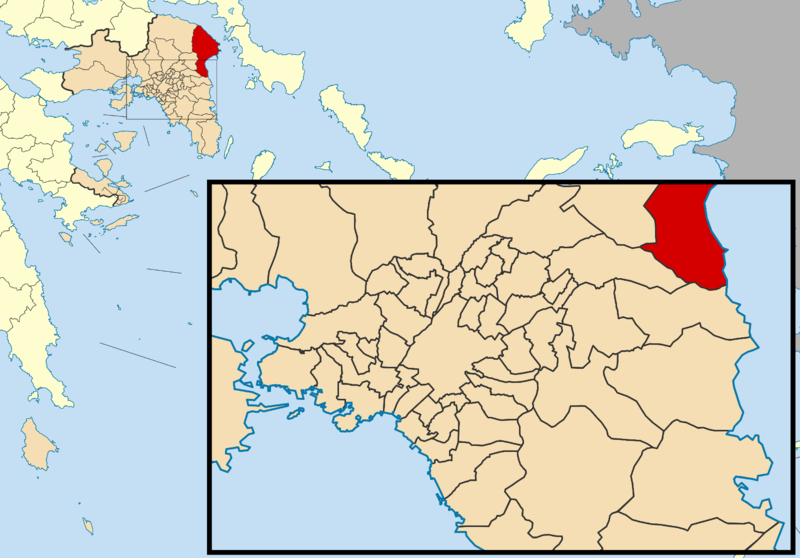
Marathon
modern town in Attica, Greece
Decelea
Decelea (, Dekéleia), was a deme and ancient village in northern Attica serving as a trade route connecting Euboea with Athens, Greece. It was situated near the entrance of the eastern pass across Mount Parnes, which leads from the northeastern part of the Athenian plain to Oropus, and from thence both to Tanagra on the one hand, and to Delium and Chalcis on the other. It was situated about 120 stadia from Athens, and the same distance from the frontiers of Boeotia. It was visible from Athens and from its heights the ships entering the harbour of Piraeus were visible as well.

Afidnes
Afidnes (, or Ἀφίδναι, from the Middle Ages until 1919: Κιούρκα - Kiourka) is a small town in East Attica, Greece. Since the 2011 local government reform it is part of the municipality Oropos, of which it is a municipal unit. The municipal unit has an area of 34.638 km2. It is situated in the eastern foothills of the Parnitha mountains, 3 km southwest of Polydendri, 5 km southeast of Malakasa and 27 km north of Athens city centre. Afidnes has a station on the railway from Athens to Thessaloniki. The A1 motorway (Athens - Lamia - Thessaloniki) passes east of the town. It is

Rhamnous
Rhamnous (; ), also Ramnous or Rhamnus, was an ancient Greek city in Attica situated on the coast, overlooking the Euboean Strait. Its ruins lie northwest of the modern town of Agia Marina in the municipality of Marathon.

Thoricus
260px|right|thumb|Archaeological site of Thorikos

Nisaea
thumb|This map depicts the long walls which connected Nisaea to the ancient City State of Megara.
Colonus
ancient Athenian deme

Acharnae
Acharnae or Acharnai (; ) was a deme of ancient Athens. It was part of the phyle Oineis.

Aigosthena
Aigosthena () was an ancient Greek fortified port city of Megaris, northwest of the ancient city of Megara to which it belonged. It is also the name of the coastal settlement at the foot of the ancient city walls, also known as Porto Germeno. The ancient citadel which stands at the foot of Mt Cithaeron and extends down to the sea at the inlet of Aigosthena, on the east side of the Gulf of Corinth, is famous for retaining several of the tallest surviving towers of ancient Greece.
Aphidna
Aphidna () or Aphidnae or Aphidnai (Ἀφίδναι) was one of the twelve ancient towns of ancient Attica. It was celebrated in the mythical period as the place where Theseus deposited Helen of Troy, entrusting her to the care of his friend Aphidnus. When the Dioscuri invaded Attica in search of their sister, the inhabitants of Deceleia informed the Lacedaemonians where Helen was concealed, and showed them the way to Aphidna. The Dioscuri thereupon took the town, and carried off their sister. We learn, from a decree quoted by Demosthenes, that Aphidna was, in his time, a fortified town, and at a grea
Oropus
Oropus or Oropos (, or rarely ἡ Ὠρωπός) was a town on the borders of ancient Attica and Boeotia, and the capital of a district, called after it Oropia (ἡ Ὠρωπία.) This district is a maritime plain, through which the Asopus flows into the sea, and extends for along the shore. It is separated from the inland plain of Tanagra by some hills, which are a continuation of the principal chain of the Diacrian mountains.
==History==
Oropus was originally a town of Boeotia; and, from its position in the maritime plain of the Asopus, it naturally belonged to that country. It was, however, a frequent subj
Kytheros
Cytherus or Kytheros ( or Κύθηρος), also known as Cytherum or Kytheron (Κύθηρον), was one of the twelve cities of ancient Attica, and afterwards a deme. Pausanias states that the nymphs of the river Cytherus in Elis were called Ionides from Ion, the son of Gargettus, when he migrated from Athens to Elis.