Category
page 1Cladoniaceae
%20(33509386894).jpg)
Cladoniaceae
The Cladoniaceae are a family of lichen-forming fungi in the order Lecanorales, comprising about 560 species distributed amongst 18 genera. This family is one of the largest among lichen-forming fungi and is globally distributed, from Arctic tundra to tropical rainforests, favouring humid environments while being intolerant of arid conditions. Molecular phylogenetics has substantially advanced the understanding of their complex taxonomic history, revealing intricate evolutionary relationships and leading to a refined classification. Notable members include reindeer moss and cup lichens of the
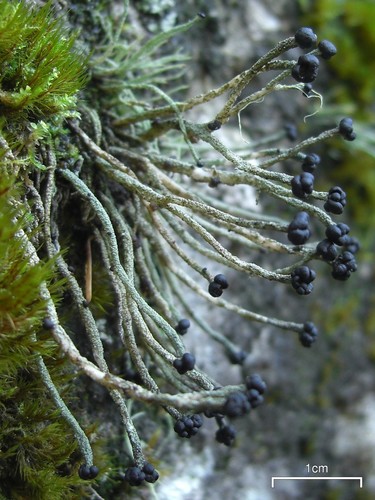
Pilophorus acicularis
species of fungus
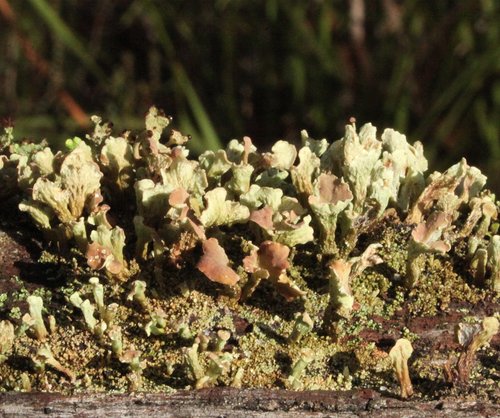
Thysanothecium
Thysanothecium is a genus of three species of lichenized fungi in the family Cladoniaceae. The genus was circumscribed by Camille Montagne and Miles Joseph Berkeley in 1846. The original specimens of the type species, T. hookeri, were collected from the area of Swan River (Australia) by James Drummond, who sent them for to William Jackson Hooker for further analysis.

Pilophorus
genus of fungi

Cetradonia linearis
Cetradonia is a lichen genus in the family Cladoniaceae. A monotypic genus, Cetradonia contains the single species Cetradonia linearis (formerly known as Cladonia linearis and as Gymnoderma lineare). The genus was circumscribed in 2002 by Jiang-Chun Wei and Teuvo Ahti. The genus was once placed in the family Cetradoniaceae (created in 2002) until that family was subsumed into the Cladoniaceae in 2006.

Gymnoderma
Gymnoderma is a genus of lichen-forming fungi in the family Cladoniaceae. Originally established in 1860 by the Finnish lichenologist William Nylander, this small genus is characterised by forming mats of small, yellow-green scales dotted with spherical brown fruiting bodies. The genus is distinguished from related lichens by a unique microscopic feature: its spore-containing structures (asci) turn deep blue when stained with iodine, which is uncommon among members of the Cladoniaceae.
Pycnothelia
Pycnothelia is a small genus of lichen-forming fungi in the family Cladoniaceae. The genus contains three species that form distinctive upright, hollow stalks (podetia) rising from a grainy crust, topped with dark, round fruiting bodies. These lichens typically grow on soil or mossy ground in cool, humid habitats. The genus has a scattered global distribution, with one species found across Europe and parts of the Americas, while the other two are restricted to islands in the Southern Hemisphere.
Squamella
Squamella is a fungal genus in the family Cladoniaceae. The genus is monotypic, containing the single species Squamella spumosa, a squamulose lichen found in Australia. The genus was established in 2001 for a lichen collected in the McIlwraith Range of far-northern Queensland, distinguished by its flattened, leaf-like scales that develop foam-like masses of tiny at their tips. It lacks the stalked structures typical of related genera and grows on bark in seasonal monsoon forests. Its precise evolutionary relationships remain uncertain due to the absence of DNA sequence data.
Notocladonia
Notocladonia is a genus of two Australasian species of lichen-forming fungi in the family Cladoniaceae. The genus was established in 2003 by Samuel Hammer to accommodate Australasian species previously misplaced in the neotropical genus Ramalea. Notocladonia species are distinguished by their spore-bearing discs (apothecia) that form at the tips of scale-like lobes or short stalks, rather than beneath the thallus as in Ramalea. Both species occur in temperate regions of southeastern Australia and New Zealand, typically growing on thin soils in open habitats.

Metus
genus of fungi
Calathaspis
Calathaspis is a fungal genus in the family Cladoniaceae. A monotypic genus, Calathaspis contains the single species Calathaspis devexa, which is found in Papua New Guinea in middle- and high-elevation forests at altitudes ranging from .