Category
page 1Climate forcing
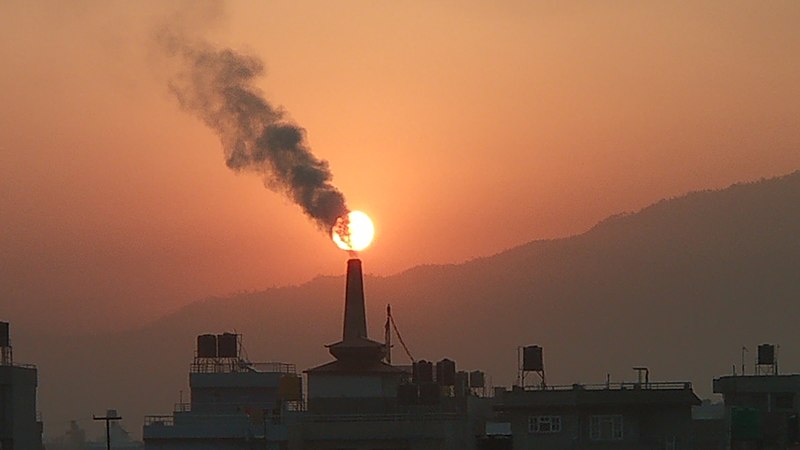
air pollution
presence of dangerous substances in the atmosphere

greenhouse effect
atmospheric heat retention
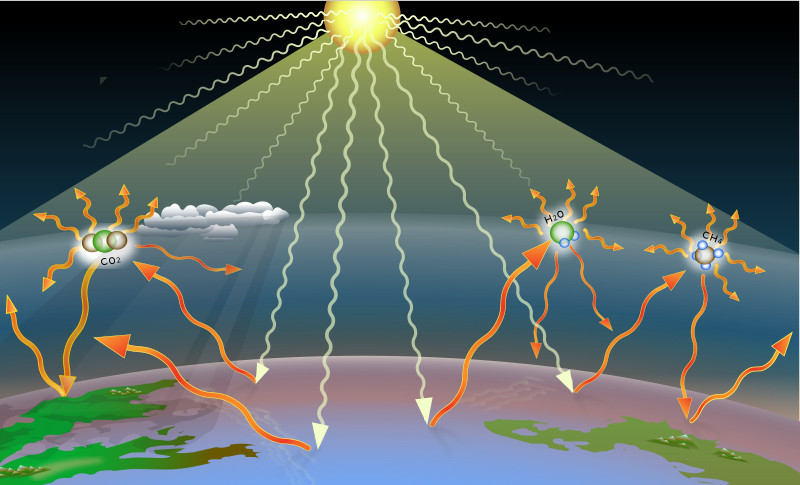
greenhouse gas
heat-trapping gas in a planet's atmosphere

albedo
thumb|Albedo change in Greenland: The map shows the difference between the amount of sunlight [[Greenland reflected in the summer of 2011 versus the amount it reflected between 2000 and 2006. Some areas reflect close to 20 percent less light than a decade ago.]]
Albedo ( ; ) is the fraction of sunlight that is diffusely reflected by a body. It is measured on a scale from 0 (corresponding to a black body that absorbs all incident radiation) to 1 (corresponding to a body that reflects all incident radiation). Surface albedo is defined as the ratio of radiosity Je to the irradiance Ee (flux per u

sunlight
thumb|right|The Sun, as seen from low Earth orbit overlooking the International Space Station. This sunlight is not filtered by the lower atmosphere, which blocks much of the solar spectrum.

weathering
thumb|upright=1.35|A natural arch produced by erosion of differentially weathered rock in Jebel Kharaz ([[Jordan)]]

nuclear winter
hypothetical climatic effect of nuclear war

Milankovich cycle
periodic changes in the orbital movements of the earth

contrail
Contrails (; short for "condensation trails") or vapour trails are line-shaped clouds produced by aircraft engine exhaust or changes in air pressure, typically at aircraft cruising altitudes several kilometres/miles above the Earth's surface. They are composed primarily of water, in the form of ice crystals. The combination of water vapor in aircraft engine exhaust and the low ambient temperatures at high altitudes cause the trails' formation.

urban heat island
urban area that is significantly warmer than its surrounding rural areas due to human activities

impact event
collision of two astronomical objects with measurable effects
particulates
microscopic solid or liquid matter suspended in the Earth's atmosphere

Earth's energy budget
accounting of the energy flows which determine Earth's surface temperature and drive its climate
volcanic winter
temperature anomaly event caused by a volcanic eruption
global warming potential
estimate of how an atmospheric gas affects global climate change
clinker
main component of Portland cement (CEM I)
general circulation model
type of climate model
waste heat
Waste heat is by necessity produced both by machines that do work and in other processes that use energy, for example in a refrigerator warming the room air or a combustion engine releasing heat into the environment.
radiative forcing
the difference between the incoming radiation energy and the outgoing radiation energy in a given climate system
large igneous province
massive volcanic formation resulting from flood basalt eruptions
runaway greenhouse effect
climatic effect causing a planet's atmosphere to trap heat and prevent cooling
greenhouse gas emissions
sources and amounts of greenhouse gases emitted to the atmosphere from human activities
black carbon
atmospheric soot; component of fine particulate matter
deforestation and climate change
interactions between deforestation and climate change
impact winter
hypothesized extended period of worldwide cold weather due to the impact of a celestial body on the Earth's surface
carbonate–silicate cycle
term in chemistry: long-term transformation of silicate rocks to carbonate rocks by weathering and sedimentation, and the transformation of carbonate rocks back into silicate rocks by metamorphism and volcanism
orbital forcing
Effect on the Earth's climate from slow orbital change
Cloud feedback
type of climate change feedback mechanism
Twomey effect
the effect of solar radiation being deflected by clouds
Ship tracks
Clouds that form around the exhaust released by ships
solar activity and climate
field of scientific study
Flying river
Water vapor transfer from the Amazon Basin
land surface effects on climate
assarting
Assarting is the act of clearing forested lands for use in agriculture or other purposes. In English land law, it was illegal to assart any part of a royal forest without permission. This was the greatest trespass that could be committed in a forest, being more than a waste: while waste of the forest involves felling trees and shrubs, which can regrow, assarting involves completely uprooting all trees—the total extirpation of the forested area.