Category
page 1Cold War terminology
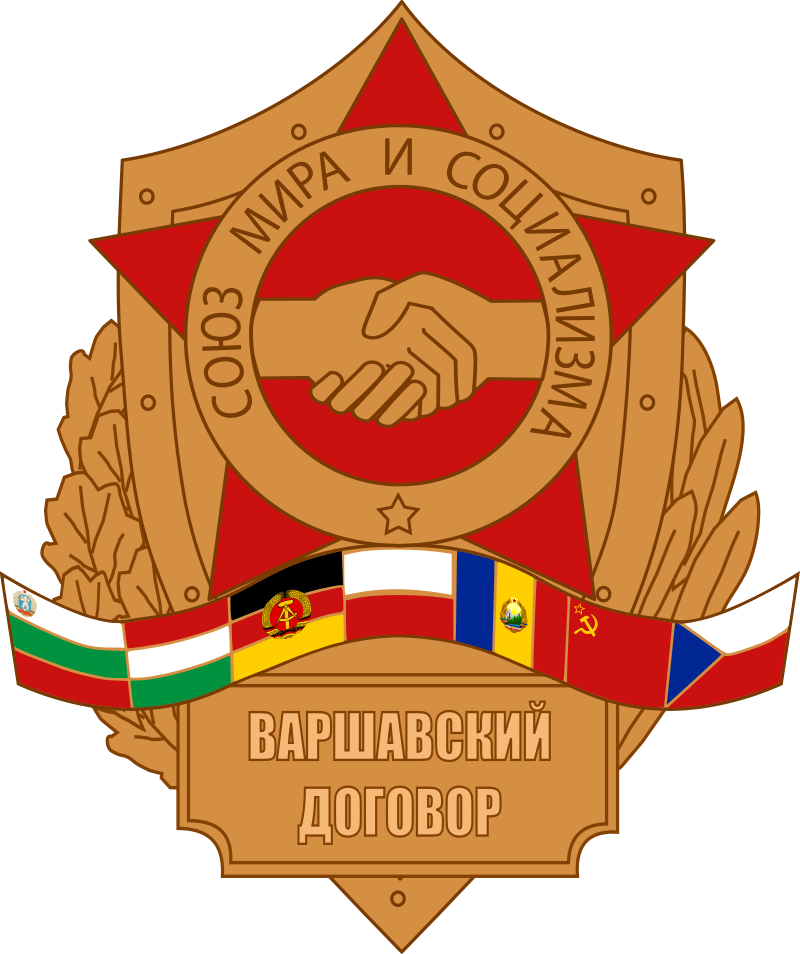
Warsaw Pact
European Eastern Military Alliance (1954 – 1991)

Sputnik 1
first artificial Earth satellite

Iron Curtain
term symbolizing the ideological-political conflict and physical boundary dividing Europe during the Cold War
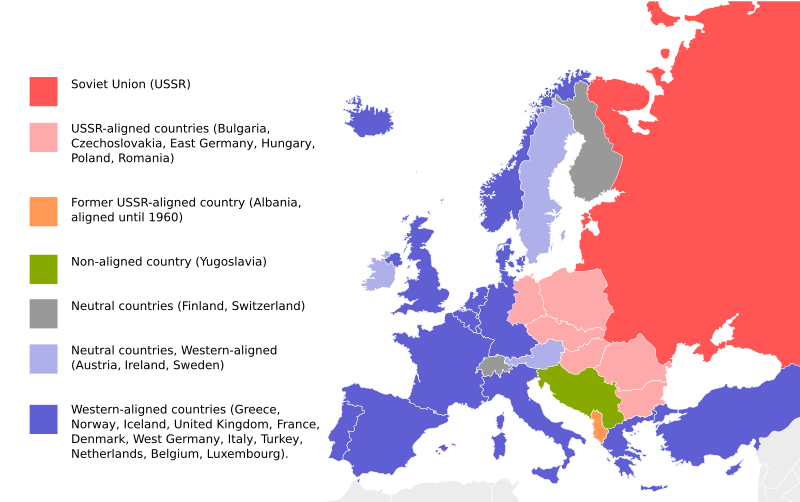
Third World
category of countries on socio economic base

hypocenter
A hypocenter or hypocentre, also called ground zero or surface zero, is the point on the Earth's surface directly below a nuclear explosion, meteor air burst, or other mid-air explosion. In seismology, the hypocenter of an earthquake is its point of origin below ground; a synonym is the focus of an earthquake.

Korean Demilitarized Zone
demilitarized zone in Korea

McCarthyism
McCarthyism is a political practice defined by the political repression and persecution of left-wing individuals and a campaign spreading fear of communist and Soviet influence on American institutions and of Soviet espionage in the United States during the late 1940s through the 1950s, heavily associated with the Second Red Scare, also known as the McCarthy era. After the mid-1950s, U.S. senator Joseph McCarthy, who had spearheaded the campaign, gradually lost his public popularity and credibility after several of his accusations were found to be false. The U.S. Supreme Court under Chief Just

domino theory
theory concerning the influence of Communism

détente
thumb|Leonid Brezhnev (left), [[Viktor Sukhodrev (center), and Richard Nixon (right) during Brezhnev's 1973 visit to Washington, D.C., a high-water mark in détente between the United States and the Soviet Union]]

mutual assured destruction
doctrine of military strategy in which a full-scale use of nuclear weapons by two or more opposing sides would cause the complete annihilation of both the attacker and the defender

First World
conceptual country classification
Strategic Defense Initiative
defunct American missile defense system (1984-1993)
Western Bloc
countries allied with the United States and NATO during the Cold War
Second World
geopolitical classification

Finlandization
thumb|right|Urho Kekkonen and [[Leonid Brezhnev in 1960 during Kekkonen's state visit to the Soviet Union.]]
whataboutism
"Whataboutism" or "whataboutery" (as in, "but what about X?") refers to the propaganda strategy of responding to an accusation with a counter-accusation instead of offering an explanation or defense against the original accusation. It is an informal fallacy that the accused party uses to avoid accountability—whether attempting to distract by shifting the conversation's focus away from their behaviour or attempting to justify themselves by pointing to the similar behaviour (which may be true or false, but irrelevant) of their opponent or another party who is not the current subject of discussio

containment
thumb|right|200px|United States Information Agency|United States Information Service propaganda poster distributed in Asia depicting [[Juan dela Cruz ready to defend the Philippines from the threat of communism]]
bamboo curtain
political demarcation
deterrence theory
military strategy during the Cold War with regard to the use of nuclear weapons
useful idiot
Derogatory term that originated in the Western bloc during the Cold War, referring to a person who, though not a spy, unwittingly promotes or defends the ideology or movements of enemy states such as those in the Eastern bloc
kremlinology
Kremlinology is the study and analysis of the Soviet government, and subsequently the Russian government, and their policies. The term emerged during the Cold War to describe a method of inference developed in response to the opacity and secrecy of the Soviet political system. Named after the Kremlin, the seat of the former Soviet government, the discipline was pioneered by the works of Boris Nicolaevsky and Franz Borkenau, among other scholars. By extension, Kremlinology is sometimes used to denote attempts to understand the inner workings of any secretive organization or decision-making proc
Moscow–Washington hotline
system that allows direct communication between the leaders of the United States and Russia
numbers station
shortwave radio station broadcasting only numbers
Third Position
set of nationalist political ideologies
balance of terror
Cold War policy of tenuous peace
Free World
propaganda term to refer to the Western Bloc
We will bury you
quote by Soviet First Secretary Nikita Khrushchev

brinkmanship
thumb|300px|The handling of the Cuban Missile Crisis has been described as brinkmanship.
Brinkmanship or brinksmanship is the practice of trying to achieve an advantageous outcome by pushing dangerous events to the brink of active conflict. The maneuver of pushing a situation with the opponent to the brink succeeds by forcing the opponent to back down and make concessions rather than risk engaging in a conflict that would no longer be beneficial to either side. This might be achieved through diplomatic maneuvers, or by creating the impression that one is willing to use extreme methods rather t

refusenik
thumb|January 10, 1973. Soviet Jewish refusenik demonstration in front of the Ministry of Internal Affairs for the right to emigrate to Israel, before being broken up by Soviet authorities.
thumb|A rare type 2 USSR exit visa. This type of visa was issued to those who received permission to leave the USSR permanently and lost their Soviet citizenship. Many people who wanted to emigrate were unable to receive this kind of exit visa.
thumb|Letter from the Soviet Ministry of Internal Affairs|MVD to a 76-year-old man from Sverdlovsk refusing him permission to move to Israel due to "knowledge of sta

Rollback
thumb|American troops detain members of the Grenadian People's Revolutionary Army (Grenada)|PRA in 1983.|alt=Two men in civilian clothes with their hands on their backs walk surrounded by three armed men in uniform. Military jeeps are seen in a second plane.
In political science, rollback is the strategy of forcing a change in the major policies of a state, usually by replacing its ruling regime. It contrasts with containment, which means preventing the expansion of that state, and with détente, which means developing a working relationship with that state. Most of the discussions of rollback
strategy of tension
policy wherein governments or groups within a government allow or encourage extremist groups to perform attacks, e.g. allegedly in Italy during 1968–1982, when far-left and far-right groups performed bombings
massive retaliation
Military doctrine focusing on using more force in retaliation to an attack
And you are lynching Negroes
Soviet catchphrase
three-world model
political concept during the Cold War
flexible response
defense strategy implemented by John F. Kennedy in 1961 to address the Kennedy administration's skepticism of Dwight Eisenhower's New Look and its policy of massive retaliation
Long Peace
absence of major wars following World War II
Captive Nations
Cold War term used in United States Public Law 86–90
missile gap
Cold War term used in the United States
The Russians are coming
phrase attributed to James Forrestal
duck and cover
suggested method of personal protection against the effects of a nuclear explosion
Red Purge
anti-communist, anti-leftist political movement in Japan after World War II