Category
page 1Colloncuran

Phorusrhacos
Phorusrhacos ( ) is an extinct genus of giant flightless terror birds that inhabited South America during the Miocene epoch. Phorusrhacos was one of the dominant land predators in South America at the time it existed. It is thought to have lived in woodlands and grasslands.
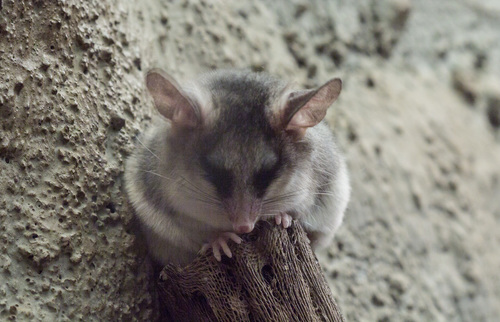
Thylamys
Thylamys is a genus of opossums in the family Didelphidae. The premaxillae are rounded rather than pointed. The females lack a pouch. The females' nipples are arranged in two symmetrical rows on the abdomen. All species but T. macrurus store fat in their tails, although this is not necessarily true for all species in the genus. Fossils belonging to the genus date back to the Miocene, with the oldest specimens being found in the Cerro Azul Formation of Argentina and the Honda Group of Colombia. Genetic studies indicate that the genus may have originated around 14 million years ago.

Purussaurus
Purussaurus is a genus of extinct giant caimans that lived in the Americas during the Miocene epoch, from the Friasian to the Huayquerian in the SALMA classification. It is known from skull material found in the Brazilian and Peruvian Amazon, Argentina, Colombian Villavieja Formation, Panamanian Culebra Formation, Urumaco, and Socorro Formations of northern Venezuela.

Kelenken
Kelenken is a genus of phorusrhacid ("terror bird"), an extinct group of large, predatory birds, which lived in what is now Argentina in the middle Miocene about 15 million years ago. The only known specimen was discovered by high school student Guillermo Aguirre-Zabala in Comallo, in the region of Patagonia, and was made the holotype of the new genus and species Kelenken guillermoi in 2007. The genus name references a spirit in Tehuelche mythology, and the specific name honors the discoverer. The holotype consists of one of the most complete skulls known of a large phorusrhacid, as well as a

Brontornis
Brontornis is an extinct genus of giant bird that inhabited Argentina during the Early to Middle Miocene. Its taxonomic position is highly controversial, with authors alternatively considering it to be a cariamiform, typically a phorusrhacid (terror bird) or an anserimorph.

Astrapotherium
Astrapotherium ("lightning beast") is an extinct genus of large astrapotherian ungulate native to South America during the early-middle Miocene. It is the best known member of the group. The type species. A. magnum have been found in the Santa Cruz Formation in Argentina. Other fossils have been found in the Deseado, Sarmiento, and Aisol Formations of Argentina and Chile (Cura-Mallín Group).

Peltephilus
thumb|Skull of P. ferox
Peltephilus, the horned armadillo, is an extinct genus of armadillo xenarthran mammals that first inhabited Argentina during the Oligocene epoch, and became extinct in the Miocene epoch. Notably, the scutes on its head were so developed that they formed horns. Aside from the horned gophers of North America, it is the only known fossorial horned mammal.

Gryposuchus
Gryposuchus (meaning "hooked crocodile") is an extinct genus of gavialid crocodilian. Fossils have been found from Argentina, Colombia, Venezuela, Brazil and the Peruvian Amazon. The genus existed during the Miocene epoch (Colhuehuapian to Huayquerian). One recently described species, G. croizati, grew to an estimated length of . Gryposuchus is the type genus of the subfamily Gryposuchinae, although a 2018 study indicates that Gryposuchinae and Gryposuchus might be paraphyletic and rather an evolutionary grade towards the gharial.

Hapalops
thumb|left|Life restoration of Hapalops longiceps and Propalaehoplophorus australis
thumb|left|Skeleton

Adinotherium
Adinotherium (meaning "not terrible beast") is an extinct genus of toxodontid, large bodied hoofed ungulates which inhabited South America during the Middle to Late Miocene, from 17.5 to 6.8 Ma and existed for approximately , Santacrucian to Huayquerian in the South American land mammal ages (SALMA). Fossils of Adinotherium have been found in the Santa Cruz and Ituzaingó Formations of Argentina and the Chucal and Río Frías Formations of Chile.

Barinasuchus
Barinasuchus (meaning "Barinas crocodile", in reference to where the type material was found) is an extinct genus of sebecid mesoeucrocodylian. It lived in Argentina, Peru, and Venezuela between the middle Eocene and the Late Miocene, ~42–11.6 Ma. Described in 2007, based on a severely damaged specimen from which only a snout tip was recovered, Barinasuchus is known from a single species, B. arveloi, named after Alberto Arvelo Torrealba, a local educator and poet.

Theosodon
Theosodon is an extinct genus of litoptern mammal from the Early to Middle Miocene of South America.

Diadiaphorus
Diadiaphorus is an extinct genus of litoptern mammal from the Miocene of Argentina (Ituzaingó, Pinturas, Chiquimil and Santa Cruz Formations) and Bolivia (Nazareno Formation), South America.

Protypotherium
Protypotherium is an extinct genus of notoungulate mammals native to South America during the Oligocene and Miocene epochs. A number of closely related animals date back further, to the Eocene. Fossils of Protypotherium have been found in the Deseadan Fray Bentos Formation of Uruguay, Muyu Huasi and Nazareno Formations of Bolivia, Cura-Mallín and Río Frías Formations of Chile, and Santa Cruz, Salicas, Ituzaingó, Aisol, Cerro Azul, Cerro Bandera, Cerro Boleadoras, Chichinales, Sarmiento and Collón Curá Formations of Argentina.

Lycopsis
Lycopsis is an extinct genus of South American metatherian that lived during the Miocene in Argentina and Colombia.

Mourasuchus
Mourasuchus is an extinct genus of giant, aberrant caiman from the Miocene of South America. Its skull has been described as duck-like, being broad, flat, and very elongate, superficially resembling Stomatosuchus from the Late Cretaceous.
Parapropalaehoplophorus septentrionalis
Parapropalaehoplophorus is an extinct genus of comparatively small (compared to Glyptodon) species of glyptodont, extinct relatives of the modern armadillo. The sole species, P. septentrionalis, identified in 2007 from the fossilized remains of a specimen found in 2004, weighed approximately 200 pounds and had a shell covered by tiny circular bumps. It lumbered around northern Chile in the Chucal Formation, an area now dominated by the Andes mountain range, some 18 million years ago. Fossils of the glyptodont also have been found in Peru (Ipururo and Pebas Formations).
Patagornis
Patagornis is a genus of extinct flightless predatory birds of the family Phorusrhacidae. Known as "terror birds", these lived in what is now Argentina during the Early and Middle Miocene; the Santa Cruz Formation in Patagonia contains numerous specimens. Patagornis was an agile, medium sized Patagornithine and was likely a pursuit predator.
Homunculus
genus of mammals
Interatherium
Interatherium is an extinct genus of interatheriid notoungulate that lived from the Early to Middle Miocene (Colhuehuapian-Mayoan). Fossils of this genus have been found in the Santa Cruz, Collón Curá and Sarmiento Formations in Argentina.
Paraptenodytes
Paraptenodytes is an extinct genus of penguins which contains two or three species sized between a Magellanic penguin and an emperor penguin (Aptenodytes forsteri). They are known from fossil bones ranging from a partial skeleton and some additional material in the case of P. antarcticus, the type specimen for the genus, and a single humerus in the case of P. brodkorbi. The latter species is therefore often considered invalid; a recent study considers it indeed valid, but distinct enough not to belong into Paraptenodytes. The fossils were found in the Santa Cruz and Chubut Provinces of Patagon
Protamandua
Protamandua is an extinct genus of anteaters. Its closest living relatives are the giant anteater (Myrmecophaga tridactyla) and tamanduas (genus Tamandua). Fossils of Protamandua are restricted to the Santa Cruz Formation of Argentina. It may have been a common ancestor of Myrmecophaga and Tamandua.
Huilatherium
Huilatherium is an extinct genus of leontiniid, a group of hoofed mammals belonging to the order Notoungulata, that comprises other South American ungulate families that evolved in parallel with some mammals of the Northern hemisphere. The leontiinids were a family of herbivorous species comprising medium to large browsers, with relatively short skulls and robust limbs, somewhat similar to their relatives, the best known toxodontids.
Hegetotherium
Hegetotherium is a small to middle-sized extinct genus of mammals, ranging from the size of rabbit (about 20-30 cm/12-16") to a beaver (about 3 ft/1 m) from the Early to Middle Miocene (Colhuehuapian-Colloncuran in the SALMA classification), through Pliocene sites of South America. Fossils of this genus have been found in the Cerro Bandera, Cerro Boleadoras, Chichinales, Collón Curá, Santa Cruz and Sarmiento Formations of Argentina, the Nazareno Formation of Bolivia, and the Galera and Río Frías Formations of Chile.
Xenastrapotherium
alt=Reconstruction of the astrapothere Xenastrapotherium christi. Artwork created with graphite and colored pencils. Author: Edwin Chávez "Disfrasaurio".|thumb|Paleoart of Xenastrapotherium christi. Artwork by Edwin Chávez "Disfrasaurio".
Xenastrapotherium is an extinct genus of astrapothere, a type of hoofed herbivorous mammal, native to South America, which lived in the Middle to Late Miocene period, typically during the Laventan stage. It is a member of the family Astrapotheriidae in the subfamily Uruguaytheriinae, large astrapotheres, equipped with a trunk-like nose and protruding teeth, s
Patagosmilus
Patagosmilus ("Patagonian knife" in Greek) is an extinct genus of meat-eating metatherian mammal of the family Thylacosmilidae, that lived in the Middle Miocene in South America. Like other representatives of this family, such as Thylacosmilus atrox and Anachlysictis gracilis, it was characterized by its elongated fangs of the upper jaw, similar to the well known "sabertooth cats" (Machairodontinae), of which they were ecological equivalents. Despite being geologically younger than Anachlysictis, the morphology of Patagosmilus (including a bowed molar row and extremely long, "saber-like" upper
Tetramerorhinus
Tetramerorhinus is an extinct genus of proterotheriid litoptern that lived during the Early and Middle Miocene in what is now Argentina and Peru.
Liptornis
Liptornis is an extinct genus of fossil birds of uncertain affinities. The type species is L. hesternus. It was described by Argentine palaeontologist Florentino Ameghino in 1894 from a large cervical vertebra from the Middle Miocene Santa Cruz Formation of Patagonia. At the time, it was referred to the Pelecanidae, though this is questionable. In his 1933 palaeornithological review, Lambrecht referred it only to the superfamily Sulides without placing it in a family. A later study has suggested family Anhingidae.
Prepotherium
Prepotherium is an extinct genus of megatheriid ground sloths that lived during the Miocene period. Fossils of Prepotherium have been found in the Collón Curá and Santa Cruz Formations of Argentina.
Neoepiblemidae
The Neoepiblemidae are an extinct family of hystricognath rodents from South America. The genera Dabbenea and Perumys are now included in Phoberomys. The delineation between Neoepiblemidae and Dinomyidae has historically been unclear, with some genera (such as Phoberomys and Eusigmomys) having varying taxonomic placement. A 2017 study found Phoberomys to be part of the group, while Eusigmomys was found to be part of the Dinomyidae.
Pebas Formation
geological formation in Colombia
Opisthodactylus
Opisthodactylus is an extinct genus of rheiform bird from the Early to Middle Miocene Santa Cruz and Chichinales Formations and the Late Miocene (Montehermosan) Andalhuala Formation of Argentina. Three species are described: the type species, O. patagonicus, O. kirchneri and O. horacioperezi. The species O. kirchneri was described in 2017 by Noriega et al. Fossils of O. horacioperezi were found together with fossils of Patagorhacos terrificus.