Category
page 1Commelinid families

Arecaceae
The Arecaceae () are a family of perennial, flowering plants in the monocot order Arecales. Their growth form can be climbers, shrubs, tree-like and stemless plants, all commonly known as palms. Those having a tree-like form are colloquially called palm trees. Currently, 181 genera with around 2,600 species are known, most of which are restricted to tropical and subtropical climates. Most palms are distinguished by their large, compound, evergreen leaves, known as fronds, arranged at the top of an unbranched stem, except for the Hyphaene genus, which has branched palms. However, palms exhibit

Zingiberaceae
Zingiberaceae, the ginger family, is a family of flowering plants containing 58 genera and about 1600 described species distributed globally in the tropics and subtropics. They are aromatic perennial herbs with creeping rhizomes, sometimes tuberous. Basal leaf sheathing forms a pseudostem taller than their true stems which emerge unbranched. Flowers are typically zygomorphic (bilaterally symmetrical) and inflorescence is raceme. Fruit is typically a dry capsule and seeds are arillate.

Musaceae
Musaceae is a family of flowering plants composed of three genera with about 91 known species, placed in the order Zingiberales. The family is native to the tropics of Africa and Asia. The plants have a large herbaceous growth habit with leaves with overlapping basal sheaths that form a pseudostem making some members appear to be woody trees. In most treatments, the family has three genera, Musa, Musella and Ensete. Cultivated bananas are commercially important members of the family, and many others are grown as ornamental plants.

Commelinaceae
Commelinaceae is a family of flowering plants. In less formal contexts, the group is referred to as the dayflower family or spiderwort family. It is one of five families in the order Commelinales and by far the largest of these with about 731 known species in 41 genera. Well known genera include Commelina (dayflowers) and Tradescantia (spiderworts). The family is diverse in both the Old World tropics and the New World tropics, with some genera present in both. The variation in morphology, especially that of the flower and inflorescence, is considered to be exceptionally high amongst the angios
.jpg)
Strelitziaceae
The Strelitziaceae are a family of monocotyledonous flowering plants, very similar in appearance and growth habit to members of the related families Heliconiaceae and Musaceae (banana family). The three genera with seven species of Strelitziaceae have been included in Musaceae in some classifications, but are generally recognized as a separate family in more recent treatments such as the APG II system (2003). The APG II system assigns the Strelitziaceae to the order Zingiberales in the commelinid clade.

Marantaceae
The Marantaceae are a family, the arrowroot family, or the prayer plant family, of flowering plants consisting of 28 genera and around 530 species, defining it as one of the most species-rich families in its order. Species of this family are found in lowland tropical forests of Africa, Asia, and the Americas. The majority (80%) of the species are found in the American tropics, followed by Asian (11%) and African (9%) tropics. They are commonly called the prayer-plant family and are also known for their unique secondary pollination presentation.

Pontederiaceae
Pontederiaceae is a family of flowering plants.
thumb|Pontederia plantaginea in [[Kerala]]

Costaceae
Costaceae, known as the Costus family or spiral gingers, is a family of pantropical monocots. It belongs to the order Zingiberales, which contains horticulturally and economically important plants such as the banana (Musaceae), bird-of-paradise (Strelitziaceae), and edible ginger (Zingiberaceae). The seven genera in Costaceae together contain about 143 known species (1 in Monocostus, 2 in Dimerocostus, 16 in Tapeinochilos, 2 in Paracostus, 8 in Chamaecostus, c. 5 in Hellenia, and c. 80 in Costus). They are native to tropical climates of Asia, Africa, Central America, and South America. Several
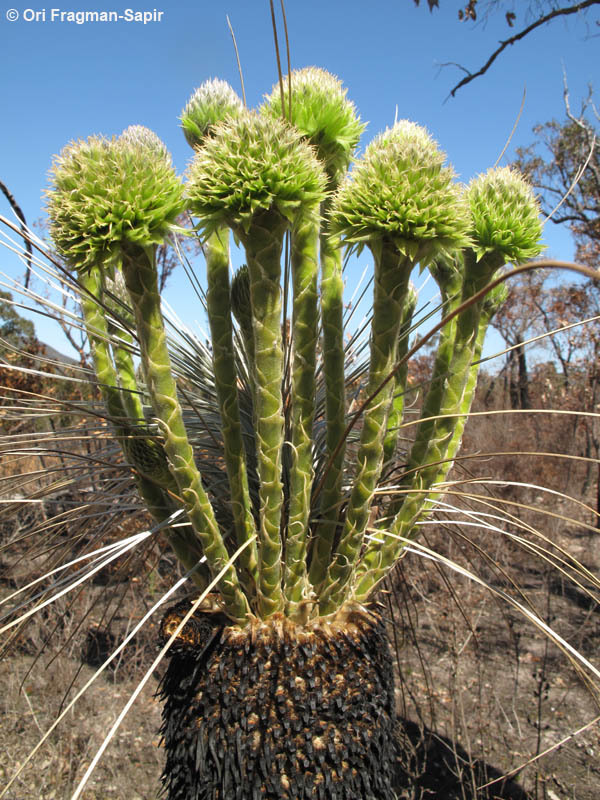
Dasypogonaceae
Dasypogonaceae is a family of flowering plants based on the type genus Dasypogon, one that has traditionally not been commonly recognized by taxonomists; the plants it contains were usually included in the family Xanthorrhoeaceae. If valid, Dasypogonaceae includes four genera with 16 species. The family is endemic to Australia. The best known representative is Kingia australis.

Haemodoraceae
thumb|upright|Anigozanthos Bush Pearl. [[Royal Botanic Gardens, Cranbourne.]]

Philydraceae
Philydraceae is a family of flowering plants composed of three genera and a total of six known species.
Cannaceae
REDIRECT Canna (plant)
Heliconiaceae
REDIRECT Heliconia