Category
page 1Comparison sorts

quicksort
Quicksort is an efficient, general-purpose sorting algorithm. Quicksort was developed by British computer scientist Tony Hoare in 1959 and published in 1961. It is still a commonly used algorithm for sorting. Overall, it is slightly faster than merge sort and heapsort for randomized data, particularly on larger distributions.

bubble sort
simple sorting algorithm
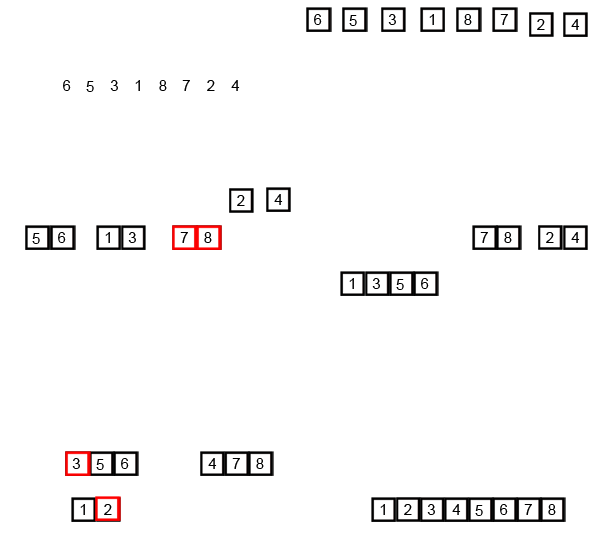
merge sort
worst-case optimal stable divide and conquer comparison sorting algorithm
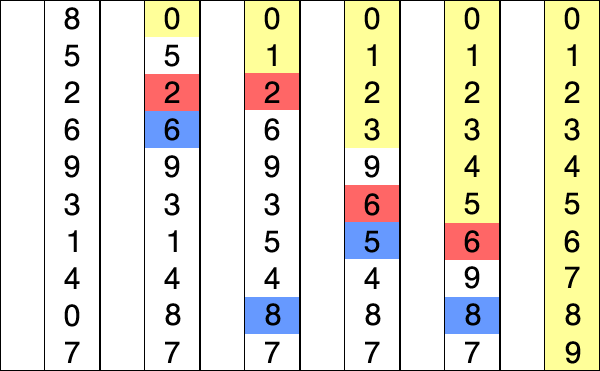
selection sort
sorting algorithm
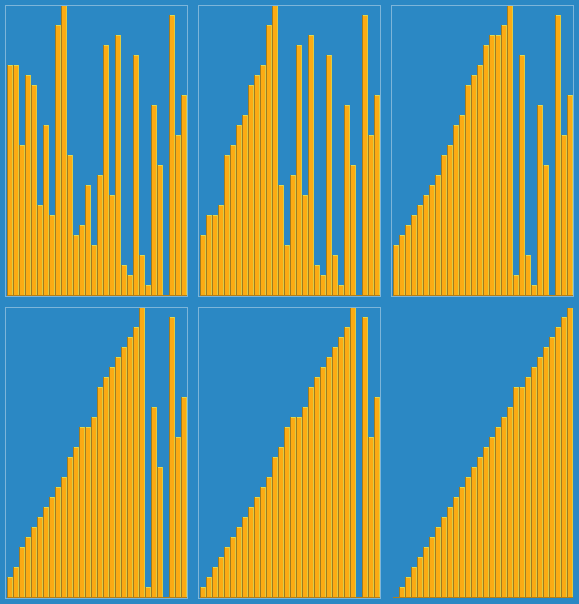
insertion sort
sorting algorithm that, at each iteration, inserts the current input element into the suitable position between the already sorted elements

heapsort
In computer science, heapsort is an efficient, comparison-based sorting algorithm that reorganizes an input array into a heap (a data structure where each node is greater than its children) and then repeatedly removes the largest node from that heap, placing it at the end of the array in a similar manner to Selection sort.

shellsort
thumb|alt=The steps of Shellsort.|Swapping pairs of items in successive steps of Shellsort with gaps 5, 3, 1
Shellsort, also known as Shell sort or '''Shell's method''', is an in-place comparison sort. It can be understood as either a generalization of sorting by exchange (bubble sort) or sorting by insertion (insertion sort). The method starts by sorting pairs of elements far apart from each other, then progressively reducing the gap between elements to be compared. By starting with far-apart elements, it can move some out-of-place elements into the position faster than a simple nearest-neigh

bogosort
In computer science, bogosort (also known as permutation sort and stupid sort) is a sorting algorithm based on the generate and test paradigm. The function successively generates permutations of its input until it finds one that is sorted. It is not considered useful for sorting, but may be used for educational purposes, to contrast it with more efficient algorithms. The algorithm's name is a portmanteau of the words bogus and sort.
cocktail shaker sort
sorting algorithm
comb sort
sorting algorithm
gnome sort
sorting algorithm
odd–even sort
sorting algorithm that repeatedly compares all odd/even indexed pairs of adjacent elements in the list, swapping misordered pairs
stooge sort
an inefficient recursive sorting algorithm
introsort
Introsort or introspective sort is a hybrid sorting algorithm that provides both fast average performance and (asymptotically) optimal worst-case performance. It begins with quicksort, it switches to heapsort when the recursion depth exceeds a level based on (the logarithm of) the number of elements being sorted and it switches to insertion sort when the number of elements is below some threshold. This combines the good parts of the three algorithms, with practical performance comparable to quicksort on typical data sets and worst-case O(n log n) runtime due to the heap sort. Since the three a

Timsort
Timsort is a hybrid, stable sorting algorithm, derived from merge sort and insertion sort, designed to perform well on many kinds of real-world data. It was implemented by Tim Peters in 2002 for use in the Python programming language. The algorithm finds subsequences of the data that are already ordered (runs) and uses them to sort the remainder more efficiently. This is done by merging runs until certain criteria are fulfilled. Timsort was Python's standard sorting algorithm from version 2.3 until it was replaced in 3.11 by Powersort, a derived algorithm with a more robust merge policy. Timso
comparison sort
type of sorting algorithm that works by comparing pairs of elements
library sort
sorting algorithm

smoothsort
In computer science, smoothsort is a comparison-based sorting algorithm. A variant of heapsort, it was invented and published by Edsger Dijkstra in 1981. Like heapsort, smoothsort is an in-place algorithm with an upper bound of operations (see big O notation). Like heapsort, smoothsort is not a stable sort. The advantage of smoothsort is that it comes closer to time if the input is already sorted to some degree, whereas heapsort averages regardless of the initial sorted state.
patience sorting
sorting algorithm
cycle sort
in-place, unstable sorting algorithm