Category
page 1Computer hardware standards
MIDI
thumb|Example of music created in MIDI format
thumb|alt=Several rack-mounted synthesizers that share a single controller|Using MIDI, a single controller (often a musical keyboard, as pictured here) can play multiple electronic instruments, which increases the portability and flexibility of stage setups. This system fits into a single rack case, but before MIDI, it would have required four separate full-size keyboard instruments, plus outboard mixing and effects units.
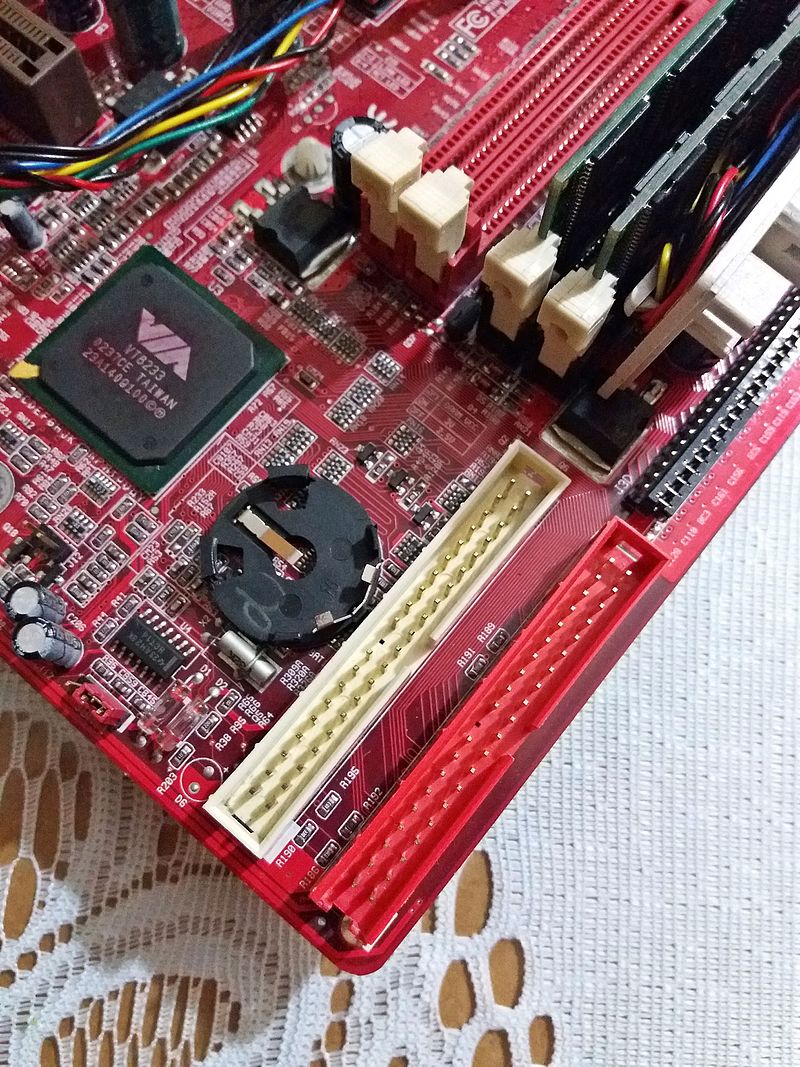
Parallel ATA
interface standard for the connection of storage devices
Industry Standard Architecture
16-bit internal bus of the IBM PC/AT

RS-232
thumb|A DB-25 connector as described in the RS-232 standard

S/PDIF
thumb|S/PDIF and TOSLINK connectors on a piece of audio equipment
Serial Peripheral Interface
synchronous serial communication interface
PS/2 connector
interface for connecting computer peripherals
NVM Express
logical interface for accessing non-volatile storage over the PCIe bus

Advanced Configuration and Power Interface
Advanced Configuration and Power Interface (ACPI) is an open standard that operating systems can use to discover and configure computer hardware components, to perform power management (e.g. putting unused hardware components to sleep), auto configuration (e.g. plug and play and hot swapping), and status monitoring. It was first released in December 1996. ACPI aims to replace Advanced Power Management (APM), the MultiProcessor Specification, and the Plug and Play BIOS (PnP) Specification. ACPI brings power management under the control of the operating system, as opposed to the previous BIOS-ce
Extended Industry Standard Architecture
bus standard for IBM PC compatible computers
Trusted Platform Module
international standard for a secure cryptoprocessor, a dedicated microcontroller designed to secure hardware through integrated cryptographic keys
System Management Bus
single-ended simple two-wire bus for the purpose of lightweight communication
80 Plus
voluntary certification program intended to promote efficient energy use in computer power supply units
AC'97
'''AC'97' (Audio Codec '97; also 'MC'97' for Modem Codec '97'') is an audio codec standard developed by Intel Architecture Labs and various codec manufacturers in 1997. The standard was used in motherboards, modems, and sound cards.
Intel High Definition Audio
specification for the audio sub-system of personal computers
Intelligent Platform Management Interface
interface standard
Low Pin Count
computer bus to connect low-bandwidth devices to the CPU

MADI
thumb|MADI interface-box (RME MADIface) equipping both optical and coaxial interfaces, each can handle 64ch digital audio per link.

MPU-401
thumb|350px|Roland MPU-401 (top-cover removed).
audio/video connector
electrical or optical connectors for carrying audio and video signals
System Management BIOS
computing specification
list of interface bit rates
Wikimedia list article
COM Express
computer-on-module form factor
Advanced RISC Computing
Computing standard based on MIPS architecture
ETX
Embedded Technology eXtended computer-on-module specification
Qseven
thumb|Qseven module VIA QSM-8Q90 with VIA Nano U3500
thumb| Wseven module iWave iW-RainbowW-G20M with Renesas RZ/G1M ([[ARM Cortex-A15)]]
Qseven, a computer-on-module (COM) form factor, is a small, highly integrated computer module that can be used in a design application much like an integrated circuit component. It is smaller than other computer-on-module standards such as COM Express, ETX or XTX and is limited to very low power consuming CPUs. The maximum power consumption should be no more than 12 watts.
OMA Device Management
Protocol specified by the Open Mobile Alliance