Category
page 1Concepts in stellar astronomy

star formation
process by which dense regions within molecular clouds in interstellar space, sometimes referred to as "stellar nurseries" or "star-forming regions", collapse and form stars
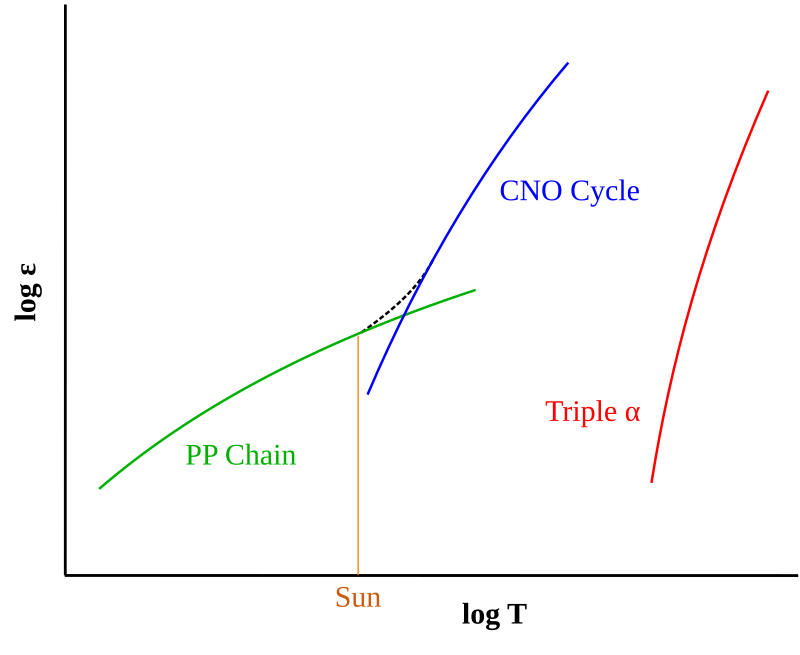
stellar nucleosynthesis
process by which the natural abundances of the chemical elements within stars change due to nuclear fusion reactions in the cores and their overlying mantles

triple-alpha process
nuclear fusion reaction chain converting helium to carbon
light curve
graph of light intensity of a celestial object or region, as a function of time
astrophysical jet
beam of ionized matter flowing along the axis of a rotating astronomical object
circumstellar disk
torus, pancake or ring-shaped accumulation of matter in orbit around a star
stellar magnetic field
magnetic field generated by the motion of conductive plasma inside a star
stellar rotation
angular motion of a star about its axis

helioseismology
Helioseismology is the study of the structure and dynamics of the Sun through its oscillations. These are principally caused by sound waves that are continuously driven and damped by convection near the Sun's surface. It is similar to geoseismology, or asteroseismology, which are respectively the studies of the Earth or stars through their oscillations. While the Sun's oscillations were first detected in the early 1960s, it was only in the mid-1970s that it was realized that the oscillations propagated throughout the Sun and could allow scientists to study the Sun's deep interior. The term was
horizontal branch
stars powered by helium fusion
stellar kinematics
study of the movement of stars
stellar structure
structure of a star. Stars of different mass, age have varying internal structures. Stellar structure models describe the internal structure of a star in detail,make detailed predictions about the luminosity,the color,the future evolution of the star
red clump
Red Clump Star
stellar collision
coming together of two stars caused by gravity, gravitational radiation, or other mechanisms not well understood

Photoevaporation
Photoevaporation is the process where energetic radiation ionises gas and causes it to disperse away from the ionising source. The term is typically used in an astrophysical context where ultraviolet radiation from hot stars acts on clouds of material such as molecular clouds, protoplanetary disks, or planetary atmospheres.
stellar mass
mass of a star in astronomy
initial mass function
empirical function that describes the initial distribution of masses for a population of stars
stellar dynamics
branch of astrophysics that statistically models the collective movement of stars

rp-process
right|thumb|280px|Nucleosynthesis of proton-rich nuclei by rapid proton capture
The rp-process (rapid proton capture process) consists of consecutive proton captures onto seed nuclei to produce heavier elements. It is a nucleosynthesis process and, along with the s-process and the r-process, may be responsible for the generation of many of the heavy elements present in the universe. However, it is notably different from the other processes mentioned in that it occurs on the proton-rich side of stability as opposed to on the neutron-rich side of stability.
p-process
The term p-process (p for proton) is used in two ways in the scientific literature concerning the astrophysical origin of the elements (nucleosynthesis). Originally it referred to a proton capture process which was proposed to be the source of certain, naturally occurring, neutron-deficient isotopes of the elements from selenium to mercury. These nuclides are called p-nuclei and their origin is still not completely understood. Although it was shown that the originally suggested process cannot produce the p-nuclei, later on the term p-process was sometimes used to generally refer to any nucleos
starspot
Starspots are stellar phenomena, so-named by analogy with sunspots. Spots as small as sunspots have not been detected on other stars, as they would cause undetectably small fluctuations in brightness. The commonly observed starspots are in general much larger than those on the Sun: up to about 30% of the stellar surface may be covered, corresponding to starspots 100 times larger than those on the Sun.
Blazhko effect
variation in period and amplitude in RR Lyrae type variable stars
gravity darkening
astronomical phenomenon where rapidly rotating star has brighter poles and darker equator
stellar mass loss
Physical phenomenon
Hypercompact stellar system
cluster of stars around a supermassive black hole
Schwarzschild criterion
mathematical inequality in astrophysics