Category
page 1Concert band instruments

trumpet
The trumpet is a brass instrument commonly used in classical and jazz ensembles. The trumpet group ranges from the piccolo trumpet—with the highest register in the brass family—to the bass trumpet, pitched one octave below the standard B or C trumpet.

clarinet
The clarinet is a single-reed musical instrument in the woodwind family, with a nearly cylindrical bore and a flared bell.

trombone
The trombone is a musical instrument in the brass family. As with all brass instruments, sound is produced when the player's lips vibrate inside a mouthpiece, causing the air column inside the instrument to vibrate. Nearly all trombones use a telescoping slide mechanism to alter the pitch instead of the valves used by other brass instruments. The valve trombone is an exception, using three valves similar to those on a trumpet, and the superbone has valves and a slide.

oboe
thumbnail|240px|Oboe reeds
The oboe ( ) is a type of double-reed woodwind instrument. Oboes are usually made of wood, but may also be made of synthetic materials, such as plastic, resin, or hybrid composites.

double bass
acoustic stringed instrument of the violin family

xylophone
The xylophone (; ) is a musical instrument in the percussion family that consists of wooden bars struck by mallets. Each bar is an idiophone tuned to a pitch of a musical scale, whether pentatonic or heptatonic in the case of many African and Asian instruments, diatonic in many western children's instruments, or chromatic for orchestral use.

tuba
The tuba (Latin, "trumpet"; ; ) is a large brass instrument in the bass-to-contrabass range with a wide conical bore. It usually has four or five valves, although some models have three and some have six. It first appeared in 1835 in Prussia as the , by adding five valves to a large 12-foot bugle pitched in F. This design provided a fully chromatic contrabass instrument with a deep, full timbre. By the 1850s, Paris instrument designer Adolphe Sax had developed the E and B band tubas with piston valves as part of his saxhorn family, and in the 1870s Václav František Červený in Austria-Hungary d

horn
valved brass instrument with coiled tubing and flared bell

bassoon
The bassoon is a musical instrument in the woodwind family, which plays in the tenor and bass ranges. It is composed of six pieces, and is usually made of wood. It is known for its distinctive tone color, wide range, versatility, and virtuosity. It is a non-transposing instrument and typically its music is written in the bass and tenor clefs, and sometimes in the treble. There are two forms of modern bassoon: the Buffet (or French) and Heckel (or German) systems. It is typically played while sitting using a seat strap, but can be played while standing if the player has a harness to hold the in

tambourine
The tambourine is a musical instrument in the percussion family consisting of a frame, often of wood or plastic, with pairs of small metal jingles, called "zills". Classically the term tambourine denotes an instrument with a drumhead, though some variants may not have a head. Tambourines are often used with regular percussion sets. They can be mounted, for example on a stand as part of a drum kit (and played with drum sticks), or they can be held in the hand and played by tapping, hitting, or shaking the instrument.

timpani
The timpani (; ) or kettledrums (also informally called timps) are musical instruments in the percussion family. A type of drum categorised as a hemispherical drum, they consist of a membrane called a head stretched over a large bowl traditionally made of copper. Thus timpani are an example of kettledrums, also known as vessel drums and semispherical drums, whose body is similar to a section of a sphere whose cut conforms the head. Most modern timpani are pedal timpani and can be tuned quickly and accurately to specific pitches by skilled players through the use of a movable foot-pedal. They a

cymbal
thumb|Characteristic rock hi-hat pattern.
The cymbals (/ˈsɪm.bəl/ ) are common percussion instruments. Often used in pairs, cymbals consist of thin, normally round plates of various copper alloys. The majority of cymbals are of indefinite pitch, although small disc-shaped cymbals based on ancient designs (such as crotales) sound a definite note. Cymbals are used in many ensembles ranging from the orchestra and percussion ensembles to jazz bands, rock bands, and marching bands. Drum kits usually incorporate at least a crash, a ride, or a crash/ride cymbal and a pair of hi-hat cymbals. A player

Gong
thumb|262px|Two men (right) are lifting the gong depicted on the 13th-century temple reliefs at the Candi Induk, Penataran|Panataran temple complex in [[East Java, Indonesia]]
thumb|262px|A gong collection in a gamelan ensemble of instruments – Indonesian Embassy [[Canberra]]

piccolo
The piccolo ( ; ) is a smaller version of the western concert flute and a member of the woodwind family of musical instruments. Sometimes referred to as a "baby flute" or piccolo flute, the modern piccolo has the same type of fingering as the standard transverse flute, but the sound it produces is an octave higher. This has given rise to the name ottavino (), by which the instrument is called in Italian and thus also in scores of Italian composers.
thumb|Early 19th-century French piccolo in D.
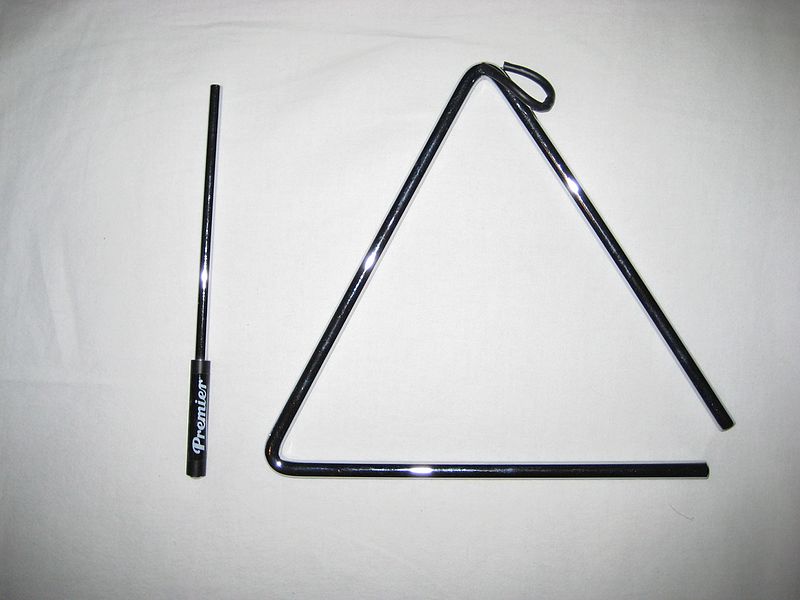
triangle
idiophone type of musical instrument in the percussion family

castanets
thumb|200px| Castanets seller in Granada, [[Spain]]
thumb|198px|Pierre-Auguste Renoir's 1909 painting Dancing girl with castanets
Castanets, also known as clackers or palillos, are a percussion instrument (idiophonic), used in Spanish, Calé, Moorish, Ottoman, Greek, Italian, Mexican, Sephardic, Portuguese, Filipino, Brazilian, and Swiss music. In ancient Greece and ancient Rome there was a similar instrument called the crotalum.

cor anglais
woodwind musical instrument

cornet
The cornet (, ) is a brass instrument similar to the trumpet but distinguished from it by its conical bore, more compact shape, and mellower tone quality. The most common cornet is a transposing instrument in B. There is also a soprano cornet in E and cornets in A and C. All are unrelated to the Renaissance and early Baroque cornett.

snare drum
type of percussion instrument
maraca
A maraca ( , , ), sometimes called shaker or chac-chac, is a rattle which appears in many genres of Caribbean and Latin music. It is shaken by a handle and usually played as part of a pair. A maraca player in the Spanish language is called a .

bass drum
percussion instrument
flugelhorn
The flugelhorn (), also spelled fluegelhorn, flugel horn, or flügelhorn, is a brass instrument that resembles the trumpet and cornet, but has a wider, more conical bore. Like trumpets and cornets, most flugelhorns are pitched in B♭, though some are in C. It is a type of valved bugle, developed in Germany in the early 19th century from a traditional English valveless bugle. The first version of a valved bugle was sold by Heinrich Stölzel in Berlin in 1828. The valved bugle provided Adolphe Sax (creator of the saxophone) with the inspiration for his B♭ soprano (contralto) saxhorns, on which the

euphonium
The euphonium ( ; ; ) is a tenor- and baritone-voiced valved brass instrument pitched in 9-foot (9) B an octave below the B trumpet or cornet, employed chiefly in brass, military, and concert bands. As with any brass instrument, sound is produced with a lip vibration or "buzz" in the mouthpiece. The euphonium is a member of the large family of valved bugles, along with the tuba and flugelhorn, characterized by a wide conical bore. Most instruments have four valves, usually compensating piston valves, although instruments with four or five rotary valves are common in Eastern and Central Europe.

glockenspiel
The glockenspiel ( ; or , : bells and : play) or bells is a percussion instrument consisting of pitched aluminum or steel bars arranged in a keyboard layout. This makes the glockenspiel a type of metallophone, similar to the vibraphone.
ratchet
percussion instrument
alto saxophone
type of saxophone
tubular bell
musical instruments in the percussion family
bass clarinet
bass member of the clarinet family

claves
Claves (; ) are a percussion instrument consisting of a pair of short, wooden sticks about 20–25 centimeters (8–10 inches) long and about 2.5 centimeters (1 inch) in diameter. Although traditionally made of wood (typically rosewood, ebony or grenadilla) many modern manufacturers offer claves made of fiberglass or plastic.
cowbell
musical instrument
güiro
The güiro () is a percussion instrument consisting of an open-ended, hollow gourd with parallel notches cut in one side. It is played by rubbing a stick or tines (see photo) along the notches to produce a zipper-like ratchet sound.
tom-tom drum
common drum, often included in a set
tenor saxophone
type of saxophone
baritone horn
low-pitched brass instrument
Western concert flute
transverse woodwind instrument made of metal or wood
soprano saxophone
the third smallest member of the saxophone family
baritone saxophone
member of the saxophone family, smaller than the bass, contrabass and subcontrabass saxophones
alto horn
brass instrument in the saxhorn family usually pitched in E♭
wood block
musical instrument
alto clarinet
an alto member of the clarinet family that is associated with Western art music and is normally pitched in E♭
temple block
percussion instrument originating in eastern Asia
E♭ clarinet
sopranino member of the clarinet family
bass saxophone
large low-pitched wind instrument
tenor drum
type of drum
clash cymbals
cymbals played in matched pairs
clapper
musical instrument
bass trombone
Low-pitched member of the trombone family of brass musical instruments
contrabass clarinet
contrabass member of the clarinet family
contra-alto clarinet
bass-contrabass member of the clarinet family