Category
page 1Constellations

constellation
A constellation is an area on the celestial sphere in which a group of visible stars forms a perceived pattern or outline, typically representing an animal, mythological subject, or inanimate object.
.png)
zodiac
The zodiac is a belt-shaped region of the sky that extends approximately 8° north and south celestial latitude of the ecliptic – the apparent path of the Sun across the celestial sphere over the course of the year. Within this zodiac belt appear the Moon and the brightest planets, along their orbital planes. The zodiac is divided along the ecliptic into 12 equal parts, called "signs", each occupying 30° of celestial longitude. These signs roughly correspond to the astronomical constellations with the following modern names: Aries, Taurus, Gemini, Cancer, Leo, Virgo, Libra, Scorpio, Sagittarius
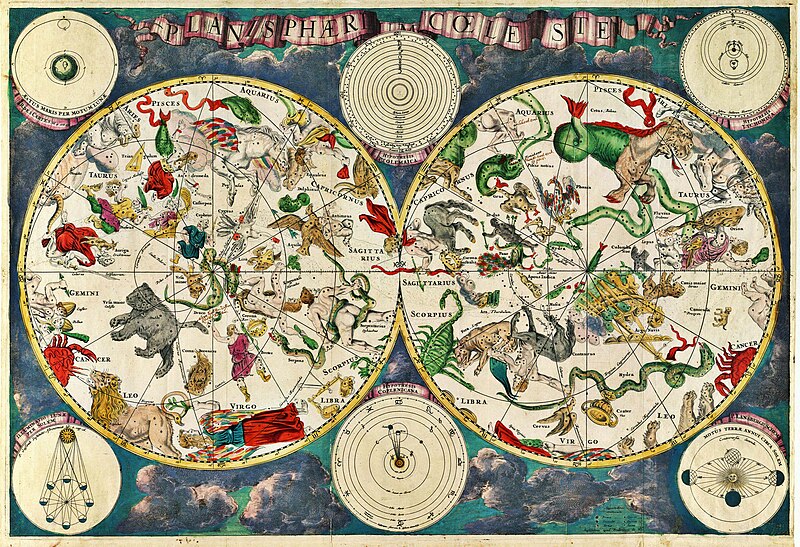
star chart
map of the night sky

list of constellations
Wikimedia list article
list of constellations by area
Wikimedia list article

nakṣatra
Nakshatra () is the term for Lunar mansion in Hindu astrology and Buddhist astrology. A nakshatra is one of the 27 (sometimes also 28) sectors along the ecliptic. Their names are related to a prominent star or asterisms in or near the respective sectors. In essence (in Western astronomical terms), a nakshatra simply is a constellation. Every nakshatra is divided into four padas ( "steps").
lists of stars by constellation
Wikimedia list article
circumpolar constellation
constellation that never set from the viewer's perspective
celestial cartography
part of astronomy concerned with mapping of stars
decans
thumb|upright=1.35|'Diagonal star table' from the late Eleventh Dynasty of Egypt|Eleventh Dynasty coffin lid; found at [[Asyut, Egypt. Roemer- und Pelizaeus-Museum Hildesheim]]
The decans (; ) are 36 groups of stars (small constellations) used in ancient Egyptian astronomy to conveniently divide the 360 degree ecliptic into 36 parts of 10 degrees each, both for theurgical and heliacal chronometrical purposes. The decans each appeared, geocentrically, to rise consecutively on the horizon throughout each daily Earth rotation. The rising of each decan marked the beginning of a new decanal "hour"
constellation family
group of related constellations