Category
page 1Controversial taxa

Xenacoelomorpha
Xenacoelomorpha () is a small phylum of bilaterian invertebrate animals, consisting of two sister groups: acoelomorphs and xenoturbellids. This new phylum was named in February 2011 and suggested based on morphological synapomorphies (physical appearances shared by the animals in the clade), which was then confirmed by phylogenomic analyses of molecular data (similarities in the DNA of the animals within the clade).

Kronosaurus
Kronosaurus ( ) is an extinct genus of large short-necked pliosaur that lived during the Aptian to Albian stages of the Early Cretaceous in what is now Australia. The first known specimen was received in 1899 and consists of a partially preserved mandibular symphysis, which was first thought to come from an ichthyosaur according to Charles De Vis. However, it was in 1924 that Albert Heber Longman formally described this specimen as the holotype of an imposing pliosaurid, to which he gave the scientific name K. queenslandicus, which is still the only recognized species nowadays. The genus name,

Tullimonstrum
Tullimonstrum, colloquially known as the Tully monster or sometimes '''Tully's monster, is an extinct genus of soft-bodied bilaterian marine animal that lived in shallow tropical coastal waters of muddy estuaries during the Pennsylvanian, about 310 million years ago. A single species, T. gregarium', is known. Examples of Tullimonstrum'' have been found only in sediments deposited far from the palaeocoast (formally termed the Essex biota), in the Mazon Creek fossil beds of Illinois, United States. Its classification has been the subject of controversy, and interpretations of the fossil have lik

Protoavis
Protoavis (meaning "first bird") is a problematic taxon known from fragmentary remains from Late Triassic Norian stage deposits near Post, Texas. The animal's true classification has been the subject of much controversy, and there are many different interpretations of what the taxon actually is. When it was first described, the fossils were described as being from a primitive bird which, if the identification is valid, would push back avian origins some 60–75 million years.

Nectocaris
Nectocaris is a genus of squid-like animal known from the Cambrian period. The initial fossils were described from the Burgess Shale of Canada. Other similar remains possibly referrable to the genus are known from the Emu Bay Shale of Australia and Chengjiang Biota of China.
Francevillian biota
possibly earliest multicellular lifeforms
.png)
Amiskwia
Amiskwia is a genus of soft-bodied marine animals known from fossils of the Middle Cambrian Lagerstätten both in the Burgess Shale in British Columbia, Canada and the Maotianshan shales of Yunnan Province, China. It is interpreted as a member of the clade Gnathifera sensu lato or as a basal cucullophoran.
Carangoides ciliarius
species of fish
Myoscolex ateles
Myoscolex is an early animal known from the Cambrian Emu Bay Shale in South Australia. It is of unknown affinity but has been interpreted as an annelid and as an arthropod close to Opabinia. Myoscolex is the earliest known example of phosphotized muscle tissue, and as to which shows distinct annulation.
hypothetical species
Species, generally extinct, described by a scientist with no evidence about its existence
Parioscorpio venator
Parioscorpio is an extinct genus of arthropod containing the species P. venator known from the Silurian-aged Waukesha Biota of the Brandon Bridge Formation near Waukesha, Wisconsin. This animal has gone through a confusing taxonomic history, being called an arachnid, crustacean, and an artiopodan arthropod at various points. This animal is one of the more famous fossil finds from Wisconsin, due to the media coverage it received based on its original description in 2020 as a basal scorpion.
Mojiang henipavirus
species of virus
Xenambulacraria
Xenambulacraria is a proposed clade of animals with bilateral symmetry as an embryo, consisting of the Xenacoelomorpha (i.e., Xenoturbella and acoelomorphs) and the Ambulacraria (i.e., echinoderms and hemichordates).
Horodyskia
Horodyskia is a fossilised organism found in rocks dated from to . Its shape has been described as a "string of beads" connected by a very fine thread. It is considered one of the oldest known eukaryotes.
Onega stepanovi
Cephalonega stepanovi is a fossil organism from Ediacaran deposits of the Arkhangelsk Region, Russia. It was described by Mikhail A. Fedonkin in 1976.
Eiectus
Eiectus is a potentially valid genus of extinct short-necked pliosaur that lived in the Early Cretaceous period. Fossil material has been recovered from the Wallumbilla Formation (Aptian) of Queensland was initially classified under the related genus Kronosaurus until 2021.
Strudiella
Strudiella devonica is a species of extinct arthropod from the Devonian. It was recovered in the Strud (Gesves, Belgium) environment from the Bois des Mouches Formation, Upper Famennian. It was originally described as the first complete Late Devonian terrestrial insect, but due to its poor state of preservation, its affinity is discussed.

Hoan Kiem turtle
controversial species of turtle from Southeast Asia
Rhyniognatha
Rhyniognatha is an extinct genus of arthropod of disputed placement. It has been considered in some analyses as the oldest insect known, as well as possibly being a flying insect. Rhyniognatha is known from a partial head with preserved mouthparts from the Early Devonian aged Rhynie chert around 400 million years ago, when Earth’s first terrestrial ecosystems were being formed. The type, and only species is R. hirsti, which was named and described in 1928. Other analyses have interpreted the specimen as a myriapod.
Volborthella tenuis
Volborthella is an animal of uncertain classification, whose fossils pre-date . It has been considered for a period a cephalopod. However discoveries of more detailed fossils showed that Volborthella’s small, conical shell was not secreted but built from grains of the mineral silicon dioxide (silica), and that it was not divided into a series of compartments by septa as those of fossil shelled cephalopods and the living Nautilus are. This illusion was a result of the laminated texture of the organisms' tests. Therefore, Volborthella's classification is now uncertain. It has been speculated tha
Bakiribu
Bakiribu () is an extinct genus of ctenochasmatid pterosaurs known from the Early Cretaceous (Aptian–Albian age) Romualdo Formation of Brazil. The genus contains a single species, Bakiribu waridza, known from the fragment remains of two individuals preserved in a regurgitalite. This indicates the pair may have been consumed by a spinosaurid theropod dinosaur. It represents the first member of the broader clade Archaeopterodactyloidea described from the Romualdo Formation. Bakiribu has a unique pattern of closely-packed comblike teeth in the upper and lower jaws that may have been used for filt
Typhloesus
Typhloesus wellsi is an extinct species of enigmatic bilaterian animals from the Bear Gulch Limestone, United States. It was once thought to be the first body fossil of a conodont, based on what turned out to be its gut contents; it is now thought to exhibit a radula, which would make it a mollusc, although different types of animal have independently evolved radula-like features. Mark Purnell, of the Centre for Palaeobiology at the University of Leicester, said that it was not definitively known "what this weird thing is".
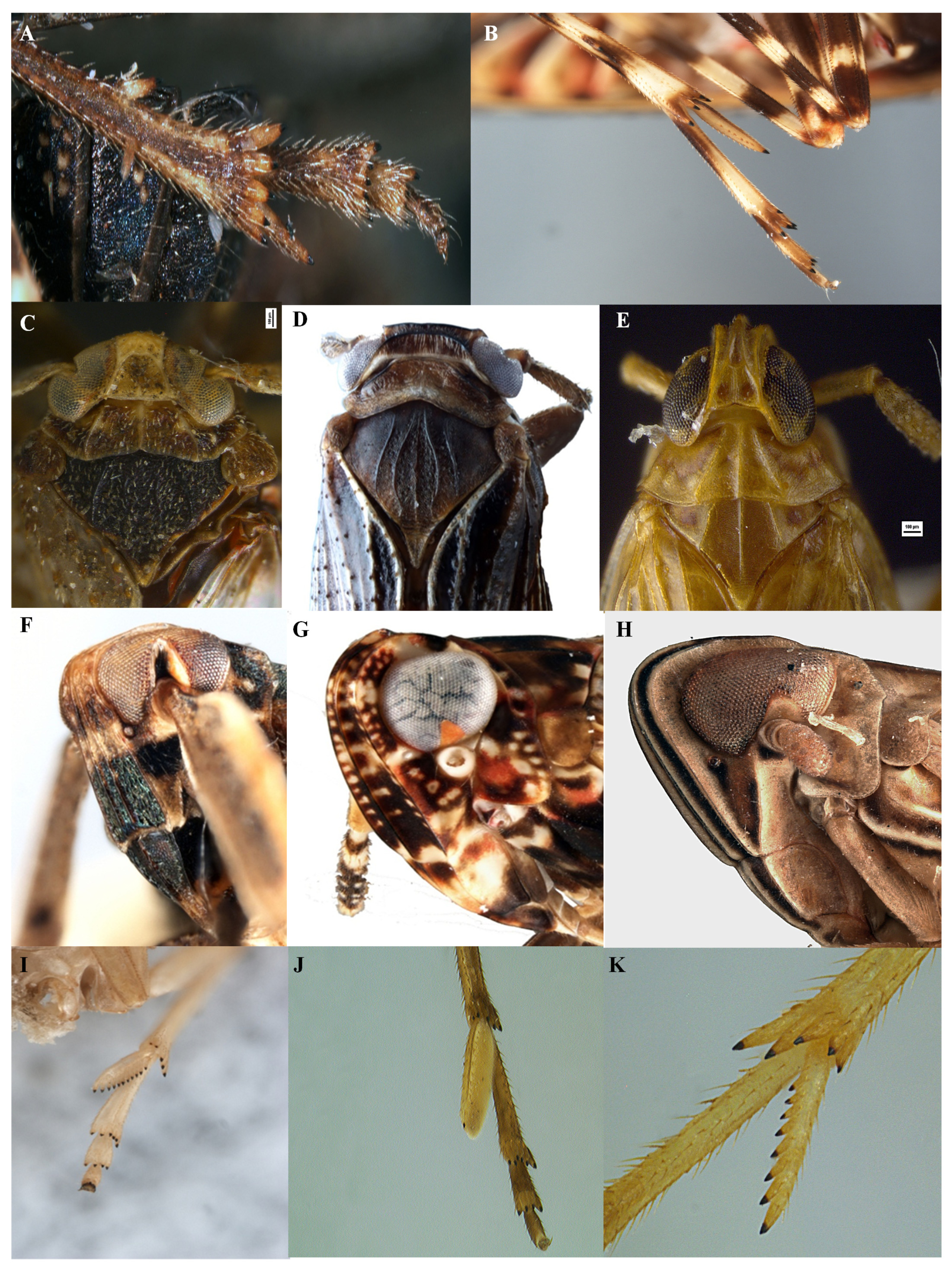
Unkana (Delphacidae)
genus of insects (planthoppers)
Tetraneuralia
Tetraneuralia is a proposed clade of spiralian bilaterians uniting the phyla Mollusca and Entoprocta. belonging to Lophotrochozoa that groups mollusks, entoprocts and the extinct family Cupithecidae. The clade is supported by several morphological similarities between the two and has turned out to be important for evolution of mollusks.