Category
page 1Copepod families

Cyclopidae
Cyclopidae is a family of copepods containing more than half of the 1,200 species in the order Cyclopoida in over 70 genera.
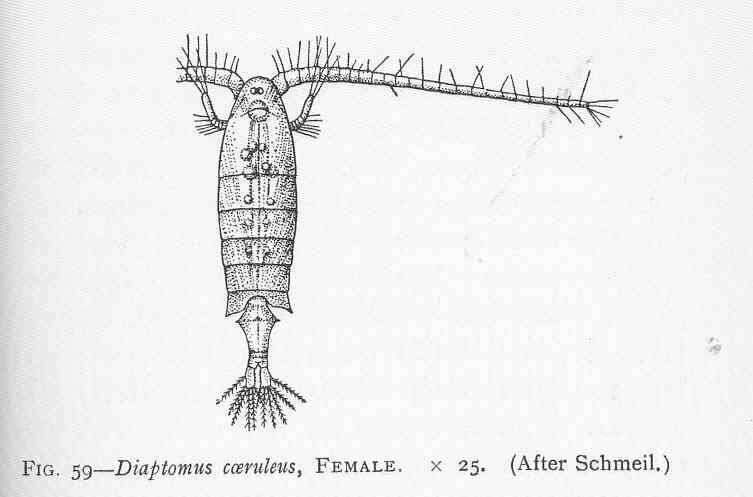
Diaptomidae
Diaptomidae is a family of freshwater pelagic copepods. It includes around 50 genera:
Calanidae
Calanidae is the large family of copepods. It includes the genus Calanus, which may be the most abundant animal genus on Earth.
Centropagidae
Centropagidae is a family of copepods in the order Calanoida. Its members are particularly known as plankton in coastal waters and in fresh water in Australia and southern South America. They are also found on subantarctic islands and in lakes in Antarctica.
Acartiidae
Acartiidae is a family of calanoid copepods distinguishable by the rostral margin not being extended. They are epipelagic, planktonic animals, not being found below a depth of . There are over 100 described species distributed throughout the world's oceans, mainly in temperate areas.
Sphyriidae
Sphyriidae is a family of marine copepods in the order Siphonostomatoida.
Ameiridae
Ameiridae is a family of crustaceans belonging to the order Harpacticoida, first described in 1927 by Albert Monard. The type genus is Ameira Boeck, 1865.
Canthocamptidae
Canthocamptidae is a family of copepods. Most of the 700 species are confined to fresh water, although there are also marine species. It contains the following genera:
Pandaridae
Pandaridae is a family of copepods belonging to the order Siphonostomatoida.
Temoridae
Temoridae is a family of copepods, containing the following genera:
Epischura S. A. Forbes, 1882
Epischurella Smirnov, 1936
Eurytemora Giesbrecht, 1881
Ganchosia Oliveira, 1946
Heterocope G. O. Sars, 1863
Lahmeyeria Oliveira, 1946
Temora Baird, 1850
Lernanthropidae
Lernanthropidae is a family of copepods in the order Siphonostomatoida.
Miraciidae
Miraciidae is a family of copepods in the family Miraciidae.

Clausocalanidae
Clausocalanidae is a family of copepods belonging to the order Calanoida.
Darcythompsoniidae
Darcythompsoniidae is a family of copepods, containing four genera. Members of the family have a very wide distribution throughout the tropics, where they live in rotting mangrove leaves. They lack egg sacs and are thought to lay their eggs directly into the leaf litter.
Paracalanidae
Paracalanidae is a family of calanoid copepods, consisting of the following genera:
Acrocalanus Giesbrecht, 1888
Calocalanus Giesbrecht, 1888
Bestiolina Andronov, 1991
Delibus Vives & Shmelava, 2007
Paracalanus Boeck, 1865
Parvocalanus Andronov, 1970
Pseudoparacalanus Robinson, 1948
Lernaeopodidae
Lernaeopodidae is a family of parasitic copepods. The females are typically large and fleshy, and attach to the host permanently using a plug made of chitin called the bulla. The males cling on to the females using their antennae. They parasitize both marine and freshwater fish. Some lernaeopodids, including Clavella and Salmincola, can have negative impacts on fish in aquaculture.
Harpacticidae
Harpacticidae is a family of copepods, containing the following genera:
Hatschekiidae
Hatschekiidae is a family of copepods in the order Siphonostomatoida.
Canuellidae
Canuellidae is a family of copepods belonging to the order Polyarthra.

Pontellidae
Pontellidae is a family of copepods in the order Calanoida, containing the following genera:
Anomalocera Templeton, 1837
Calanopia Dana, 1852
Epilabidocera C. B. Wilson, 1932
Isocope Brady, 1915
Ivellopsis Claus, 1893
Labidocera Lubbock, 1853
Pontella Dana, 1846
Pontellina Dana, 1852
Pontellopsis Brady, 1883
Misophriidae
Misophriidae is a family of copepods belonging to the order Misophrioida.

Augaptilidae
Augaptilidae is a family of copepods.

Eucalanidae
Eucalanidae is a family of copepods belonging to the order Calanoida.

Ectinosomatidae
Ectinosomatidae is a family of the Harpacticoida, a huge group of crustaceans belonging to the subclass Copepoda. Like most of their relatives, they are usually benthic inhabitants of marine environments. Ectinosomatidae commonly inhabit sediment and fragments of dead corals or glass sponges, and occasionally algae and bryozoans, in the deep oceans. In the epifaunal species, the first leg pair is often modified to allow the animals a better grip on the substrate.
Tegastidae
Tegastidae is a family of copepods, which are characterised by having laterally compressed bodies (resembling that of an amphipod), a claw-like mandible in the nauplius stage, and by a modified male genital complex. Species have been described in seven genera. Two species of Smacigastes are found at hydrothermal vents, while the remaining species are found in shallow water, associated with algae, bryozoans and cnidarians, such as corals.
Phaennidae
Phaennidae is a family of planktonic copepods, found in pelagic or benthopelagic waters. It contains the following genera:
Brachycalanus Farran, 1905
Cephalophanes Sars, 1907
Cornucalanus Wolfenden, 1905
Kirnesius Markhaseva & Semenova, 2005
Onchocalanus Sars, 1905
Phaenna Claus, 1863
Phaennocalanus Markhaseva, 2002
Talacalanus Wolfenden, 1911
Xanthocalanus Giesbrecht, 1892
Pseudocycnidae
Pseudocycnidae is a family of marine copepods in the order Siphonostomatoida.
Kroyeriidae
Kroyeriidae is a family of copepods in the order Siphonostomatoida.
Eudactylinidae
Eudactylinidae is a family of copepods, most of which live as parasites on the gills of elasmobranch fishes; two genera lives on the gills of teleost fishes (Heterocladius and Jusheyus).
Asterocheridae
Asterocheridae is a family of copepods belonging to the order Siphonostomatoida.
Nicothoidae
Nicothoidae is a family of copepods, containing the following genera:
Monstrillidae
Monstrilloida is an order of copepods with a cosmopolitan distribution in the world's oceans. The order contains a single family, Monstrillidae. The name of the first ever described genus Monstrilla is derived from Latin, meaning "tiny monster", because the lack of usual diagnostic features of copepods puzzled early taxonomists.
Artotrogidae
Artotrogidae is a family of copepods in the order Siphonostomatoida.

Metridinidae
Metridinidae is a family of copepods, comprising three genera – Gaussia, Metridia and Pleuromamma. It has also been referred to as "Metridiidae", but following a petition to the International Commission on Zoological Nomenclature, that name has been restricted to the family Metridiidae Carlgren, 1893, based on the anthozoan genus Metridium. All species in the family can produce blue-green bioluminescence; the light is produced in glands, whose position varies between genera.
Parastenocarididae
Parastenocarididae is a family of copepods in the order Harpacticoida adapted to life in groundwater. It contains the following genera:
Phyllodicolidae
Phyllodicolidae is a family of copepods belonging to the order Cyclopoida.
Diaixidae
Diaixidae is a family of copepods belonging to the order Calanoida.
Euchaetidae
Euchaetidae is a family of marine copepods. The family is cosmopolitan and occurs in all the oceans, including the Southern and Arctic Oceans. Euchaetidae are medium to large-sized copepods.

Candaciidae
REDIRECT Candacia
Pennellidae
thumb|Complete life cycle of a pennellid, Peniculus minuticaudae Shiino, 1956 (Copepoda: Siphonostomatoida), infecting cultured threadsail filefish, [[Stephanolepis cirrhifer]]
Pseudodiaptomidae
Pseudodiaptomidae is a family of crustaceans belonging to the order Calanoida.
Mormonillidae
Mormonillidae is a family of planktonic marine copepods, the only member of the order Mormonilloida. There are five known species in two genera:
Mormonilla Giesbrecht, 1891
Mormonilla atlantica Wolfenden, 1905
Mormonilla phasma Giesbrecht, 1891
Neomormonilla Ivanenko & Defaye, 2006
Neomormonilla extremata Ivanenko & Defaye, 2006
Neomormonilla minor (Giesbrecht, 1891)
Neomormonilla polaris (G. O. Sars, 1900)
Longipediidae
Longipediidae is a family of copepods belonging to the order Polyarthra. It contains a single genus.
Platycopiidae
Platycopiidae is a family of copepods. Until the description of Nanocopia in 1988, it contained the single genus Platycopia. It now contains four genera, three of which are monotypic; the exception is Platycopia, with 8 species.