Category
page 1Coptic Orthodox Church

Coptic
latest stage of the Egyptian language
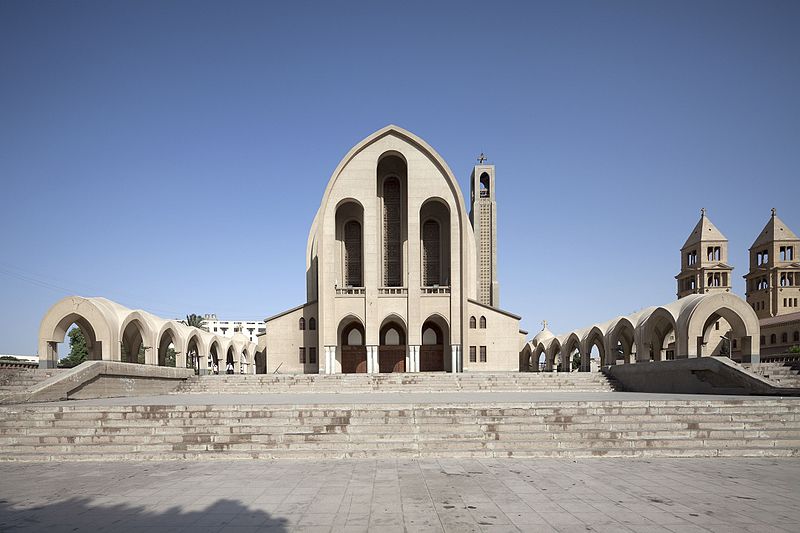
Coptic Orthodox Church
international Oriental Orthodox Christian church led by the Patriarch of Alexandria on the Holy See of St. Mark

Copts
Copts (; ) are a Christian ethnoreligious group native to Egypt who have inhabited the area of modern Egypt since antiquity. They are, like the broader Egyptian population, descended from the ancient Egyptians. Copts predominantly follow the Coptic Orthodox Church, the Alexandrian Greek Orthodox Church and the Coptic Catholic Church. They are the largest Christian population in Egypt and the Middle East, as well as in Sudan and Libya. Copts account for roughly 5 to 15 percent of the population of Egypt.

Coptic script
script used for writing the Coptic language and Nubian languages

Kingdom of Makuria
Makuria (Old Nubian: , Dotawo; ; ) was a medieval Nubian kingdom in what is today northern Sudan and southern Egypt. Its capital was Dongola (Old Nubian: , Touggoul) in the fertile Dongola Reach, about halfway between the 3rd and 4th Nile cataract.

Alodia
Alodia, also known as Alwa (Greek: Ἀρούα, Aroua; , ʿAlwa), was a medieval kingdom in what is now central Sudan. Its capital was the city of Soba, located near modern-day Khartoum at the confluence of the Blue and White Nile rivers.
Coptic calendar
Egyptian liturgical calendar

Nobatia
Nobatia or Nobadia (; Greek: Νοβαδία, Nobadia; Old Nubian: ⲙⲓⲅⲛ̅ Migin or ⲙⲓⲅⲓⲧⲛ︦ ⲅⲟⲩⲗ, Migitin Goul lit. "''of Nobadia's land''") was a late antique kingdom in Lower Nubia, modern day southern Egypt. Together with the two other Coptic-Nubian kingdoms, Makuria and Alodia, it succeeded the kingdom of Kush. After its establishment in around 400, Nobadia gradually expanded by defeating the Blemmyes in the north and incorporating the territory between the second and third Nile cataract in the south. In 543, it converted to Coptic Christianity. It would then be annexed by Makuria, under unknown cir
Patriarch of Alexandria
Archbishop of Alexandria, Egypt; includes the designation "pope"
Coptic art
Christian art of the Byzantine-Greco-Roman Egypt and of Coptic Christian Churches
Catechetical School of Alexandria
Christian seminary, 2nd-4th centuries
Coptic Museum
museum in Coptic Cairo, Egypt
Our Lady of Zeitoun
Marian apparition that occurred in Zeitoun, a district of Cairo, Egypt, beginning 1968
Coptic literature
body of writings in the Coptic language of Egypt
asterisk
liturgical object
Liturgy of Saint Basil
byzantine and Coptic Liturgy
Kingdom of Fazughli
16th to 17th-century East African state
Coptic cross
Christian cross variants associated in some way with Coptic Christians
Bible translations into Coptic
Coptic music
music genre
history of the Patriarchs of Alexandria
historical work of the Coptic Orthodox Church of Alexandria, written in Arabic
Coptic Hospital
hospital in Cairo, Egypt
Coptic history
aspect of the history of Egypt focusing on the history of the Copts
CTV
Egyptian TV channel
Agpeya
thumb|right|200px|Agpeya
The Agpeya (, ) is the Coptic Christian "Prayer Book of the Hours" or breviary, and is equivalent to the Shehimo in the Syriac Orthodox Church (another Oriental Orthodox Christian denomination), as well as the Byzantine Horologion and Roman Liturgy of the Hours used by the Eastern Orthodox Church and Roman Catholic Church, respectively. The Agpeya prayers are popular Christian prayers recited at fixed prayer times, facing the east by both individuals and families at home seven times a day, as well as for communal prayers as an introduction to Mass at church; this Chris
Fast of Nineveh
three-day fast in Syriac Christianity
Nayrouz
Nayrouz (, ) is a feast when martyrs and confessors are commemorated within the Coptic Orthodox Church. Celebrated on September 11, the day is both the start of the Coptic new year and its first month, Thout. Nayrouz is also commemorated by Ethiopian Christians who also call it Enkutatash. Children wear new clothes and give bouquets of flowers to people.
Our Lady of Warraq
believed, by some, to be a mass apparition of the Virgin Mary
Mystery of Crowning
eastern Christian wedding ritual
list of Coptic saints
Wikimedia list article
Ennarea
Ennarea, also known as E(n)narya or In(n)arya (Gonga: Hinnario), was a kingdom in the Gibe region in what is now western Ethiopia. It became independent from the kingdom of Damot in the 14th century and would be the most powerful kingdom in the region until its decline in the 17th century. Being located on the southwestern periphery of the Ethiopian Empire, Ennarea was its tributary throughout much of its history, supplying the emperor with gold and slaves. The culmination of this relationship was the Christianization of the Ennarean elite in the late 1580s. From the late 16th century the king