Category
page 1Cretaceous bony fish
Mawsonia
genus of fishes (fossil)

Protosphyraena
Protosphyraena is a fossil genus of swordfish-like marine fish, that thrived worldwide during the Cretaceous period (Albian-Maastrichtian). Fossil remains of this taxon are mainly discovered in North America and Europe, and potential specimens are also known from Asia, Africa and Australia. Its fossils are best known from the Smoky Hill Member of the Niobrara Formation of Kansas (Late Coniacian-Early Campanian).

Enchodus
Enchodus (from , 'spear' and 'tooth') is an extinct genus of aulopiform ray-finned fish related to lancetfish and lizardfish. Species of Enchodus flourished during the Late Cretaceous, where they were a widespread component of marine ecosystems worldwide, and there is some evidence that they may have survived to the Paleocene or Eocene; however, this may just represent reworked Cretaceous material.

Scheenstia
Scheenstia is an extinct genus of neopterygian ray-finned fish from the Late Jurassic–Early Cretaceous of Europe. Fossils have been found in both marine and freshwater environments.
thumb|left|Life restoration of S. maxima
Most species of the genus were previously referred to the related genus Lepidotes, but most Late Jurassic–Early Cretaceous species of that genus have since been re-classified as Scheenstia following detailed phylogenetic analysis. It is a member of Lepisosteiformes meaning that its closest living relatives are gars. The teeth of Scheenstia are low and rounded, and were likel
Mawsoniidae
Mawsoniidae is an extinct family of prehistoric coelacanth fishes which lived during the Triassic to Cretaceous periods. Members of the family are distinguished from their sister group, the Latimeriidae (which contains the living coelacanths of the genus Latimeria) by the presence of ossified ribs, a coarse rugose texture on the dermatocranium and cheek bones, the absence of the suboperculum and the spiracular, and reduction or loss of the descending process of the supratemporal.
Stratodus
Stratodus ("layer tooth") is a genus of giant prehistoric aulopiform fish found in Cretaceous-aged marine strata of Kansas, Alabama, Morocco, Israel, Niger, South Dakota, and Jordan. It has also been found in the Tamaguélelt Formation of Mali, dating to the Lower Eocene, indicating that Stratodus survived the Cretaceous-Paleogene extinction event. This sleek fish has an upper jaw filled with multiple rows of tiny teeth and was the largest aulopiform, reaching in length.
Megalocoelacanthus
thumb|left|Life restoration
Axelrodichthys
Axelrodichthys is an extinct genus of mawsoniid coelacanth from the Cretaceous of Africa, North and South America, and Europe. Several species are known, the remains of which were discovered in the Lower Cretaceous (Aptian-Albian) of Brazil, North Africa, and possibly Mexico, as well as in the Upper Cretaceous of Morocco (Cenomanian), Madagascar (Coniacian –Santonian) and France (Lower Campanian to Lower Maastrichtian). The Axelrodichthys of the Lower Cretaceous frequented both brackish and coastal marine waters (lagoon-coastal environment) while the most recent species lived exclusively in fr
Armigatus
Armigatus is an extinct genus of marine clupeomorph fishes belonging to the order Ellimmichthyiformes. These fishes lived in the Cretaceous (Albian to Campanian, about 103-72 million years ago); their fossil remains have been found in Mexico, Europe, the Middle East and North Africa, suggesting the genus ranged across the Tethys Sea.
Ferganoceratodus
Ferganoceratodus (from Fergana + Ceratodus) is a genus of prehistoric freshwater lungfish known from worldwide during the Mesozoic. Based on morphological evidence, it has either been recovered as a basal member of the Ceratodontiformes or to be the sister group of the Neoceratodontidae (containing the extant Australian lungfish).
Gwawinapterus
Gwawinapterus beardi is a species of saurodontid ray-finned fish from the Late Cretaceous period of British Columbia, Canada. While initially described as a very late-surviving member of the pterosaur family Istiodactylidae, further examination has cast doubt on the identification of the specimen as a pterosaur, and research published in 2012 identified the remains as having come from a saurodontid fish.
Sinamia
Sinamia is an extinct genus of freshwater amiiform fish which existed in China, Japan, South Korea and North Korea during the Early Cretaceous period. Like the related bowfin, it has an elongated low-running dorsal fin, though this was likely convergently evolved.
Pachyrhizodus
Pachyrhizodus is an extinct genus of ray-finned fish that lived during the Cretaceous to Paleocene in what is now Europe, North America, South America, and Oceania. Many species are known, primarily from the Cretaceous of England and the midwestern United States.
Rhacolepis
Rhacolepis is an extinct genus of ray-finned fish from the Cretaceous Romualdo Formation of Brazil. Complete fossilised hearts from this species have been recovered.thumb|R. buccalis skull|leftleft|thumb|Inside the stomach of a Notelops|Notelops brama.
left|thumb|R. buccalis with several hundred small shrimp in stomach.
thumb|Fossil in Vienna
Amiopsis
Amiopsis is an extinct genus of freshwater and marine ray-finned fish belonging to the family Amiidae, making it closely related to the modern bowfin. Fossils are known from the Late Jurassic Solnhofen Limestone, Germany (A. lepidota), the Early Cretaceous Purbeck Group, England (A. damoni), La Pedrera de Rúbies Formation, Spain (A. woodwardi) and Bernnissant Iguanodon locality, Belgium (A. dolloi) and the Late Cretaceous (Cenomanian) of the Balkans (A. prisca type species). The monophyly of the genus is questionable, due to it being based on a single character, "the presence of three or more
Lycoptera
Lycoptera is an extinct genus of fish that lived from Lower Cretaceous, Barremian to Aptian in present-day China, North Korea, Mongolia and Siberia. Although there is record from Jurassic Formation in Siberia, its age remains questionable. It is known from abundant fossils representing sixteen species, which serve as important index fossil used to date geologic formations in China. Along with the genus Peipiaosteus, Lycoptera has been considered a defining member of the Jehol Biota, a prehistoric ecosystem famous for its feathered dinosaurs, which flourished for 20 million years during the Ear
Belonostomus
Belonostomus (from , 'dart' and 'mouth') is a genus of prehistoric ray-finned fish that was described by Louis Agassiz in 1844. It is a member of the order Aspidorhynchiformes, a group of fish known for their distinctive elongated rostrums.
Rhynchodercetis
Rhynchodercetis (meaning "beaked throat whale") is a genus of prehistoric ray-finned fishes.
Araripichthys
Araripichthys is an extinct genus of marine ray-finned fish that lived from the Aptian to Coniacian stages of the Cretaceous period. The genus is named after the Araripe Basin, where it was found in the Crato and Santana Formations. Other fossils of the genus have been found at Goulmima in Morocco, the Tlayua Formation of Mexico and the Apón Formation of Venezuela.
Cladocyclus
Cladocyclus (derived from the Greek κλάδος/kládos ("branch") and κύκλος/kýklos ("circle")) is an extinct genus of marine ichthyodectiform ray-finned fish from the middle Cretaceous. It was a predator of about in length.
Peipiaosteus
thumb|left|Peipiaosteus pani fossil
thumb|left|Peipiaosteus pani fossil
thumb|left|Fossil of the Peipiaosteidae|peipiaosteid Yanosteus longidorsalis (at [[MHNT), a close relative of Peipiaosteus]]
Arganodus
Arganodus is an extinct genus of freshwater lungfish that had a wide global distribution throughout much of the Triassic period, with a single species surviving across Gondwana into the Cretaceous. It is the only member of the family Arganodontidae, although it is sometimes placed in the Ceratodontidae or synonymized with the genus Asiatoceratodus.
Trewavasia
Trewavasia carinata is an extinct pycnodontid fish in the family Coccodontidae that lived during the lower Cenomanian of what is now Lebanon. It had a large, forward-pointing horn-like spine between its eyes, and a massive stump-like spine emanating from the back of its head. T. carinata is closely related the genera Corusichthys and Hensodon, as well as Coccodus. It is named after Ethelwynn Trewavas.
thumb|left|Artist's reconstruction
Sorbinichthys
Sorbinichthys is a genus of extinct ray-finned fish from the Cenomanian of Lebanon and Morocco. It is classified within the order Ellimmichthyiformes. Both species within the genus are small (15 cm) and, like other members of their order, have deep bodies. The most notable feature of the genus is the presence of extremely long 2nd fin rays on the dorsal and pectoral fins that are much longer than the other rays on the respective fins. Sorbinichthys is one of the most basal members of the order and, in some analyes, the sister group of the rest of the order. The fish lived in shallow coast
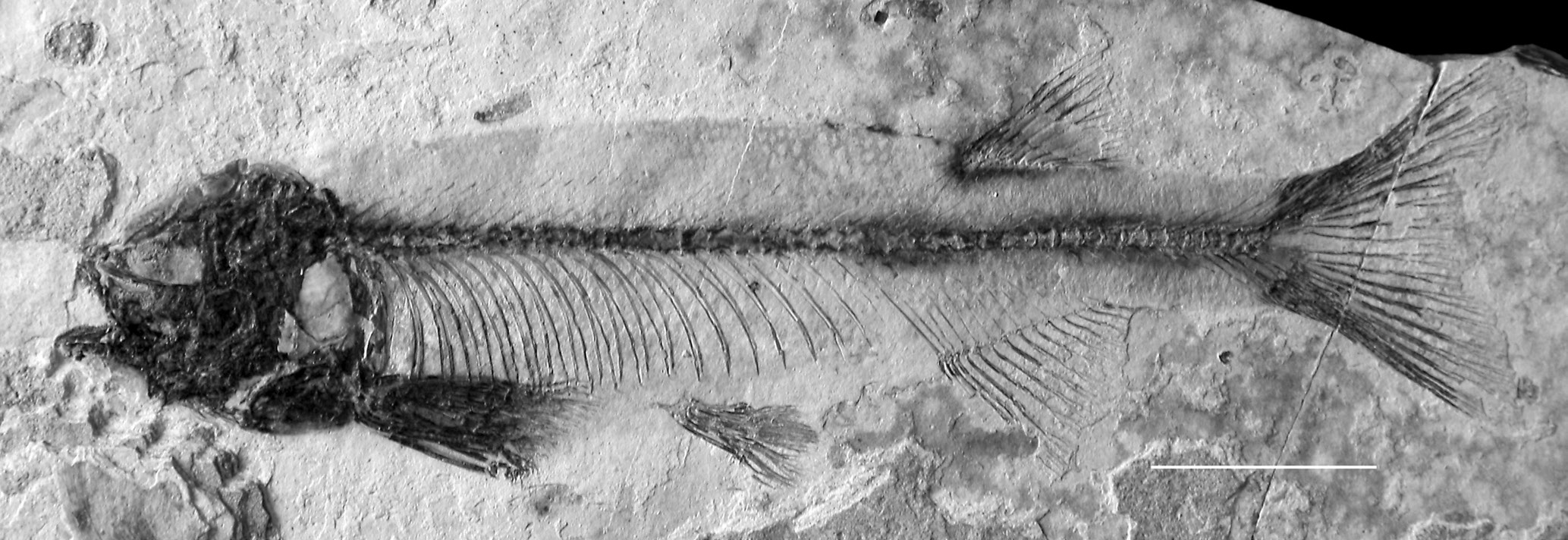
Lycopteridae
Lycopteridae is an extinct family of freshwater osteoglossomorph ray-finned fishes.
Palaeobalistum
Palaeobalistum is an extinct genus of prehistoric ray-finned fish which ranged from the Cretaceous to Eocene periods.
Prionolepis
Prionolepis is a genus of prehistoric ray-finned fish belonging to the order Alepisauriformes.
Chuhsiungichthys
Chuhsiungichthys is an extinct genus of ichthyodectiform ray-finned fish that lived in freshwater environments in what is now Yunnan, China, and Kyushu, Japan during the Cretaceous. It differs from its sister genus, Mesoclupea, primarily by having a comparatively more anteriorly-placed dorsal fin.
Gebrayelichthys
Gebrayelichthys is a genus of pycnodontiform fish of the family Gebrayelichthyidae. It comprises two species, Gebrayelichthys uyenoi and Gebrayelichthys verticalis. Their extremely deep body shape is unique among known fishes, only comparable to some Paleogene tetraodontiformes, and suggests an ostraciiform locomotion.
Gebrayelichthyidae
Gebrayelichthyidae is a family of extinct pycnodontid fish, with a superficially shrimpfish-like appearance that lived during the lower Cenomanian.
Ionoscopus
Ionoscopus is an extinct genus of ray-finned fish.

Coccodontidae
Coccodontidae is a family of extinct pycnodontid fish that lived during the lower Cenomanian. The various genera had massive, curved spines.
Nardovelifer altipinnis
Nardovelifer altipinnis is the oldest known lamprid fish. It dates from the Campanian age of Nardò, Italy.