Category
page 1Cretaceous extinctions
Deinonychosauria
Deinonychosauria is a clade of paravian dinosaurs which lived from the Late Jurassic to the Late Cretaceous periods. Fossils have been found across the globe in North America, Europe, Africa, Asia, South America, and Antarctica, with fossilized teeth giving credence to the possibility that they inhabited Australia as well. This group of dinosaurs are known for their sickle-shaped toe claws and features in the shoulder bones.
Mawsoniidae
Mawsoniidae is an extinct family of prehistoric coelacanth fishes which lived during the Triassic to Cretaceous periods. Members of the family are distinguished from their sister group, the Latimeriidae (which contains the living coelacanths of the genus Latimeria) by the presence of ossified ribs, a coarse rugose texture on the dermatocranium and cheek bones, the absence of the suboperculum and the spiracular, and reduction or loss of the descending process of the supratemporal.
Trematosauria
Trematosauria is one of two major groups of temnospondyl amphibians that survived the Permian-Triassic extinction event, the other (according to Yates and Warren 2000) being the Capitosauria. The trematosaurs were a diverse and important group that included many medium-sized to large forms that were semi-aquatic to fully aquatic. The group included long-snouted forms such as the trematosauroids and short, broad-headed forms such as the metoposaurs. Although most groups did not survive beyond the Triassic, one lineage, the brachyopoids, continued until the Cretaceous period. Trematosauria is de
Paulchoffatiidae
Paulchoffatiidae is a family of extinct mammals that lived predominantly during the Late Jurassic epoch, though a couple of genera are known from the Early Cretaceous. Fossils have been reported from Europe (Portugal, Spain, Germany, and England). Paulchoffatiids were members of the order Multituberculata. They were relatively early representatives and are within the informal suborder of "Plagiaulacida". The family was named by G. Hahn in 1969, and it honors the Portuguese geologist Léon Paul Choffat.
Exogyra
Exogyra is an extinct genus of marine oysters that belongs to the family Gryphaeidae (honeycomb oysters). These bivalves were cemented by the more cupped left valve. The right valve is flatter, and the beak is curved to one side. Exogyra lived on solid substrates in warm seas during the Jurassic and Cretaceous periods.
Zygopteridales
Zygopteridales is an extinct order of ferns or fern-like plants which grew primarily during the Carboniferous. It comprises two families: Zygopteridaceae, which contains at least a dozen named genera, and Teledeaceae, which comprises two genera (Teledea and Senftenbergia). A few other genera are of uncertain placement and are not assigned to any family yet.

Asteracanthus
Asteracanthus (from , 'star' and , 'spine') is an extinct genus of hybodont, known from the Middle Jurassic (Bathonian) to the Early Cretaceous (Valanginian).
Williamsoniaceae
Williamsoniaceae is a family within the Bennettitales, an extinct group of seed plants. Members of this family are believed to have been around two meters tall and with widely serrate leaves along a central stem. Reproductive organs of the Williamsoniaceae have varied widely in the fossil record but almost all have been found to be borne on stalks emerging from a ring of leaves.
thumb|Fossils and schematic diagram of Pterophyllum (plant)|Pterophyllum bavieri from the Late Triassic ([[Rhaetian) of northern Iran, Shemshak Group, A and B: leaves attached to a branch C: complete leaf]]
Caytoniales
The Caytoniales are an extinct order of seed plants known from fossils spanning from the Middle Triassic (Anisian) to the Late Cretaceous (Campanian). They are regarded as "seed ferns" because they are seed-bearing plants with fern-like leaves. Although at one time considered angiosperms because of their berry-like cupules, that hypothesis was later disproven. Nevertheless, many authorities consider them likely ancestors or close relatives of angiosperms. The origin of angiosperms remains unclear, and they cannot be linked with any known seed plants groups with certainty.
Cladophlebis
Cladophlebis is an extinct form genus of fern, which has been reported from the Permian to the end of the Cretaceous and from all continents of the world.
Sphenopteris
Sphenopteris is a genus of seed ferns containing the foliage of various extinct plants, ranging from the Devonian to Late Cretaceous. One species, S. höninghausi, was transferred to the genus Crossotheca in 1911.

Anacoracidae
Anacoracidae is a family of extinct mackerel sharks that lived during the Cretaceous. It includes four valid genera: Nanocorax, Ptychocorax, Scindocorax, and Squalicorax. Two previously-included genera, Galeocorax and Pseudocorax, were reassigned to the family Pseudocoracidae.
Toxasteridae
Toxasteridae is an extinct family of sea urchins.
Cycadeoidaceae
Cycadeoidaceae is a family of bennettitalean plants which flourished in the Mesozoic era. Two genera, Cycadeoidea and Monanthesia, are currently recognised though most species are poorly known. They had a similar morphology to cycads, with thick, branchless trunks covered in scale leaves.
alt=Cycadeoidea_sp|thumb|Cycadeoidea (a member of the Cycadeoidaceae) on display at the [[Naturmuseum Senckenberg]]
Baieroxylon
Baieroxylon is an extinct prehistoric genus of plants belonging to the Ginkgoaceae family during the Triassic, Jurassic, and Cretaceous Periods.
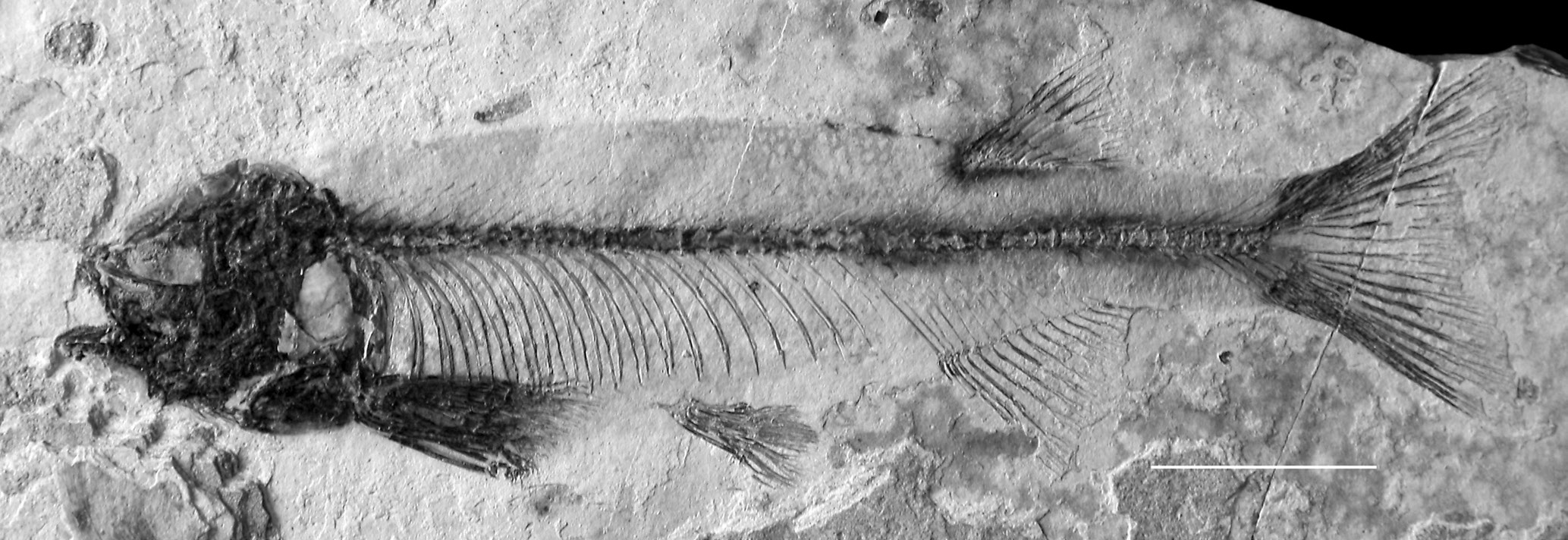
Lycopteridae
Lycopteridae is an extinct family of freshwater osteoglossomorph ray-finned fishes.
Nerinea
Nerinea is an extinct genus of fossil sea snails, marine gastropod molluscs in the clade Heterobranchia.

Palaeoniscidae
225px|thumb|Restoration of Palaeoniscum freieslebeni showing the typical morphology of most taxa that have been referred to Palaeoniscidae
Palaeoniscidae is an extinct family of "palaeoniscoid" ray-finned fishes (Actinopterygii). The family includes the genus Palaeoniscum and potentially other Palaeozoic and Mesozoic early actinopterygian genera. The name is derived from the Ancient Greek words παλαιός (palaiós, ancient) and ὀνίσκος (oniskos, 'cod-fish' or woodlouse).