Category
page 1Cretaceous lizards

Varanoidea
Varanoidea is a superfamily of lizards, including the well-known family Varanidae (the monitors and goannas). Also included in the Varanoidea are the Lanthanotidae (earless monitor lizards), and the extinct Palaeovaranidae.

Oculudentavis
Oculudentavis is an extinct genus of lizard of uncertain taxonomic placement, originally but inaccurately identified as an avialan dinosaur (bird, in the broad sense). It contains two known species, O. khaungraae and O. naga. Each species is known from one partial fossil specimen in Burmese amber, which differ in several proportions. Their skulls measure in length, indicating that Oculudentavis would have been comparable in size with the modern bee hummingbird if it were an avialan. Both specimens were retrieved from 99-million-year-old deposits of the Hukawng Basin in Kachin State, northern M

Xianglong
Xianglong (meaning "flying dragon" in Chinese) is a genus of Cretaceous lizard discovered in the Zhuanchengzi, near Yizhou, Yixian, Liaoning Province of China. It is known from LPM 000666, a single complete skeleton with skin impressions. The specimen comes from the Barremian-aged (Lower Cretaceous) Yixian Formation, near Yizhou. The most notable feature about Xianglong is its bizarre oversized ribs, eight on each side, which were attached to a membrane of body tissue and allowed the lizard to glide, similar to living gliding Draco lizards. While in its original description it was considered t

Tetrapodophis
Tetrapodophis (Greek meaning "four-footed snake") is an extinct genus of lizard from the Early Cretaceous (Aptian) aged Crato Formation of Brazil. It has an elongated snake-like body, with four disproportionately short limbs. The species is known from one fossil specimen.

Aigialosauridae
Aigialosauridae (from Greek, aigialos, meaning "seashore", and sauros, "lizard") is a family of Late Cretaceous semiaquatic pythonomorph lizards closely related to the mosasaurs. Regarded by some paleontologists as a distinct monophyletic group and by others as an adaptive grade within the basal mosasauroids, recent molecular and morphological data suggests that they are the oldest known members of the lineage leading to the mosasaurs.
Yabeinosaurus
left|thumb|IVPP V18005, a specimen preserved with over 15 embryos inside it, Paleozoological Museum of China
Yabeinosaurus is an extinct genus of lizard from the Early Cretaceous Jehol Group of northeastern China. The type species Yabeinosaurus tenuis is known from many well-preserved skeletons belonging to both juvenile and adult individuals. For about 60 years Yabeinosaurus was known only from juvenile specimens, leading scientists to believe that it was a small lizard with weakly developed bones. Because of this, it was thought to be closely related to geckos. Larger specimens can be up to
Adriosaurus
Adriosaurus is an extinct genus of squamate which lived in what is now Slovenia and other parts of Europe during the Late Cretaceous. It was a small, snake-like reptile, with the type species Adriosaurus suessi measuring up to in length. Adriosaurus represents the first occurrence of vestigial limbs in fossil lizards, having lost its manus and forearm completely in order to elongate its axial skeleton. These unique anatomical features led to discussions of the evolutionary patterns of limb reduction in Squamata.
Kaganaias hakusanensis
Kaganaias (meaning 'Kaga water nymph') is an extinct genus of basal and oldest dolichosaur that lived in what is now Japan during the Early Cretaceous. Kaganaias was semi-aquatic and is the only known aquatic squamate from before the Cenomanian stage of the Cretaceous. It is also the first to be found in an inland area, instead of on the coast where aquatic squamates are commonly found. Its generic name is derived from Kaga Province, the old name for the Ishikawa Prefecture where the specimens were found, while the species name hakusanensis comes from the mountain that gives its name to Hakusa
Palaeosaniwa canadensis
Palaeosaniwa is an extinct genus of carnivorous lizard from the Late Cretaceous of North America. The type (and only) species, Palaeosaniwa canadensis, given by Charles Whitney Gilmore in 1928, means "ancient Saniwa from Canada".
Huehuecuetzpalli
Huehuecuetzpalli (translating to "the ancient lizard" in Nahuatl) is an extinct genus of lizard from the Early Cretaceous (late Albian) Tlayúa Formation, a Lagerstätte near Tepexi de Rodríguez, Central Mexico. One species, H. mixtecus, is known. Although it is not the oldest known lizard, Huehuecuetzpalli may be amongst the most basal members of Squamata (the group that includes lizards and snakes), and has been variously considered a close relative of Bavarisaurus, Bellairsia, Marmoretta and Oculudentavis, or as the most basal iguanomorphan. Its basal position makes it an important taxon in u
Dalinghosaurus longidigitus
Dalinghosaurus (often incorrectly spelled "Dalinghesaurus") is an extinct genus of lizards, first described in 1998 by S.A. Ji of the Peking University Department of Geology. The type species is Dalinghosaurus longidigitus. It is known from the Early Cretaceous (Aptian) aged Yixian Formation of Liaoning, China.
Dolichosaurus
Dolichosaurus (meaning "long lizard") is an extinct genus of marine squamate of the Upper Cretaceous Cenomanian chalk deposits of England. It was described and named by Owen in 1850. It is a member of the family Dolichosauridae. It was a small reptile measuring long. It had an elongate neck resulting from an increased number of cervical vertebrae.
Paramacellodus
Paramacellodus is an extinct genus of scincomorph lizards from the Early Cretaceous of England and France, and the Late Jurassic of Portugal and the western United States. The type species, Paramacellodus oweni, was named in 1967 from the earliest Cretaceous (Berriasian) Purbeck Group in Dorset, England. Additional material referable to a species of Paramacellodus, possibly P. oweni, has been described from the Morrison Formation, specifically in Como Bluff, Wyoming, and Dinosaur National Monument, Utah. An indeterminate species is known from the Berriasian aged Angeac-Charente bonebed in Fran
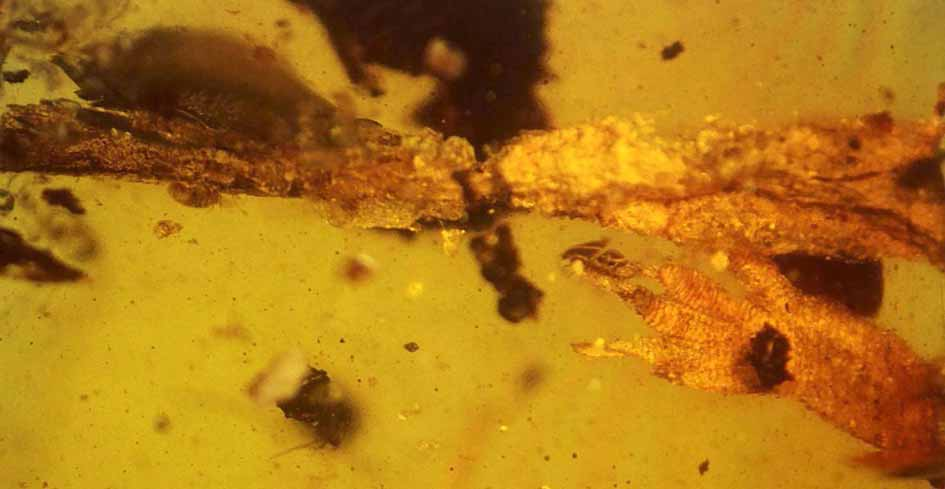
Cretaceogekko burmae
Cretaceogekko (meaning “Cretaceous gecko”) is an extinct monotypic genus of gecko (represented by the type species Cretaceogekko burmae) known from a single partial specimen preserved in Burmese amber from the Cenomanian of Myanmar. The specimen was found in the Hukawng Valley in 2001 and the genus and species were named by E. Nicholas Arnold and George Poinar in 2008. The specimen includes a foot and partial tail. Cretaceogekko is the oldest known gecko, predating the Late Cretaceous gecko Gobekko and the Paleogene gecko Yantarogecko, which has also been preserved in amber.
Gueragama
Gueragama is an extinct genus of iguanian lizard from the Cretaceous of Brazil. It belongs to a group of iguanians called Acrodonta, whose living members include chameleons and agamids and are currently restricted to the Old World. Gueragama is the only acrodont known from South America, providing evidence that the group once ranged across much of Gondwana and only became restricted to the Old World after the supercontinent broke apart. The type species, Gueragama sulamericana, was named in 2015 on the basis of an isolated lower jaw from Goio-Erê Formation in the Bauru Basin, which was deposit
Retinosaurus
Retinosaurus (meaning "amber lizard") is an extinct genus of scincomorph lizard from the Early Cretaceous of Myanmar. The genus contains a single species, Retinosaurus hkamtiensis, known from a specimen preserved in amber.
Eichstaettisaurus
Eichstaettisaurus (meaning "Eichstätt lizard") is a genus of lizards from the Late Jurassic and Early Cretaceous of Germany, Spain, and Italy. With a flattened head, forward-oriented and partially symmetrical feet, and tall claws, Eichstaettisaurus bore many adaptations to a climbing lifestyle approaching those of geckos. The type species, E. schroederi, is among the oldest and most complete members of the Squamata, being known by one specimen originating from the Tithonian-aged Solnhofen Limestone of Germany. A second species, E. gouldi, was described from another skeleton found in the Matese
Igua
Igua is an extinct genus of iguanian lizards belonging to a group called Gobiguania that was endemic to the Gobi Desert during the Late Cretaceous. The type species Igua minuta was named in 1991 on the basis of a skull from the Barun Goyot Formation in Mongolia. The skull itself is very small, only long, and may have belonged to a juvenile given that it possesses a large fontanelle and that many of the bones are unfused. The snout-vent length of the individual (the total body length minus the tail) is estimated to have been . Igua differs from related gobiguanians like Polrussia in having a mo
Gobiguania
Gobiguania is an extinct clade of iguanian lizards from the Late Cretaceous. All known gobiguanians are endemic to the Gobi Desert of Mongolia. Gobiguania was given a phylogenetic definition by Jack Conrad and Mark Norell in 2007 as all taxa more closely related to Anchaurosaurus gilmorei than to Iguana iguana (the green iguana), Crotaphytus collaris (the common collared lizard), or Agama agama (the common agama). According to Conrad and Norell's phylogenetic analysis, Gobiguania includes Anchaurosaurus as well as several other Late Cretaceous lizards such as Ctenomastax, Temujinia, Saichangur
Coniasaurus
Coniasaurus is an extinct genus of Late Cretaceous marine squamates that range in age from Cenomanian to Santonian. It was first described by Richard Owen in 1850 from lower Cenomanian chalk deposits in South East England (Sussex). Two species have been described from this genus: C. crassidens (Owen, 1850), known from Cenomanian to Santonian deposits from South East England, Germany and North America, and C. gracilodens (Caldwell, 1999) from the Cenomanian of southeast England.
Aphanizocnemus
Aphanizocnemus is an extinct genus of lizard from Lebanon. It is a marine lizard that lived during the Late Cretaceous. It is often classified in the family Dolichosauridae as a close relative of snakes, although some studies have placed it as an even closer relative to snakes than dolichosaurids. Only one species of Aphanizocnemus is known, the type species A. libanensis. A. libanensis was named in 1997 on the basis of a single complete skeleton. Although the type locality is unknown, it is said to "almost certainly" originate from the Sannine Formation.
Cherminotus longifrons
Cherminotus is an extinct genus of varanoid lizard from the Late Cretaceous of Mongolia. The type and only species, Cherminotus longifrons, was named in 1984.