Category
page 1Crewed spacecraft

International Space Station
The International Space Station (ISS) is a space station in low Earth orbit (LEO). It is the product of the International Space Station program and is operated by five partner space agencies: NASA, Roscosmos (Russia), ESA (Europe), JAXA (Japan), and CSA (Canada). It is the first space station built, maintained and crewed through international cooperation and the largest human spacecraft ever constructed. It is an orbital research station, where scientific experiments in microgravity are conducted and the space environment is studied. Since 2 November 2000, it has hosted the longest continuous presence of humans in space. Alongside Tiangong, it is one of the only two currently operational space stations.

Space Shuttle
partially reusable launch system and space plane developed by NASA (1981–2011)
Mir
Mir (, ; ) was a space station operated in low Earth orbit from 1986 to 2001, first by the Soviet Union and later by the Russian Federation. Mir was the first modular space station and was assembled in orbit from 1986 to 1996. It had a greater mass than any previous spacecraft. At the time it was the largest artificial satellite in orbit, succeeded by the International Space Station (ISS) after Mir's deorbiting. The station served as a microgravity research laboratory in which crews conducted experiments in biology, human biology, physics, astronomy, meteorology, and spacecraft syste
.jpg)
Skylab
Skylab was the United States' first space station, launched by NASA, occupied for about 24 weeks between May 1973 and February 1974. It was operated by three trios of astronaut crews: Skylab 2, Skylab 3, and Skylab 4. Skylab was constructed from a repurposed Saturn V third stage (the S-IVB), and took the place of the stage during launch. Operations included an orbital workshop, a solar observatory, Earth observation and hundreds of experiments. Skylab's orbit eventually decayed and it disintegrated in the atmosphere on July 11, 1979, scattering debris across the Indian Ocean and Western Austra
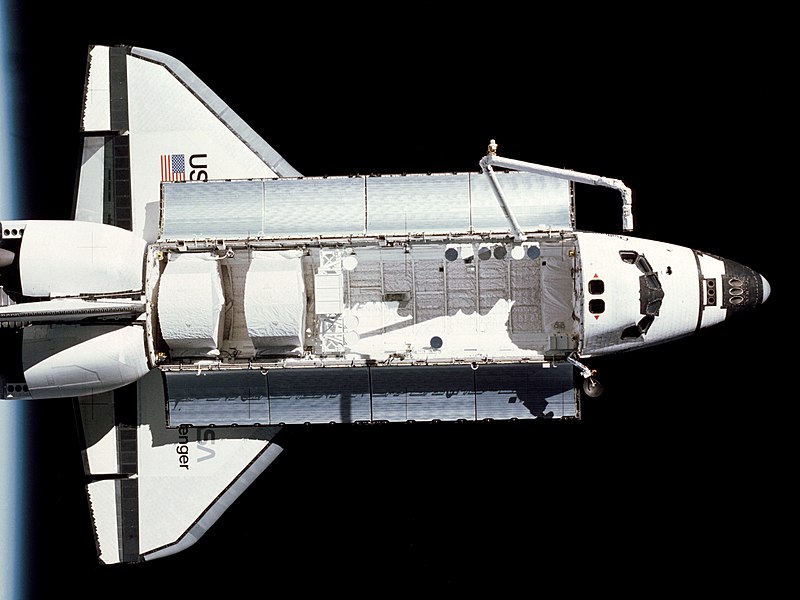
Challenger
American Space Shuttle orbiter

Soyuz
series of spacecraft designed for the Soviet space programme

Discovery
American Space Shuttle orbiter
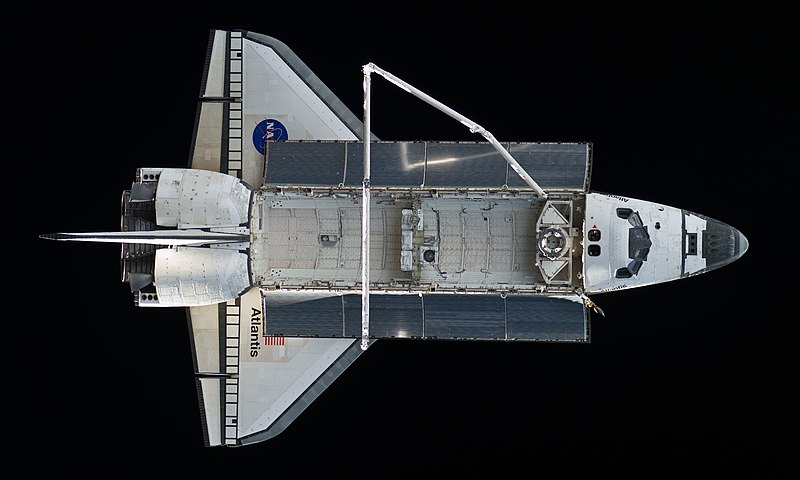
Atlantis
American Space Shuttle orbiter
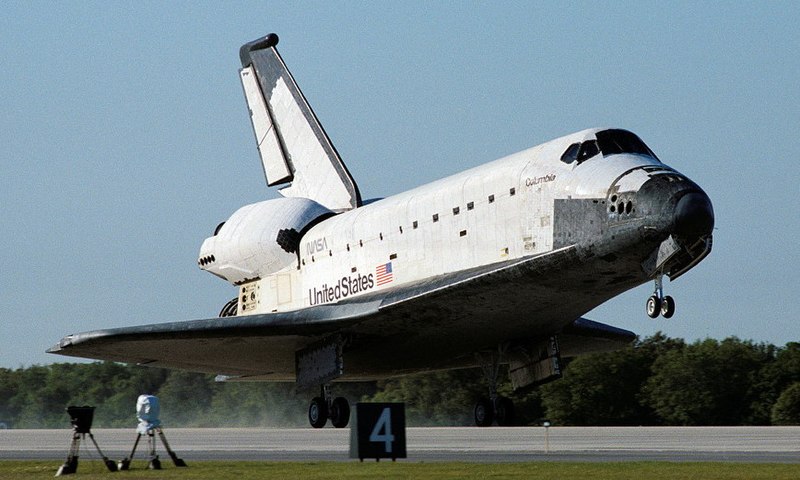
Columbia
American Space Shuttle orbiter

Orion (spacecraft)
The Orion Multi-Purpose Crew Vehicle (MPCV) is a partially reusable crewed spacecraft used by NASA for the Artemis lunar exploration program. It consists of a crew module (CM), a space capsule built by Lockheed Martin, and is paired with a European Service Module (ESM) provided by the European Space Agency (ESA) and manufactured by Airbus Defence and Space. Orion supports a crew of four beyond low Earth orbit for up to 21 days undocked or up to six months when docked. It is equipped with a NASA Docking System port and glass cockpit displays. It is intended to be launched atop the Space Launch System (SLS) rocket with a tower-mounted launch escape system.

Endeavour
American Space Shuttle orbiter

Starship
SpaceX super heavy-lift reusable launch vehicle

Project Mercury
first human spaceflight program of the United States

Project Gemini
NASA's second human spaceflight program

Buran
first and only operational spaceplane in the Soviet Buran programme

X-15
1959 experimental aircraft model by North American Aviation and NASA

Apollo Lunar Module
lander used in the Apollo program

Dragon 2
reusable spacecraft by SpaceX
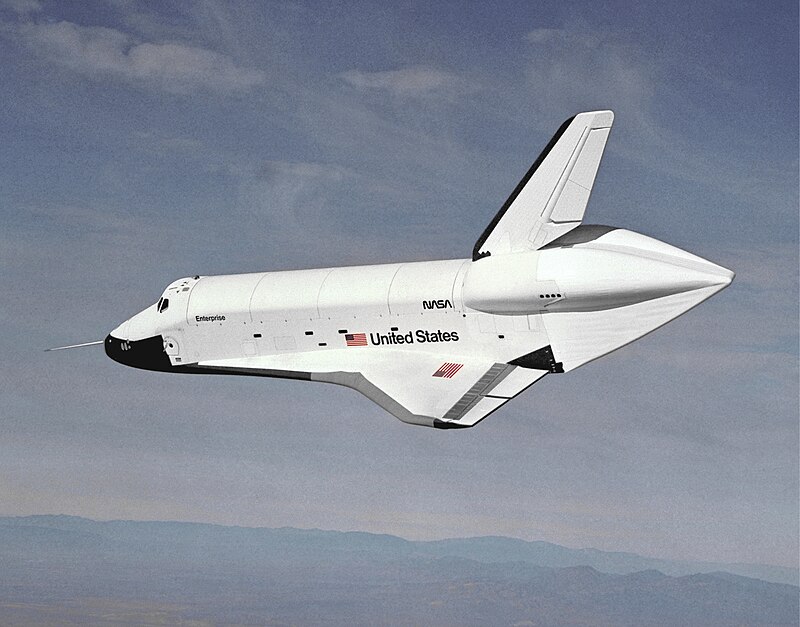
Enterprise
American Space Shuttle test vehicle

Shenzhou
class of crewed spacecraft from China
Vostok
type of spacecraft built by the Soviet Union
Boeing Starliner
crew capsule manufactured by Boeing
Lunar Gateway
planned lunar international space station
Apollo Command and Service Module
component of the United States Apollo spacecraft

SpaceShipOne
SpaceShipOne is an experimental air-launched rocket-powered aircraft with sub-orbital spaceflight capability at speeds of up to /
using a hybrid rocket motor. The design features a unique "feathering" atmospheric reentry system where the rear half of the wing and the twin tail booms folds 70 degrees upward along a hinge running the length of the wing; this increases drag while retaining stability. SpaceShipOne completed the first crewed private spaceflight in 2004. That same year, it won the US$10 million Ansari X Prize and was immediately retired from active service. Its mother ship was name
Apollo
American spacecraft
X-20 Dyna-Soar
research aircraft by Boeing

SpaceShipTwo
The Scaled Composites Model 339 SpaceShipTwo (SS2) is a retired air-launched suborbital spaceplane type designed for space tourism. It was manufactured by The Spaceship Company, a California-based company owned by Virgin Galactic.

Kliper
Kliper (Клипер, English: Clipper) was an early-2000s proposed partially-reusable (excluding orbital section and thermal protection shield) crewed spacecraft concept by RSC Energia. Due to a lack of funding from the European Space Agency (ESA) and the Russian Space Agency (RSA), the project was indefinitely postponed in 2006.
Hermes
proposed spaceplane by the European Space Agency
Salyut 3
Soviet space station launched on 25 June 1974

Gaganyaan
Gaganyaan (,, from Sanskrit: , "celestial" and , "craft, vehicle") is an Indian crewed orbital spacecraft intended to be the formative spacecraft of the Indian Human Spaceflight Programme. The spacecraft is being designed to carry three people to low Earth orbit, and a planned upgraded version will be equipped with rendezvous and docking capabilities.
China Manned Space Program
spaceflight programme in China
Voskhod
series of Soviet crewed spacecraft
Orel
Russian reusable space capsule
Space Shuttle orbiter
reusable spacecraft component of the Space Shuttle system
Buran programme
Soviet reusable spaceplane programme
LK
lunar lander developed for the Soviet lunar program
NASA X-38
airplane
Soyuz 7K-L1
Soviet spacecraft for crewed lunar flyby
Salyut 5
Soviet space station launched in 1976
Starship Human Landing System
proposed lunar lander for the Artemis program
Mengzhou spacecraft
Chinese crewed space capsule under development
Soyuz 7K-LOK
Soviet crewed lunar orbiting spacecraft
Soyuz 7K-OK
first generation of the Soyuz spacecraft of the Soyuz programme
VSS Enterprise
spacecraft
Soyuz-TMA
revision of the Soyuz spacecraft
Blue Moon
robotic lunar lander developed by Blue Origin
HEAT-1X Tycho Brahe
Dutch rocket and human-rated spacecraft built by Copenhagen Suborbitals
CSTS
Crew Space Transportation System (CSTS), or Advanced Crew Transportation System (ACTS), was a proposed design for a crewed spacecraft for low Earth orbit operations such as servicing the International Space Station, but also capable of exploration of the Moon and beyond. It was originally a joint project between the European Space Agency (ESA) and the Roscosmos, but later became solely an ESA project. This study was conceived as a basic strategic plan to keep a viable European human spaceflight program alive.
VSS Unity
American commercial sub-orbitable space ship
Soyuz-T
The Soyuz-T () was the third generation of the Soyuz spacecraft and operated from 1979 to 1986. The T designation stood for "transport" (), reflecting its primary role ferrying crews to and from space stations. The design was based on the second-generation Soyuz 7K-T and incorporated experience gained from the Military Soyuz program and the Soyuz 7K-TM used for the Apollo–Soyuz Test Project.
.jpg)
Soyuz-TM
The Soyuz TM () were fourth generation (1986–2002) Soyuz spacecraft used for ferry flights to the Mir and ISS space stations. The Soyuz spacecraft consisted of three parts, the Orbital Module, the Descent Module and the Service Module.
Soyuz 7K-OKS
version of the Soyuz spacecraft
Soyuz MS
latest revision of the Soyuz spacecraft
Soyuz 7K-T
second generation of the Soyuz spacecraft
Lynx
Cancelled American spacecraft

Eagle
lunar module used during Apollo 11; first crewed spacecraft on the Moon
Orbital Piloted Assembly and Experiment Complex
Proposed Russian space station
Soyuz 7K-TM
variant of the 2nd-generation Soyuz spacecraft (1974–1976)