Category
page 1Crustacean superfamilies

Paguroidea
superfamily of crustaceans
Majoidea
Majoidea is a is a superfamily of crab which contains spider crabs, along with the decorator crabs.
Grapsoidea
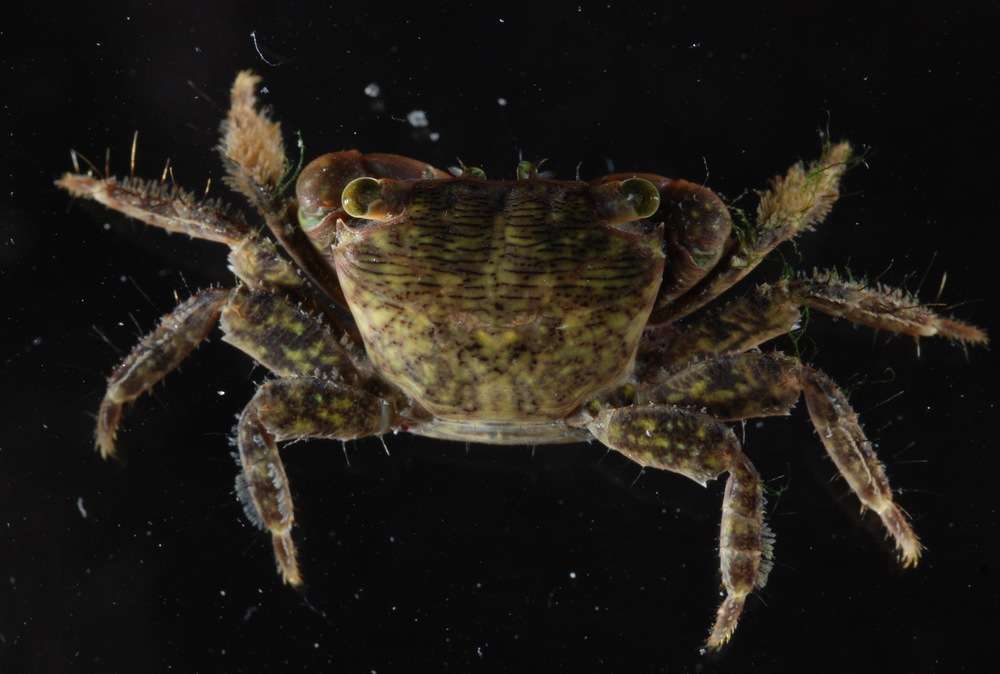
The Grapsoidea are a superfamily of crabs; they are well known and contain many taxa which are terrestrial (land-living), semiterrestrial (taking to the sea only for reproduction), or limnic (living in fresh water). Another well-known member with a more conventional lifestyle is the Chinese mitten crab, Eriocheir sinensis.
%20Figure%203.png)
Portunoidea
__NOTOC__
Ocypodoidea
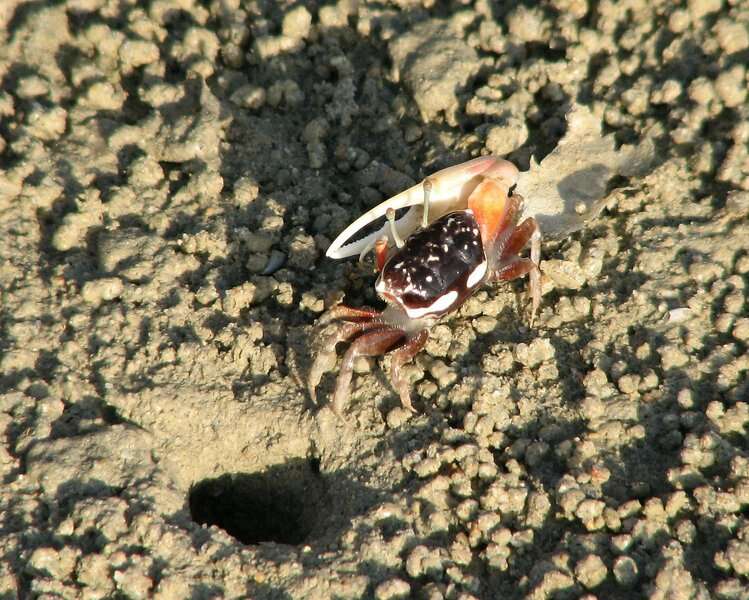
The Ocypodoidea, or ocypoid crabs, are a superfamily of crabs, named after the genus Ocypode. It contains the following families:
Cancroidea
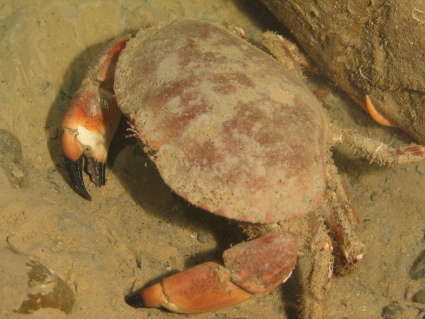
Cancroidea is a superfamily of crabs, comprising the families Atelecyclidae and Cancridae. Four other families have been separated into new superfamilies: Cheiragonidae into Cheiragonoidea, Corystidae into Corystoidea, and both Pirimelidae and Thiidae into Portunoidea. Montezumellidae has been moved from Cancroidea to his own Superfamily Montezumelloidea.
Alpheoidea
Alpheoidea is a superfamily of shrimp. Species of shrimp in the superfamily Alpheoidea are drag swimmers, as opposed to lift swimmers.
Astacoidea
Astacoidea is superfamily of freshwater crayfish that live in the Northern Hemisphere. The other superfamily of crayfish, Parastacoidea, lives in the Southern Hemisphere. Astacoidea consists of three families: Astacidae (from Europe and western North America), Cambaridae (from eastern North America), and Cambaroididae (from eastern Asia). Crayfish are closely related to lobsters, as shown in the simplified cladogram below.
Potamoidea
Potamoidea is a superfamily of freshwater crabs, comprising the two families Potamidae and Potamonautidae. Two previously recognised families, Deckeniidae and Platythelphusidae, are now treated as parts of the family Potamonautidae.
Hippoidea
Hippoidea is a superfamily of decapod crustaceans known as mole crabs or sand crabs.
Galatheoidea
The Galatheoidea are a superfamily of decapod crustaceans comprising the porcelain crabs and some squat lobsters. Squat lobsters within the three families of the superfamily Chirostyloidea are not closely related to the squat lobsters within the Galatheoidea. The fossil record of the superfamily extends back to the Middle Jurassic genus Palaeomunidopsis.
Xanthoidea
Xanthoidea is a superfamily of crabs, comprising seven families. Formerly, a number of other families were included in Xanthoidea, but many of these have since been removed to other superfamilies. These include Carpilioidea, Eriphioidea, Hexapodoidea, Pilumnoidea and Trapezioidea. Even in this reduced state, Xanthoidea remains one of the most species-rich superfamilies of crabs.
Crangonoidea
Crangonoidea is a superfamily of shrimp containing the two families Crangonidae and Glyphocrangonidae.
Calappoidea
Calappoidea is a superfamily of crabs comprising the two families Calappidae and Matutidae. The earliest fossils attributable to the Calappoidea date from the Aptian.
Dromioidea
Dromioidea is a superfamily of crabs mostly found in Madagascar. Dromioidea belongs to the group Dromiacea, taxonomically ranked as a section, which is the most basal grouping of Brachyura crabs. Dromiacea likely diverged from the rest of Brachyura around the Late Triassic or Early Jurassic, and the earliest fossils attributable to the Dromioidea date from the Late Jurassic.
Homoloidea
Homoloidea is a superfamily of dromiacean crabs. Homoloidea belongs the group Dromiacea, taxonomically ranked as a section, and is the sister group to Dromioidea. Dromiacea is the most basal grouping of Brachyura crabs, and likely diverged from the rest of Brachyura around the Late Triassic or Early Jurassic. The close relation between Homoloidea and Dromioidea is primarily established through ultrastructural characteristics of the sperm.
Eriphioidea
Eriphioidea is a superfamily of crabs. It contains six families:
Pilumnoidea
Pilumnoidea is a superfamily of crabs, whose members were previously included in the Xanthoidea. The three families are unified by the free articulation of all the segments of the male crab's abdomen and by the form of the gonopods. The earliest fossils assigned to this group are of Eocene age.
Goneplacoidea
Goneplacoidea is a superfamily of crabs containing 11 extant families, and two families known only from fossils (marked "†").
Acidopsidae
† Carinocarcinoididae
Chasmocarcinidae
Conleyidae
Euryplacidae
Goneplacidae
Litocheiridae
† Martinocarcinidae
Mathildellidae
Progeryonidae
Scalopidiidae
Sotoplacidae
Vultocinidae
Gecarcinucoidea
Gecarcinucoidea is a superfamily of freshwater crabs. Its members have been grouped into families in various ways, with some authors recognizing families such as "Deckeniidae", "Sundathelphusidae", and "Parathelphusidae", but now only the family Gecarcinucidae is currently recognized.
Trapezioidea
Trapezioidea is a superfamily of crabs. Its members live symbiotically with corals and have a fossil record stretching back to the Eocene.
Anthuroidea
Anthuroidea is a superfamily of isopod crustaceans, formerly treated as a suborder, Anthuridea. The group is characterised by "an elongate cylindrical body form, without dorsal coxal plates, and with a uropodal exopod attached to the peduncle proximally and dorsally". There are more than 500 described species in 57 genera, arranged across six families:
Antheluridae Poore & Lew Ton, 1988
Anthuridae Leach, 1814
Expanathuridae Poore, 2001
Hyssuridae Wägele, 1981
Leptanthuridae Poore, 2001
Paranthuridae Menzies & Glynn, 1968
Dairoidea
Dairoidea is a superfamily of crabs, comprising two families which each contain a single genus: Dairidae (the living fossil Daira ) and Dacryopilumnidae (Dacryopilumnus) .
Leucosioidea
Leucosioidea is a superfamily of crabs containing the two families Leucosiidae and Iphiculidae.
Dorippoidea
Dorippoidea is a superfamily of crabs. The earliest fossils attributable to the Dorippoidea date from the Late Cretaceous.
Palicoidea
Palicoidea is a superfamily of crabs, comprising the two families Crossotonotidae and Palicidae. Together, they contain 13 genera, including two genera in the Palicidae known only from fossils. The two families were previously treated as two subfamilies in a Palicidae of wider circumscription.
Family Crossotonotidae
Bresilioidea
Bresilioidea is a superfamily of shrimp. It is likely to be an artificial group, containing five families which may or may not be related.

Carpilioidea
thumb|Harpactoxanthopsis quadrilobata fossil, Middle Eocene, Venetia Region, northern Italy
Gammaroidea
Gammaroidea is a superfamily of crustaceans in the order Amphipoda.
Campylonotoidea
Campylonotoidea is a superfamily of shrimp, containing the two families Campylonotidae and Bathypalaemonellidae. Fenner A. Chace considered it to be the sister group to the much larger superfamily Palaemonoidea, with which it shares the absence of endopods on the pereiopods, and the fact that the first pereiopod is thinner than the second. Using molecular phylogenetics, Bracken et al. proposed that Campylonotoidea may be closer to Atyoidea. There are sixteen described species in 3 genera; no fossils are known.
Glypheoidea
The Glypheoidea (containing the glypheoid lobsters), is a group of lobster-like decapod crustaceans which forms an important part of fossil faunas, such as the Solnhofen limestone. These fossils included taxa such as Glyphea (from which the group takes its name), and Mecochirus, mostly with elongated (often semichelate) chelipeds. This group of decapods is a good example of a living fossil, or a lazarus taxon, since until their discovery in the 1970s, the group was considered to have become extinct in the Eocene. The superfamily Glypheoidea comprises five families. The two extant species, Neog
Chirostyloidea
Chirostyloidea is an anomuran superfamily with squat lobster-like representatives. It comprises the three families Chirostylidae, Eumunididae and Kiwaidae. Although representatives of Chirostyloidea are superficially similar to galatheoid squat lobsters, they are more closely related to Lomisoidea and Aegloidea together forming the clade Australopoda. No fossils can be confidently assigned to the Chirostyloidea, although Pristinaspina may belong either in the family Kiwaidae or Chirostylidae.
Coronuloidea
Coronuloidea is a superfamily of barnacles in the order Balanomorpha.
Dakoticancroidea
Dakoticancroidea is a superfamily of fossil crabs divided into the following two families:
Caprelloidea
Caprelloidea is a superfamily of marine crustaceans in the order Amphipoda. It includes "untypical" forms of amphipods, such as the skeleton shrimps (Caprellidae) and whale lice (Cyamidae). The group was formerly treated as one of the four amphipod suborders, Caprellidea, but has been moved down to the superfamily rank by Myers & Lowry (2003, 2013) after phylogenetic studies of the group, and is now contained in the infraorder Corophiida of the suborder Senticaudata. The group includes the following families.
Seroloidea
Seroloidea is a superfamily of isopod crustaceans in the suborder Sphaeromatidea.