Category
page 1Crystallography

crystallography
thumb|A crystalline solid: atomic resolution image of strontium titanate. Brighter spots are columns of [[strontium atoms and darker ones are titanium-oxygen columns.]]
thumb|Octahedral and tetrahedral interstitial sites in a face centered cubic structure
thumb|Kikuchi lines (physics)|Kikuchi lines in an [[electron backscatter diffraction pattern of monocrystalline silicon, taken at 20 kV with a field-emission electron source]]

crystal structure
unique arrangement of atoms or molecules in a crystalline liquid or solid
crystallization
Crystallization is a process that leads to solids with a uniform pattern of atoms or molecules, i.e. a crystal. The uniform nature of a crystalline solid can be contrasted with amorphous solids in which atoms or molecules lack regular organization. Crystallization can occur by various routes including precipitation from solution, freezing of a liquid, or deposition from a gas. Attributes of the resulting crystal can depend largely on factors such as temperature, air pressure, cooling rate, or solute concentration.

X-ray crystallography
technique used for determining the atomic or molecular structure of a crystal, in which the ordered atoms cause a beam of incident X-rays to diffract into specific directions
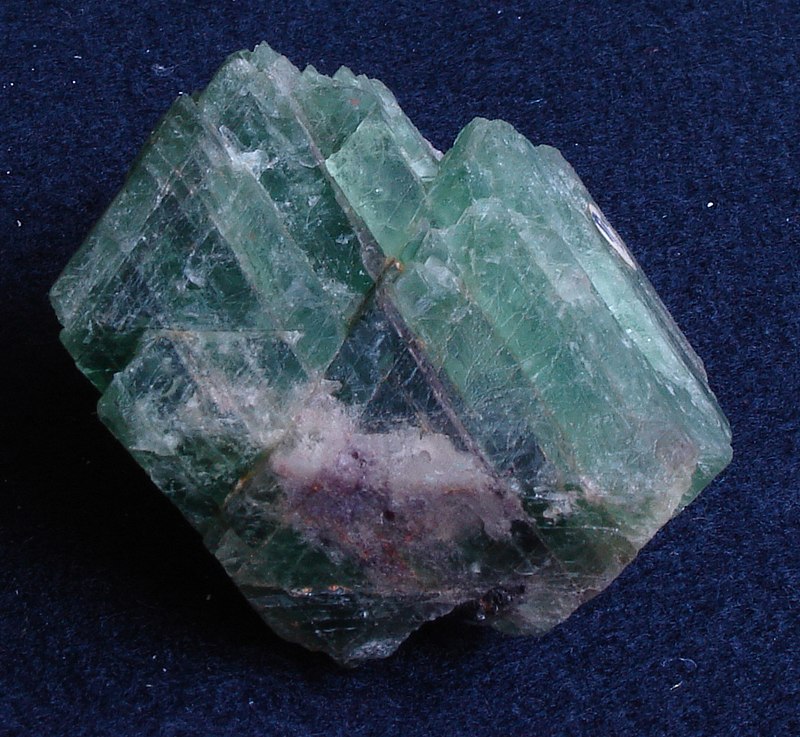
cleavage
tendency of crystalline materials to split along definite crystallographic structural planes

crystal polymorphism
ability of a solid material to exist in more than one form or crystal structure

homologous series
series of chemical substances with the same general formula, varying by a single parameter
crystal system
class of space groups, lattices, point groups, or crystals
crystal twinning
two separate crystals sharing some of the same crystal lattice points in a symmetrical manner
crystal habit
mineralogical term for the visible shape of a mineral

quasicrystal
thumb|Potential energy surface for silver depositing on an aluminium–[[palladium–manganese (Al–Pd–Mn) quasicrystal surface. Similar to Fig. 6 in Ref.]]
Bravais lattice
an infinite array of discrete points in three dimensional space generated by a set of discrete translation operations
Miller index
describing crystal lattice planes
Bragg's law
gives the angles for coherent and incoherent scattering from a crystal lattice
Electron diffraction
Bending of electron beams due to electrostatic interactions with matter
water of crystallization
water molecules present in a hydrated compound's crystal structure, without being covalently bound
stereographic projection
particular mapping that projects a sphere onto a plane

epitaxy
Epitaxy (prefix epi- means "on top of") is a type of crystal growth or material deposition in which new crystalline layers are formed with one or more well-defined orientations with respect to the crystalline seed layer. The deposited crystalline film is called an epitaxial film or epitaxial layer. The relative orientation(s) of the epitaxial layer to the seed layer is defined in terms of the orientation of the crystal lattice of each material. For most epitaxial growths, the new layer is usually crystalline and each crystallographic domain of the overlayer must have a well-defined orientation
lattice energy
energy change upon formation of one mole of a crystalline compound
space group
symmetry group of a configuration in space
reciprocal lattice
fourier transform of real-space lattices, important in solid-state physics
Brillouin zone
primitive cell in the reciprocal space lattice of crystals
grain boundary
concept in materials science: the interface between two grains, or crystallites, in a polycrystalline material
time crystal
quantum system whose ground state is one in which the particles are in repetitive motion
isomorphism
having crystal structures of the same symmetry
Wigner–Seitz cell
primitive cell of crystal lattices with Voronoi decomposition applied
crystal chemistry
study of the principles of chemistry behind crystals
Madelung constant
сonstant in crystallography
Pearson symbol
means of describing a crystal structure
perovskite structure
type of crystal structure
unit cell
base of crystal structure
X-ray diffraction
physical phenomenon
point group
group of geometric symmetries (isometries) that keep at least one point fixed
crystal growth
after a first nucleation, second step of crystallization consisting in the regular accretion of atoms or ions at the surface of the crystal

facet
thumb|A faceted amethyst
Facets () are flat faces on geometric shapes. The organization of naturally occurring facets was key to early developments in crystallography, since they reflect the underlying symmetry of the crystal structure. Gemstones commonly have facets cut into them in order to improve their appearance by allowing them to reflect light. The earliest diamond cutting techniques were simply to polish the natural shape of rough diamonds, often octahedral crystals. It wasn't until the 14th century that faceting, the process of cutting and polishing a gemstone to create multiple flat
wallpaper group
mathematical classification of a two-dimensional repetitive pattern
close-packing of equal spheres
dense arrangement of congruent spheres in an infinite, regular arrangement
Burgers vector
vector characterising a dislocation in a crystal lattice
glide reflection
symmetry operation combining reflection across and translation along an axis
sphere packing
an arrangement of non-overlapping spheres within a containing space
crystal optics
sub-branch of optical physics
atomic packing factor
fraction of volume in a crystal structure that is occupied by the constituent particles
euhedral crystal
well-formed crystal with sharp and well developed faces
Kapustinskii equation
formula for lattice energy of a crystal
Hermann–Mauguin notation
notation to represent symmetry in point groups, plane groups and space groups
crystallographic point group
classification system for crystals
neutron scattering
physical phenomenon
texture
distribution of crystallographic orientations of a polycrystalline sample
Debye-Waller factor
dimensionless number used in condensed matter physics to describe the attenuation of X-ray scattering or coherent neutron scattering caused by thermal motion
Ewald's sphere
energy conservation during diffraction by atoms
Avrami equation
equation that describes how solids transform from one phase to another at constant temperature
trihexagonal tiling
a tiling of the plane by regular hexagons and equilateral triangles, with each edge separating both types of shape
Laue equations
equations describing diffraction in a crystal lattice
Schoenflies notation
notation to represent symmetry in point groups
diamond cubic
cubic crystal structure of diamond and other substances

Crystallographic Information File
file format for representing crystallographic information
Patterson function
X-ray crystallography
Friedel's law
structure factor
mathematical description in crystallography
reflection high-energy electron diffraction
technique in crystallography