Category
page 1Dedicated deck card games

Uno
Card game
Dominion
2008 designer card game created by Donald X. Vaccarino
7 Wonders
2010 card game
Munchkin
card game spoofing table-top RPG play
Black Peter
card game of German origin

Bang!
2002 card game
Citadels
board game (2000)
Cards Against Humanity
party game
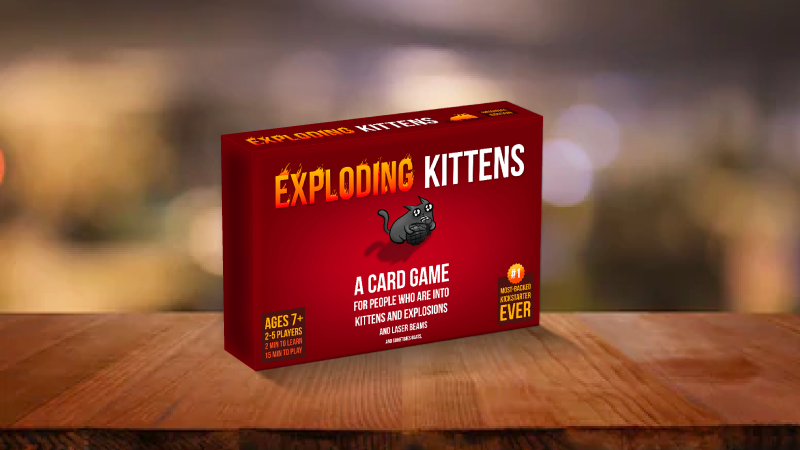
Exploding Kittens
2015 card game
Take 5
1994 card game
Hanabi
card game

Bohnanza
thumb|A Bohnanza game-playing tournament in the [[Czech Republic]]
Illuminati
cards boardgame
Set
card game
Old maid
card game
%20LACMA%20M.2001.210.4.1-.10.jpg)
Ganjifa
thumb|Various Ganjifa cards from Dashavatara set
Ganjifa, Ganjapa or Gânjaphâ, is a card game and type of playing cards that are most associated with Persia and India. After Ganjifa cards fell out of use in Iran before the twentieth century, India became the last country to produce them. The form prevalent in Odisha is Ganjapa.
Love Letter
2012 card game

As-Nas
thumb|As-Nas cards|320px
Mille Bornes
card game

Dobble
Dobble is a game in which players have to find symbols in common between two cards. It was the UK’s best-selling game in 2018 and 2019.
San Juan
card game

Fluxx
Fluxx is a card game published by Looney Labs. It is different from most other card games, in that the rules and the conditions for winning are altered throughout the game, via cards played by the players.
Machi Koro
2012 board game
The Great Dalmuti
card game designed by Richard Garfield, illustrated by Margaret Organ-Kean, and published in 1995 by Wizards of the Coast
Saboteur
2004 connection boardgame
Gnav
thumb|Gnav pieces.
Gnav is a traditional Danish and Norwegian social game that has been played with either special cards or wooden pieces with similar motifs. Gnav packs appeared after 1820 and the game was popular until c. 1920. The game can be played by 20 or more players, and a minimum of two. Today, only the playing card version is available in Norway.
Phase 10
Card game
happy families
card game
Lost Cities
board game of Reiner Knizia
Modern Art
board game
minchiate
Minchiate, also known as Germini or Tarocchi fiorentini (Florentine tarot), is an early 16th-century card game, originating in Florence, Italy. It is no longer widely played. The term can also refer to the special deck of 97 playing cards used in the game. The deck is similar to the conventional tarot cards, but contains an expanded suit of trumps. The game was similar to but more complex than tarocchi. The minchiate represents a Florentine variant on the original game.
Quartets
card game
SKIP-BO
thumb|upright|Cards in box
Skip-Bo is a commercial version of the card game Spite and Malice, a derivative of Russian Bank (also known as Crapette or Tunj), which in turn originates from Double Klondike (also called Double Solitaire). In 1967, Minnie Hazel "Skip" Bowman (1915–2001) of Brownfield, Texas, began producing a boxed edition of the game under the name SKIP-BO. In 1980 the game was purchased by International Games, which was subsequently bought by Mattel in 1992. A mobile version of the game for iOS was released by Magmic in September, 2013.
There is a new version called "SKIP-BO” tha

Lotería
Lotería (Spanish word meaning "lottery") is a traditional Mexican board game of chance, similar to bingo, but played with a deck of cards instead of numbered balls. Each card has an image of an object, its name, and a number, although the number is usually ignored. Each player has at least one '', a board with a randomly created 4 × 4 grid selected from the card images. Players choose a tabla ("board") to play with, from a variety of previously created '', each with a different selection of images.
Race for the Galaxy
2007 board game
Coloretto
Coloretto is a card game designed by Michael Schacht, originally published in 2003. The game cards depict chameleons, showing that "a player may change his color many times during the game". Rules are provided in both English and French. The published game is designed for 3–5 players,
but rules for a two-player version of the game are available at the Rio Grande Games website.
Madiao
Madiao (), also ma diao, ma tiu or ma tiao, is a late imperial Chinese trick-taking gambling card game, also known as the game of paper tiger. The deck used was recorded by Lu Rong in the 15th century and the rules later by Pan Zhiheng and Feng Menglong during the early 17th century. Korean poet Jang Hon (1759-1828) wrote that the game dates back to the Yuan dynasty (1271-1368). It continued to be popular during the Qing dynasty until around the mid-19th century. It is played with 40 cards, and four players.
Aluette
Aluette or Vache ("Cow") is an old, plain trick-taking card game that is played on the west coast of France. It is played by two teams, usually of four people, but sometimes also of six. It is unusual in using a unique pack of 48 Spanish playing cards and a system of signalling between playing partners. The French colloquial names for the game, jeu de la Vache or Vache, refer to the cow depicted on one of the cards.
uta-garuta
is a type of a deck of karuta, Japanese traditional playing cards. A set of uta-garuta contains two sets of 100 cards, with a waka poem written on each. Uta-garuta is also the name of the game in which the deck is used. The standard collection of poems used is the Hyakunin Isshu, chosen by poet Fujiwara no Teika in the Kamakura period, which is often also used as the name of the game.
The Mind
2018 card game
Ligretto
Ligretto is a card game for two to twelve players. The game in its current form was designed by Michael Michaels and published in 1988 by the German company Rosengarten Spiele. Since 2000 the game has been published by Schmidt-Spiele of Berlin, Germany. A blue version of the game has been published by Playroom Entertainment in North America and other English-speaking countries since 2009.
Four Color Cards
East Asian card game
Catan Card Game
board game
Goita
thumb|Goita tiles laid out
Goita (ごいた) is a traditional Japanese game from Noto, Ishikawa played with 32 tiles or cards similar to Shogi pieces. Unlike actual Shogi pieces, the tiles are the same size and have blank backs. It may be a descendant of an earlier Meiji period game played with 40 or 42 cards. It is related to (Color Crowns) played with uta-garuta.
Ganjapa
thumb|upright=1.3|Ganjapa cards
thumb|"Atharangi Ganjapa" cards painted with traditional Pattachitra painting of Krishna in his [[Nabagunjara form]]
Gånjåpā () are the traditional playing cards from the Indian state Odisha. It can also refer to the trick-taking card game that they are used for.
It is played with circular shaped Pattachitra painted cards. Originated in the 16th century, Ganjaku is a recreational game for male members of the Odia society, primarily villagers, kings and their courtmen. Ganjapa is played as "Chārirångi" (cards of 4 colors), "Āṭhårångi" (cards of 8 colors), "Dåsårå
The Crew: The Quest for Planet Nine
2019 cooperative Science Fiction card game by Thomas Sing
Wings of War
A modular wargame about air combat.
Sushi Go!
card game