Category
page 1Deeds of Apollo

Achilles
In Greek mythology, Achilles ( ) or Achilleus () was a hero of the Trojan War who was known as being the greatest of all the Greek warriors. The central character in Homer's Iliad, he was the son of the Nereid Thetis and Peleus, king of Phthia and famous Argonaut. Achilles was raised in Phthia along with his childhood companion Patroclus and received his education by the centaur Chiron. In the Iliad, he is presented as the commander of the mythical tribe of the Myrmidons.

Hermes
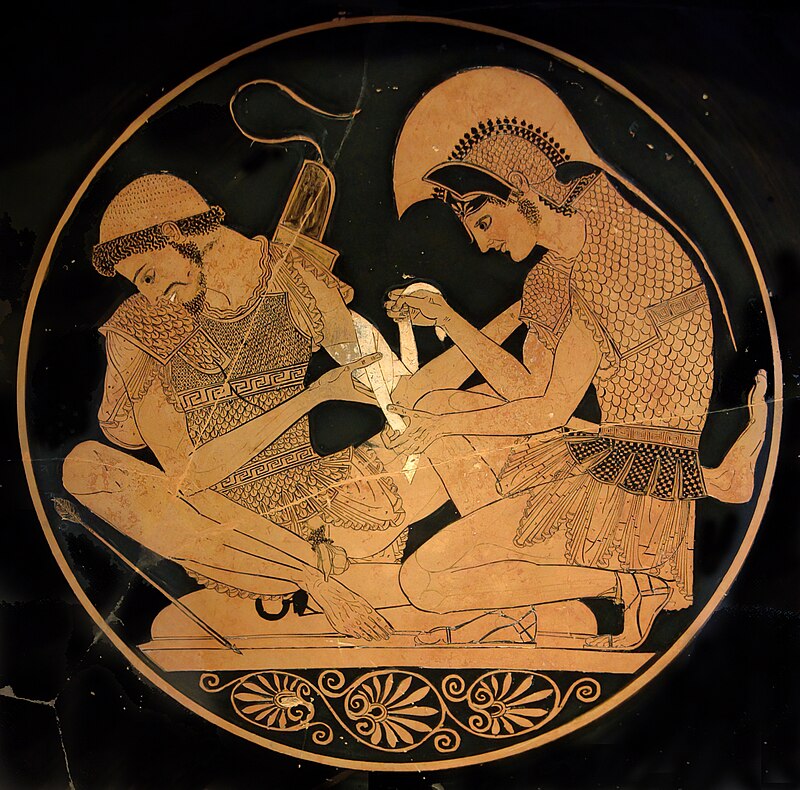
Trojan War
legendary war in Greek mythology

Heracles

Orion
giant huntsman in Greek mythology

Adonis
In Greek mythology, Adonis (; , ) was the mortal lover of the goddesses Aphrodite and Persephone. He was considered to be the ideal of male beauty in classical antiquity.

Leto
In ancient Greek mythology and religion, Leto (; ) is a childhood goddess, the daughter of the Titans Coeus and Phoebe, the sister of Asteria, and the mother of Apollo and Artemis.

Midas
thumb|King Midas on a red-figure stamnos from Chiusi around 440 BC, British Museum
%20(14569094819).jpg)
Chiron
In Greek mythology, Chiron, also Cheiron or Kheiron, (; or , , , or ) was held to be the superlative centaur amongst his brethren since he was called the "wisest and justest of all the centaurs".
%20(cropped).jpg)
Daphne

Laocoön
thumb|270px|right|Laocoön and His Sons in the Vatican
Laocoön (; , , gen.: ) is a figure in Greek and Roman mythology and the Epic Cycle.

Hyacinth
mythological prince, loved by Apollo
Nestor
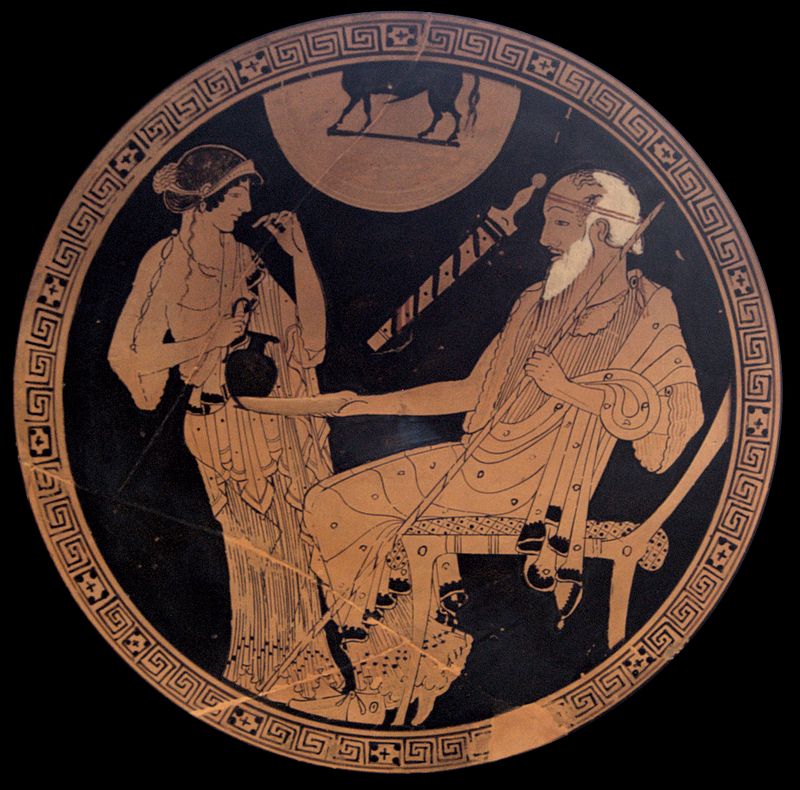
wise ruler of Pylos in Greek mythology, son of Neleus

Giants
Giants from Greek myth

Python
earth-dragon of Delphi

Admetus
king of Pherae in Thessaly, in Greek mythology

Niobe
thumb|Paestan lekythos depicting Niobe turning to stone, c. 330 B.C, [[Altes Museum, Berlin]]

Zephyrus
In Greek mythology and religion, Zephyrus () (), also spelled in English as Zephyr (), is the god and personification of the West wind, one of the several wind gods, the Anemoi. The son of Eos (the goddess of the dawn) and Astraeus, Zephyrus is the most gentle and favourable of the winds, associated with flowers, springtime and even procreation. In myths, he is presented as the tender breeze, known for his unrequited love for the Spartan prince Hyacinthus. Alongside Boreas, the two are the most prominent wind gods with relatively limited roles in recorded mythology.
.jpg)
Tiresias
thumb|300px|right|alt=A person with flowing robes holding a staff strikes two intertwined snakes on the ground|Tiresias strikes two snakes with a stick, and is transformed into a woman by Hera. Engraving by Johann Ulrich Kraus c. 1690. Taken from Die Verwandlungen des Ovidii (The Metamorphoses of Ovid).
thumb|300px|alt=A baroque painting showing a male and female figure together|Pietro della Vecchia, Tiresias Transformed into a Woman, 17th century.
In Greek mythology, Tiresias (; ) was a blind prophet of Apollo in Thebes, famous for clairvoyance and for being transformed into a woman for seven

Laomedon
In Greek mythology, Laomedon (; , Lāomédōn, "ruler of the people") was a Trojan king, son of Ilus and thus nephew of Ganymede and Assaracus.

Marsyas
thumb|upright|220px|''Marsyas receiving Apollo's punishment'', Istanbul Archaeology Museums|İstanbul Archaeology Museum

Asteria
In Greek mythology, Asteria or Asterie ( ; ) is a daughter of the Titans Phoebe and Coeus (Polus) and the sister of Leto. According to Hesiod, by the Titan Perses she had a single child, a daughter named Hecate, the goddess of witchcraft. Other authors made Asteria the mother of the fourth Heracles and Hecate by Zeus.

Tityos
thumb|Tityos attempts to rape Leto and is stopped by Apollo and Artemis on an Attic red-figure amphora from Vulci, 510–520 BCE, by the Phintias (painter)|Phintias Painter. [[Louvre, Paris.]]
Cyrene
nymph, mother of Aristaeus by Apollo
Aloadae
In Greek mythology, the Aloadae () or Aloads (Ancient Greek: Ἀλωάδαι Aloadai) were Otus or Otos (Ὦτος means "insatiability") and Ephialtes (Ἐφιάλτης, which means "nightmare"), Thessalian sons of Princess Iphimedia, wife of Aloeus, by Poseidon, whom she induced to make her pregnant by going to the seashore and disporting herself in the surf or scooping seawater into her bosom. From Aloeus, sometimes their real father, they received their patronymic, the Aloadae. They had a sister Pancratis (Pancrato) who was renowned for her great beauty.
Melampus
In Greek mythology, Melampus (; ) was a legendary soothsayer and healer, originally of Pylos, who ruled at Argos. He was the introducer of the worship of Dionysus, according to Herodotus, who asserted that his powers as a seer were derived from the Egyptians and that he could understand the language of animals. A number of pseudepigraphal works of divination were circulated in Classical and Hellenistic times under the name Melampus. According to Herodotus and Pausanias (vi.17.6), on the authority of Hesiod, his father was Amythaon, whose name implies the "ineffable" or "unspeakably great"; thu

Phineus
thumb|250px|Phineus with the Boreads.

Zagreus
In ancient Greek religion and mythology, Zagreus () was a god sometimes identified with an Orphic Dionysus who was dismembered by the Titans and reborn. In the earliest mention of Zagreus, he is paired with Gaia and called the "highest" god, though perhaps only in reference to the gods of the underworld. Aeschylus, however, links Zagreus with Hades, possibly as Hades' son, or as Hades himself. Noting "Hades' identity as Zeus' katachthonios alter ego", Timothy Gantz postulated that Zagreus, originally the son of Hades and Persephone, later merged with the Orphic Dionysus, the son of Zeus and Pe
Coronis
goddess from Greek mythology: princess, daughter of Phlegyas, lover of Ischys and Apollo, mother of Asclepius; killed by Apollon and Artemis
Idas
son of Aphareus, husband of Marpessa, argonaut in Greek mythology
Creusa
legendary princess of Athens
Maron
mythical son of Euanthes
Tmolus
King of Lydia and husband to Omphale in Greek mythology
Alcathous
mythical character, son of Pelops
Ischys
In Greek mythology, Ischys () was the son of Elatus.
Delphyne
In Greek mythology, Delphyne () is the name given, by some accounts, to the monstrous serpent killed by Apollo at Delphi. Although, in Hellenistic and later accounts, the Delphic monster slain by Apollo is usually said to be the male serpent Python, in the earliest known account of this story, the Homeric Hymn to Apollo (6th century BC), the god kills a nameless she-serpent (drakaina), subsequently called Delphyne. According to the Suda, Delphi was named after Delphyne.
Eurytus
king of Oechalia
Periphas
legendary king of Attica, turned into an eagle by Zeus
%20-%20Napoli%20MAN%20111479.jpg)
Niobids
thumb|302x302px|Roman fresco: Apollo and [[Artemis shoot the sons of Niobe, who flee (partly on horseback) in an idyllic landscape, 1st c. BC - 1st c. AD]]
thumb|right|302x302px|Roman sarcophagus: Apollo and [[Artemis killing the 14 children of Niobe (front side). Artemis; 5 daughters with a nurse; younger son with a pedagogue; 3 other sons; Apollo. Top: dead Niobids. 160–170 Ad]]
In Greek mythology, the Niobids were the children of Amphion of Thebes and Niobe, slain by Apollo and Artemis because Niobe, born of the royal house of Phrygia, had boastfully compared the greater number of her own o
Apollo and Daphne
story from ancient Greek mythology
Amphion and Zethus
Greek mythical characters
Carmanor
mythical hero of Crete
Meleagrids
In Greek mythology, the Meleagrids (Ancient Greek: ) are the sisters of the hero Meleager, and daughters of Althaea and Oeneus.
.jpg)
Cragaleus
thumb|Cragaleus
In Greek mythology, Cragaleus (; Ancient Greek: Κραγαλεύς) was a son of Dryops who dwelt in the land Dryopis next to a spring which was believed to have appeared at a place where Heracles hit the earth with his club (near Thermopylae).
Clinis
In Greek mythology, Clinis or Kleinis () was a native of Babylon and father, by Harpe, of three sons, Harpasus, Lycius, and Ortygius, and of a daughter Artemiche.
Bolina
In Greek mythology, Bolina (; ) or Boline () was a nymph. According to Pausanias, Bolina was once a mortal maiden of Achaea. She was loved by the god Apollo, and when he attempted to approach her, Bolina fled from him and threw herself into the sea to escape his advances. Thereupon the god made her immortal. On the spot where Bolina fell into the sea, the town Bolina was founded.
Caanthus
Caanthus is also a synonym of the cylindrical bark beetle genus Ciconissus.
theomachy
A theomachy (Ancient Greek: Θεομαχία) is a battle among gods in Greek mythology. An early example is the Titanomachy (War of the Titans), in which the elder Olympian Gods fought against the preceding generation, the Titans. The war lasted ten years and resulted in the victory of the Olympians and their dominion over the world. Another case is the Gigantomachy, the battle fought between the Giants - the children of Gaia - and all the Olympian gods for supremacy of the cosmos.
Botres
In Greek mythology, Botres () was a Theban son of Eumelus and grandson of Eugnotus.
Branchus
seer, son of Smicrus in Greek mythology
Aegypius
Greek mythical character
Acanthus
son of Autonous in Greek mythology
Babys
satyr in Greek mythology