Category
page 1Deeds of Artemis
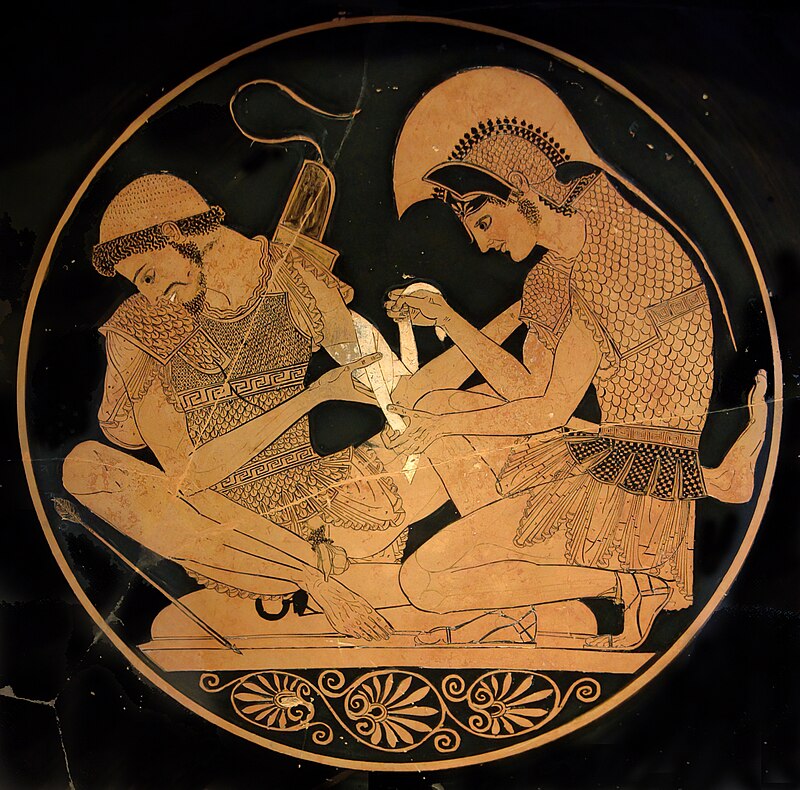
Trojan War
legendary war in Greek mythology

Heracles

Agamemnon
In Greek mythology, Agamemnon (; Agamémnōn) was a king of Mycenae who commanded the Achaeans during the Trojan War. He was the son (or grandson) of King Atreus and Queen Aerope, the brother of Menelaus, the husband of Clytemnestra, and the father of Iphigenia, Iphianassa, Electra, Laodike, Orestes and Chrysothemis. Legends make him the king of Mycenae or Argos, thought to be different names for the same area. Agamemnon was killed upon his return from Troy by Clytemnestra, or in an older version of the story, by Clytemnestra's lover Aegisthus.

Orion
giant huntsman in Greek mythology

Leto
In ancient Greek mythology and religion, Leto (; ) is a childhood goddess, the daughter of the Titans Coeus and Phoebe, the sister of Asteria, and the mother of Apollo and Artemis.

Ariadne
In Greek mythology, Ariadne (; ) was a Cretan princess, the daughter of King Minos of Crete. There are variations of Ariadne's myth, but she is known for helping Theseus escape from the Minotaur and being abandoned by him (or herself dying) on the island of Naxos. There, Dionysus saw Ariadne sleeping, fell in love with her, and later married her. Many versions of the myth recount Dionysus throwing Ariadne's jeweled crown into the sky to create a constellation, the Corona Borealis.

Iphigenia
thumb|Roman fresco of Iphigenia, from Magdalensberg

Giants
Giants from Greek myth

Callisto
nymph in Greek mythology

Admetus
king of Pherae in Thessaly, in Greek mythology

Niobe
thumb|Paestan lekythos depicting Niobe turning to stone, c. 330 B.C, [[Altes Museum, Berlin]]

Actaeon
thumb|The death of Actaeon on Red-figure pottery|red-figure [[skyphos from Paestum, 4th century BC (Karlsruhe, Badisches Landesmuseum).]]
Arethusa
nymph in Greek mythology who fled from the river god Alpheus
Ceryneian Hind
animal from Greek mythology
Hippolytus
son of Theseus in Greek mythology
Alpheus
river and river god in Greek mythology
Taygete
In Classical Greek mythology, Taygete (; , , ) was a nymph, one of the Pleiades according to the Bibliotheca (3.10.1) and a companion of Artemis, in her archaic role as potnia theron, "Mistress of the animals", with its likely roots in prehistory. Mount Taygetos in Laconia, dedicated to the goddess, was her haunt.

Tityos
thumb|Tityos attempts to rape Leto and is stopped by Apollo and Artemis on an Attic red-figure amphora from Vulci, 510–520 BCE, by the Phintias (painter)|Phintias Painter. [[Louvre, Paris.]]
Cyrene
nymph, mother of Aristaeus by Apollo
.jpg)
Britomartis
Britomartis (;) was a Greek goddess of mountains, nets, and hunting who was primarily worshipped on the island of Crete. She was sometimes described as a nymph, but she was more commonly conflated or syncretized with the goddesses Artemis, Athena, and Aphaea. She was also known as Dictynna, Dicte, Dictymna, or as a daughter of Dictynna (Δίκτυννα).
Aloadae
In Greek mythology, the Aloadae () or Aloads (Ancient Greek: Ἀλωάδαι Aloadai) were Otus or Otos (Ὦτος means "insatiability") and Ephialtes (Ἐφιάλτης, which means "nightmare"), Thessalian sons of Princess Iphimedia, wife of Aloeus, by Poseidon, whom she induced to make her pregnant by going to the seashore and disporting herself in the surf or scooping seawater into her bosom. From Aloeus, sometimes their real father, they received their patronymic, the Aloadae. They had a sister Pancratis (Pancrato) who was renowned for her great beauty.
Oeneus
In Greek mythology, Oeneus (; ) was a Calydonian king. He introduced wine-making to Aetolia, which he learned from Dionysus and the first who received a vine-plant from the same god.
Coronis
goddess from Greek mythology: princess, daughter of Phlegyas, lover of Ischys and Apollo, mother of Asclepius; killed by Apollon and Artemis
Erigone
daughter of Aegisthus and Clytemnestra in Greek mythology
Aura
divine personification of the breeze in Greek and Roman mythology
Broteas
In Greek mythology, Broteas (Ancient Greek: Βροτέας), a hunter, was the son of Tantalus (by Dione, Euryanassa or Eurythemista), whose other offspring were Niobe and Pelops.

Acontius
thumb|1835 statue of Acontius inscribing the apple by Ulisse Cambi, Florence Art Gallery.
Pirene
nymph
Chione
mother of Philammon and Autolycus by Apollo and Hermes respectively
%20-%20Napoli%20MAN%20111479.jpg)
Niobids
thumb|302x302px|Roman fresco: Apollo and [[Artemis shoot the sons of Niobe, who flee (partly on horseback) in an idyllic landscape, 1st c. BC - 1st c. AD]]
thumb|right|302x302px|Roman sarcophagus: Apollo and [[Artemis killing the 14 children of Niobe (front side). Artemis; 5 daughters with a nurse; younger son with a pedagogue; 3 other sons; Apollo. Top: dead Niobids. 160–170 Ad]]
In Greek mythology, the Niobids were the children of Amphion of Thebes and Niobe, slain by Apollo and Artemis because Niobe, born of the royal house of Phrygia, had boastfully compared the greater number of her own o
Carmanor
mythical hero of Crete
Polyphonte
Polyphonte () is a character in Greek mythology, transformed into a strix.
Laodamia
In Greek mythology, the name Laodamia () referred to:
Agron
son of Eumelus in Greek mythology
Eurytion
Eurytion (; ) or Eurythion (; ) was a name attributed to several individuals in Greek mythology:
Cydippe
The name Cydippe () is attributed to four individuals in Greek mythology.
Cleothera
thumb|320px|right|Detail of Camiro and Clytie in a reconstruction of the Nekyia by Polygnotus, 1892
theomachy
A theomachy (Ancient Greek: Θεομαχία) is a battle among gods in Greek mythology. An early example is the Titanomachy (War of the Titans), in which the elder Olympian Gods fought against the preceding generation, the Titans. The war lasted ten years and resulted in the victory of the Olympians and their dominion over the world. Another case is the Gigantomachy, the battle fought between the Giants - the children of Gaia - and all the Olympian gods for supremacy of the cosmos.
Proetids
thumb|Melampus and the Proetids in the temple of Artemis, by Aubin-Louis Millin (1759–1818).
Clinis
In Greek mythology, Clinis or Kleinis () was a native of Babylon and father, by Harpe, of three sons, Harpasus, Lycius, and Ortygius, and of a daughter Artemiche.
Byssa
daughter of Eumelus in Greek mythology
Erinome
In ancient Greek and Roman mythology, Erinoma () or Erinona () is a beautiful maiden who attracted the attention of both Zeus and Adonis, as well as the wrath of Hera and Aphrodite. Her story seems to be a local variant of Adonis's myth originating from the island of Cyprus, and survives only in the late works of Servius, a Latin grammarian who lived during the early fifth century AD.
Eumelus
Eumelus ( Eúmēlos means "rich in sheep") was the name of:
Echemeia
In Greek mythology, Echemeia () is a minor character who angered the goddess Artemis.
Amarynthus
Amarynthus (Ancient Greek: Ἀμάρυνθος) was, in Greek mythology, a hunter of Artemis, from whom the town of Amarynthus in Euboea (Stephanus of Byzantium says that it was Euboea itself) was believed to have derived its name. From this hero, or rather from the town of Amarynthus, Artemis derived the surname Amarynthia or Amarysia, under which she was worshipped there and also in Attica.