Category
page 1Deeds of Athena
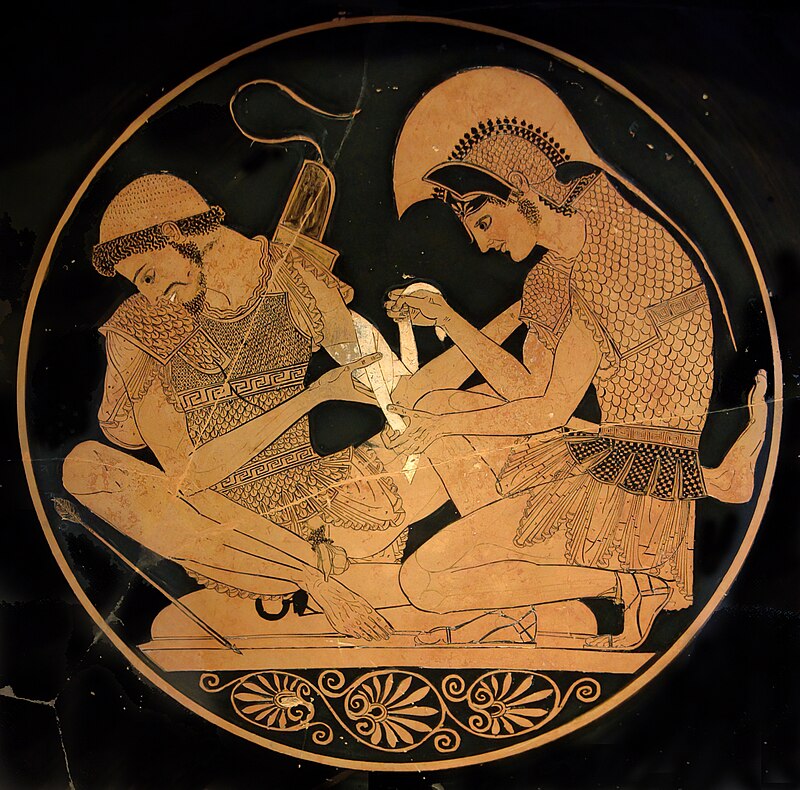
Trojan War
legendary war in Greek mythology

Prometheus
In Greek mythology, Prometheus (; ) is a Titan responsible for creating or aiding humanity in its earliest days. He defied the Olympian gods by taking fire from them and giving it to humanity in the form of technology, knowledge and, more generally, civilization.

Heracles

Odysseus
In Greek and Roman mythology, Odysseus (; , ), also known by the Latin variant Ulysses (, ; ), is a legendary Greek king of Ithaca and the hero of Homer's epic poem, the Odyssey. Odysseus also plays a key role in Homer's Iliad and other works in that same epic cycle.

Hephaestus
Hephaestus ( , ; eight spellings; ) is the Greek god of artisans, blacksmiths, carpenters, craftsmen, fire, metallurgy, metalworking, sculpture, and volcanoes. In Greek mythology, Hephaestus was the son of Hera, either on her own or by her husband Zeus. He was cast off Mount Olympus by his mother Hera because of his lameness, the result of a congenital impairment; or in another account, by Zeus for protecting Hera from his advances.

Medusa
In Greek mythology, Medusa (; ), also called Gorgo () or the Gorgon, was one of the three Gorgons. Medusa is generally described as a woman with living snakes in place of hair; her appearance was so hideous that anyone who looked upon her was turned to stone. Medusa and her Gorgon sisters Euryale and Stheno were usually described as daughters of Phorcys and Ceto; of the three, only Medusa was mortal.

Perseus
In Greek mythology, Perseus (, ; ) is the legendary founder of the Perseid dynasty. He was, alongside Cadmus and Bellerophon, the greatest Greek hero and slayer of monsters before the days of Heracles. He beheaded the Gorgon Medusa for Polydectes and saved Andromeda from the sea monster Cetus. He was a demigod, being the son of Zeus and the mortal Danaë, as well as the half-brother and great-grandfather of Heracles (as they were both children of Zeus, and Heracles's mother was Perseus's granddaughter).
.jpg)
Gorgons
thumb|Running Gorgon; amphora, Munich, Staatliche Antikensammlungen 2312 (c. 490 BC)

Triton
Greek god, messenger of the sea

Cadmus
In Greek mythology, Cadmus (; ) was the legendary Phoenician founder of Boeotian Thebes. He was, alongside Perseus and Bellerophon, the greatest hero and slayer of monsters before the days of Heracles. Commonly stated to be a prince of Phoenicia, the son of king Agenor and queen Telephassa of Tyre, the brother of Phoenix, Cilix and Europa, Cadmus traced his origins back to Poseidon and Libya.

Arachne
Arachne (; from , cognate with Latin ) is the protagonist of a tale in classical mythology known primarily from the version told by the Roman poet Ovid (43 BCE–17 CE). In Book Six of his epic poem Metamorphoses, Ovid recounts how the talented mortal Arachne challenged the goddess Minerva (the Roman equivalent of Athena) to a weaving contest. When Minerva could find no flaws in the tapestry Arachne had woven for the contest, the goddess became enraged and beat the girl with her shuttle. After Arachne hanged herself out of shame, she was transformed into a spider. The myth both provide

Giants
Giants from Greek myth

Diomedes
thumb|Athena counseling Diomedes shortly before he enters the battle. Schlossbrücke, Berlin.
.jpg)
Tiresias
thumb|300px|right|alt=A person with flowing robes holding a staff strikes two intertwined snakes on the ground|Tiresias strikes two snakes with a stick, and is transformed into a woman by Hera. Engraving by Johann Ulrich Kraus c. 1690. Taken from Die Verwandlungen des Ovidii (The Metamorphoses of Ovid).
thumb|300px|alt=A baroque painting showing a male and female figure together|Pietro della Vecchia, Tiresias Transformed into a Woman, 17th century.
In Greek mythology, Tiresias (; ) was a blind prophet of Apollo in Thebes, famous for clairvoyance and for being transformed into a woman for seven

Ismene
thumb|upright=1.15|Tydeus and Ismene on a [[Corinthian black-figure amphora, ca. 560 BC, Louvre.]]
.jpg)
Danaus
thumb

Daughters of Danaus
thumb|331x331px|The Danaides (1904), a Pre-Raphaelite interpretation by [[John William Waterhouse]]
In Greek mythology, the Danaïdes (; ), also Danaides or Danaids, were the fifty daughters of Danaus, king of Libya. In the most common version of the myth, the daughters were forced to marry the sons of Danaus' brother Aegyptus. In retaliation, Danaus commanded them to kill their husbands on their wedding night, and all but one, Hypermnestra, obeyed. The Danaids were then condemned to spend eternity carrying water in a sieve or perforated jug.
Erichthonius
legendary king of Athens
Enceladus
mythological giant
Cecrops I
mythical king of ancient Athens

Tydeus
Tydeus (; Ancient Greek: Τυδεύς Tūdeus) was an Aetolian hero in Greek mythology, belonging to the generation before the Trojan War. He was one of the Seven against Thebes, and the father of Diomedes, who is frequently known by the patronymic Tydides.
Judgement of Paris
story from Greek mythology

Alcyoneus
thumb|right|Alcyoneus (?), Athena, Gaia, and Nike, detail of the Gigantomachy frieze, [[Pergamon Altar, Pergamon museum, Berlin.]]

Zagreus
In ancient Greek religion and mythology, Zagreus () was a god sometimes identified with an Orphic Dionysus who was dismembered by the Titans and reborn. In the earliest mention of Zagreus, he is paired with Gaia and called the "highest" god, though perhaps only in reference to the gods of the underworld. Aeschylus, however, links Zagreus with Hades, possibly as Hades' son, or as Hades himself. Noting "Hades' identity as Zeus' katachthonios alter ego", Timothy Gantz postulated that Zagreus, originally the son of Hades and Persephone, later merged with the Orphic Dionysus, the son of Zeus and Pe
Pallas
mythical Greek deity, daughter of Triton
Argus
mythological Greek character, builder of Argo
Aglaurus, daughter of Cecrops
daughter of Cecrops I in Greek mythology

Pandrosus
Pandrosos or Pandrosus () was known in Greek myth as one of the three daughters of Cecrops I, the first king of Athens, and Aglaurus, daughter of King Actaeus.
Pallas
son of Uranus and Gaia, killed and flayed by Athena
Herse
Athenian princess, daughter of Cecrops
Perdix
mythical character, nephew of Daedalus
Nyctimene
daughter of Epopeus in Greek mythology
Agron
son of Eumelus in Greek mythology
Menippe and Metioche
daughters of Orion in Greek mythology
Iodame
In Greek mythology, Iodame or Iodama (; ) was a Thessalian princess as the daughter of King Itonus of Iton in Phthiotis. She was the granddaughter of Amphictyon.
Cornix
daughter of Coronaeus in Greek mythology
Cleothera
thumb|320px|right|Detail of Camiro and Clytie in a reconstruction of the Nekyia by Polygnotus, 1892
theomachy
A theomachy (Ancient Greek: Θεομαχία) is a battle among gods in Greek mythology. An early example is the Titanomachy (War of the Titans), in which the elder Olympian Gods fought against the preceding generation, the Titans. The war lasted ten years and resulted in the victory of the Olympians and their dominion over the world. Another case is the Gigantomachy, the battle fought between the Giants - the children of Gaia - and all the Olympian gods for supremacy of the cosmos.
Byssa
daughter of Eumelus in Greek mythology
Alcinoe
mythological Greek character, daughter of Polybus
Myrmex
mythical craftsman emulous of Athena
Erinome
In ancient Greek and Roman mythology, Erinoma () or Erinona () is a beautiful maiden who attracted the attention of both Zeus and Adonis, as well as the wrath of Hera and Aphrodite. Her story seems to be a local variant of Adonis's myth originating from the island of Cyprus, and survives only in the late works of Servius, a Latin grammarian who lived during the early fifth century AD.
Pallas
mythical son of Lykaon
Babys
satyr in Greek mythology
Asterius
mythical figure of Miletus
Eumelus
Eumelus ( Eúmēlos means "rich in sheep") was the name of: