Category
page 1Deeds of Hera
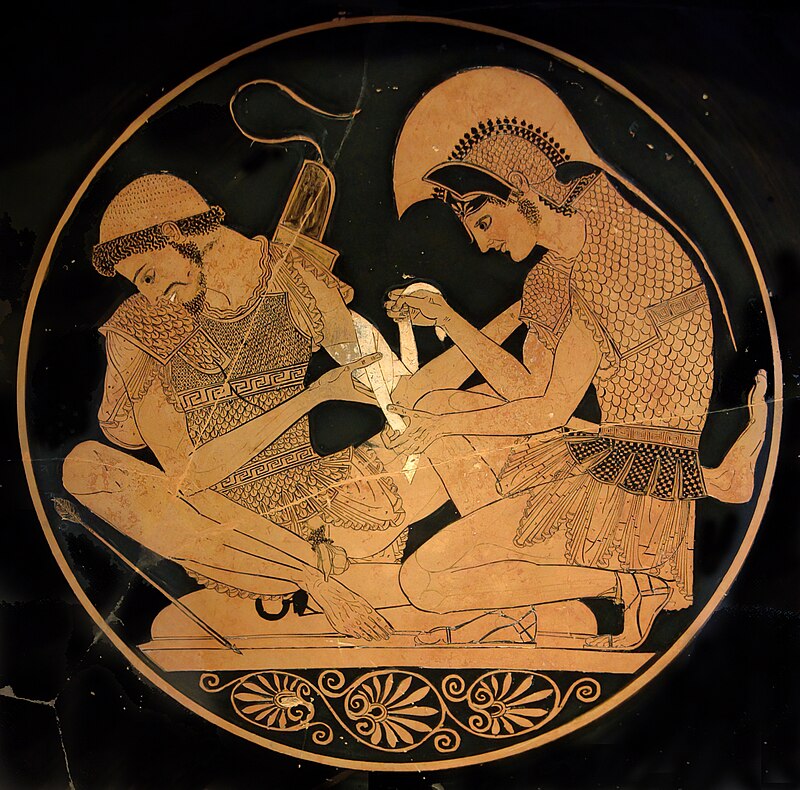
Trojan War
legendary war in Greek mythology

Dionysus
In ancient Greek religion and myth, Dionysus (; ) is the god of wine-making, orchards, fruit, vegetation, fertility, festivity, insanity, ritual madness, religious ecstasy, and theatre. He was also known as Bacchus ( or ; ) by the Greeks (a name later adopted by the Romans) for a frenzy he is said to induce called baccheia. His wine, music, and ecstatic dance were considered to free his followers from self-conscious fear and care, and subvert the oppressive restraints of the powerful. His thyrsus, a fennel-stem sceptre, sometimes wound with ivy and dripping with honey, is both a beneficent wan

Heracles

Hephaestus
Hephaestus ( , ; eight spellings; ) is the Greek god of artisans, blacksmiths, carpenters, craftsmen, fire, metallurgy, metalworking, sculpture, and volcanoes. In Greek mythology, Hephaestus was the son of Hera, either on her own or by her husband Zeus. He was cast off Mount Olympus by his mother Hera because of his lameness, the result of a congenital impairment; or in another account, by Zeus for protecting Hera from his advances.

Jason
thumb|upright=1.25|Jason, between the jaws of the dragon which guards the Golden Fleece, is saved by [[Athena. The fleece hangs from a tree behind them. Attic kylix, 480–470 BC, attributed to Douris.]]

Argonauts
thumb|Gathering of the Argonauts, Attica|Attic red-figure [[krater, 460–450 BC (Louvre G 341)]]
The Argonauts ( ; ) were a band of heroes in Greek mythology, who in the years before the Trojan War (around 1300 BC) accompanied Jason to Colchis in his quest to find the Golden Fleece. Their name comes from their ship, Argo, named after its builder, Argus. They were sometimes called Minyans, after a prehistoric tribe in the area.

Leto
In ancient Greek mythology and religion, Leto (; ) is a childhood goddess, the daughter of the Titans Coeus and Phoebe, the sister of Asteria, and the mother of Apollo and Artemis.

Iris
the personification of the rainbow in ancient Greek religion and mythology

Io
nymph seduced by Zeus in Greek mythology

Alkmene
In Greek mythology, Alcmene ( ; ) or Alcmena ( ; ; ; meaning "strong in wrath") was the wife of Amphitryon, by whom she bore two children, Iphicles and Laonome. She is best known as the mother of Heracles, whose father was the god Zeus. Alcmene was also referred to as Electryone (), a patronymic name as a daughter of Electryon.
.jpg)
Hypnos
In Greek mythology, Hypnos (; Ancient Greek: , 'sleep'), also spelled Hypnus, is the personification of sleep. The Roman equivalent is Somnus. His name is the origin of the word hypnosis. Pausanias wrote that Hypnos was the dearest friend of the Muses.

Lamia
thumb|The Kiss of the Enchantress (Isobel Lilian Gloag, ), inspired by Keats's "Lamia", depicts Lamia as half-serpent, half-woman
.jpg)
Semele
In Greek mythology, Semele (; ), or Thyone (; ), was the youngest daughter of Cadmus and Harmonia, and the mother of Dionysus by Zeus (her own great-grandfather).

Argus Panoptes
giant with hundred eyes in Greek mythology

Priapus
In Greek mythology, Priapus (; ) is a minor rustic fertility god, protector of livestock, fruit plants, gardens, and male genitalia. Priapus is marked by his oversized penis, and his permanent erection, which gave rise to the medical term priapism. He became a popular figure in Roman erotic art and Latin literature, and is the subject of the often humorously obscene collection of verse called the Priapeia.

Python
earth-dragon of Delphi

Giants
Giants from Greek myth

Callisto
nymph in Greek mythology

Hippolyta
In Greek mythology, Hippolyta, or Hippolyte (; Hippolytē), was a daughter of Ares and Otrera, queen of the Amazons, and a sister of Antiope and Melanippe. She wore her father Ares' zoster, the Greek word found in the Iliad and elsewhere meaning "war belt". Some English translations prefer "girdle". Hippolyta figures prominently in the myths of both Heracles and Theseus. The myths about her are so varied it is thought that they may be about different women. The name Hippolyta translates as "she who unleashes the horses", deriving from two Greek roots meaning "horse" and "let loose".
Echo
mountain nymph of Greek mythology

Eurystheus
thumb|338x338px|Hercule apporte à Eurysthée la ceinture de la reine des Amazones by Daniel Sarrabat
.jpg)
Tiresias
thumb|300px|right|alt=A person with flowing robes holding a staff strikes two intertwined snakes on the ground|Tiresias strikes two snakes with a stick, and is transformed into a woman by Hera. Engraving by Johann Ulrich Kraus c. 1690. Taken from Die Verwandlungen des Ovidii (The Metamorphoses of Ovid).
thumb|300px|alt=A baroque painting showing a male and female figure together|Pietro della Vecchia, Tiresias Transformed into a Woman, 17th century.
In Greek mythology, Tiresias (; ) was a blind prophet of Apollo in Thebes, famous for clairvoyance and for being transformed into a woman for seven

Ixion
thumb|The Fall of Ixion by Cornelis van Haarlem
.jpg)
Geryon
thumb|upright|A statuette of Geryon at the [[Museum of Fine Arts of Lyon]]
In Greek mythology, Geryon (; , genitive ), also Geryone (, or ), son of Chrysaor and Callirrhoe, the grandson of Medusa and the nephew of Pegasus, was a fearsome giant who dwelt on the island Erytheia of the mythic Hesperides in the far west of the Mediterranean. A more literal-minded later generation of Greeks associated the region with Tartessos in southern Iberia. Geryon was often described as a monster with either three bodies and three heads, or three heads and one body, or three bodies and one head. He is common
Ino
queen in Greek mythology

Athamas
thumb|right|206x206px| The Fury of Athamas by John Flaxman (1755-1826).

Tityos
thumb|Tityos attempts to rape Leto and is stopped by Apollo and Artemis on an Attic red-figure amphora from Vulci, 510–520 BCE, by the Phintias (painter)|Phintias Painter. [[Louvre, Paris.]]
Judgement of Paris
story from Greek mythology
Stentor
In Greek mythology, Stentor () was a herald of the Greek forces during the Trojan War.

Zagreus
In ancient Greek religion and mythology, Zagreus () was a god sometimes identified with an Orphic Dionysus who was dismembered by the Titans and reborn. In the earliest mention of Zagreus, he is paired with Gaia and called the "highest" god, though perhaps only in reference to the gods of the underworld. Aeschylus, however, links Zagreus with Hades, possibly as Hades' son, or as Hades himself. Noting "Hades' identity as Zeus' katachthonios alter ego", Timothy Gantz postulated that Zagreus, originally the son of Hades and Persephone, later merged with the Orphic Dionysus, the son of Zeus and Pe
Chrysippus
son of Pelops

Aëdon
Aëdon () was in Greek mythology, the daughter of Pandareus of Ephesus. According to Homer, she was the wife of Zethus, and the mother of Itylus. Aëdon features in two different stories, one set in Thebes and one set in Western Asia Minor, both of which contain filicide and explain the origin of the nightingale, a bird in constant mourning.

Galanthis
thumb|right|250px|Birth of Heracles by [[Jean Jacques Francois Le Barbier.]]
Macris
In Greek mythology, Macris ( a reference to the elongated shape of Euboea) also called Nysa (), is a daughter of Aristaeus who reared the goddess Hera in her youth, before incurring the wrath of the goddess and being banished by her.
.jpg)
Iynx
thumb|Detail of an earring showing a figure of Eros holding an iynx toy. Created in Northern Greece, |264x264px

Cedalion
thumb|200px|Cedalion standing on the shoulders of Orion; detail from Blind Orion Searching for the Rising Sun by Nicolas Poussin, 1658, Oil on canvas; 46 7/8 x 72 in. (119.1 x 182.9 cm), [[Metropolitan Museum of Art]]
Rhodope
daughter of Hebrus in Greek mythology
Antigone of Troy
daughter of Laomedon in Greek mythology

Gerana
Gerana, sometimes also called Oenoe, is a queen of the Pygmy folk in Greek mythology, who incurred the wrath of the goddess Hera and was subsequently turned into a bird bearing her name, the crane. This aetiological tale explains the ancient rivalry between the Pygmies and the cranes, and also serves as a cautionary tale against the people who hubristically claimed to be better than even the gods themselves.
Merops
set of mythological Greek characters
Cleothera
thumb|320px|right|Detail of Camiro and Clytie in a reconstruction of the Nekyia by Polygnotus, 1892
Proetids
thumb|Melampus and the Proetids in the temple of Artemis, by Aubin-Louis Millin (1759–1818).
theomachy
A theomachy (Ancient Greek: Θεομαχία) is a battle among gods in Greek mythology. An early example is the Titanomachy (War of the Titans), in which the elder Olympian Gods fought against the preceding generation, the Titans. The war lasted ten years and resulted in the victory of the Olympians and their dominion over the world. Another case is the Gigantomachy, the battle fought between the Giants - the children of Gaia - and all the Olympian gods for supremacy of the cosmos.
Ceyx and Alcyone
ancient Greek mythological figure
Erinome
In ancient Greek and Roman mythology, Erinoma () or Erinona () is a beautiful maiden who attracted the attention of both Zeus and Adonis, as well as the wrath of Hera and Aphrodite. Her story seems to be a local variant of Adonis's myth originating from the island of Cyprus, and survives only in the late works of Servius, a Latin grammarian who lived during the early fifth century AD.