Category
page 1Deeds of Hermes
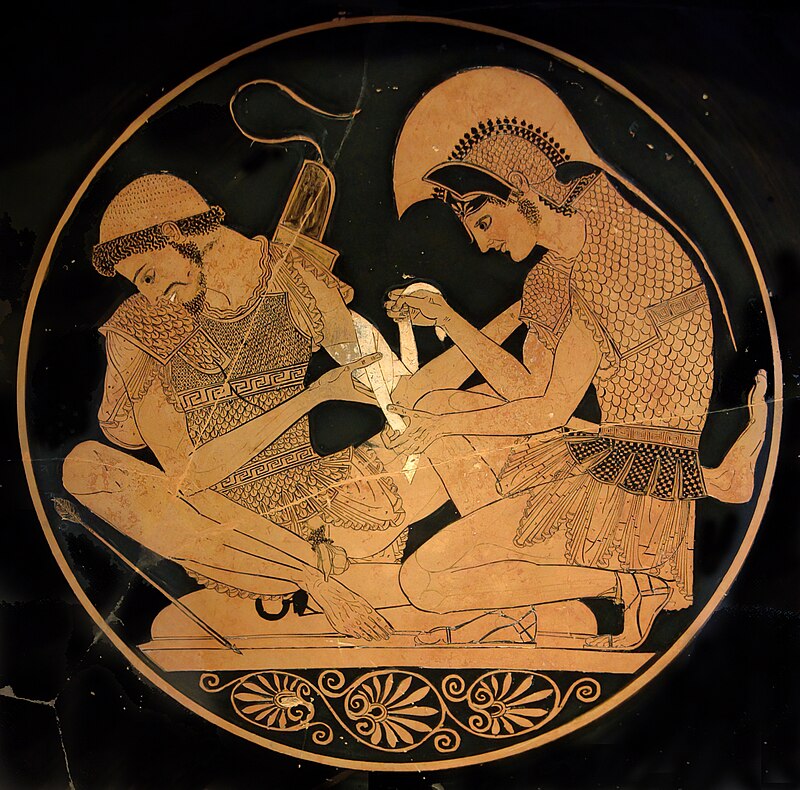
Trojan War
legendary war in Greek mythology

Dionysus
In ancient Greek religion and myth, Dionysus (; ) is the god of wine-making, orchards, fruit, vegetation, fertility, festivity, insanity, ritual madness, religious ecstasy, and theatre. He was also known as Bacchus ( or ; ) by the Greeks (a name later adopted by the Romans) for a frenzy he is said to induce called baccheia. His wine, music, and ecstatic dance were considered to free his followers from self-conscious fear and care, and subvert the oppressive restraints of the powerful. His thyrsus, a fennel-stem sceptre, sometimes wound with ivy and dripping with honey, is both a beneficent wan

Odysseus
In Greek and Roman mythology, Odysseus (; , ), also known by the Latin variant Ulysses (, ; ), is a legendary Greek king of Ithaca and the hero of Homer's epic poem, the Odyssey. Odysseus also plays a key role in Homer's Iliad and other works in that same epic cycle.

Perseus
In Greek mythology, Perseus (, ; ) is the legendary founder of the Perseid dynasty. He was, alongside Cadmus and Bellerophon, the greatest Greek hero and slayer of monsters before the days of Heracles. He beheaded the Gorgon Medusa for Polydectes and saved Andromeda from the sea monster Cetus. He was a demigod, being the son of Zeus and the mortal Danaë, as well as the half-brother and great-grandfather of Heracles (as they were both children of Zeus, and Heracles's mother was Perseus's granddaughter).

Cerberus
thumb|right|Heracles, wearing his characteristic lion-skin, club in right hand, leash in left, presenting a three-headed Cerberus, snakes coiling from his snouts, necks and front paws, to a frightened [[Eurystheus hiding in a giant pot. Caeretan hydria (c. 530 BC) from Caere (Louvre E701)]]

Pandora
thumb|Pandora by John William Waterhouse, 1896

Orion
giant huntsman in Greek mythology

Hecate
Hecate ( ; ) is a goddess in ancient Greek religion and mythology, most often shown holding a pair of torches, a key, or snakes, or accompanied by dogs, and in later periods depicted as three-formed or triple-bodied. She is variously associated with crossroads, night, light, magic, witchcraft, and the Moon. Her earliest appearance in literature was in Hesiod's Theogony in the 8th century BCE as a goddess of great honour with domains in sky, earth, and sea. She had popular followings among the witches of Thessaly, and an important sanctuary among the Carians of Asia Minor in Lagina. The earlies

Typhon
thumb|right|280px|Zeus aiming his thunderbolt at a winged and snake-footed Typhon. Chalcidian black-figured [[hydria ( BC), Staatliche Antikensammlungen (Inv. 596).]]
Typhon (; , ), also known as Typhoeus (; ), Typhaon () or Typhos (), was a monstrous serpentine giant and one of the deadliest creatures in Greek mythology. According to Hesiod, Typhon was the son of Gaia and Tartarus. However, one source has Typhon as the son of Hera alone, while another makes Typhon the offspring of Cronus. Typhon and his mate Echidna were the progenitors of many famous monsters.

Io
nymph seduced by Zeus in Greek mythology

Argus Panoptes
giant with hundred eyes in Greek mythology

Giants
Giants from Greek myth
Antiope
Greek mythological figure; daughter of Nycteus and mother of Amphion
Philemon and Baucis
ancient Greek mythical characters
Judgement of Paris
story from Greek mythology
Stentor
In Greek mythology, Stentor () was a herald of the Greek forces during the Trojan War.
Coronis
goddess from Greek mythology: princess, daughter of Phlegyas, lover of Ischys and Apollo, mother of Asclepius; killed by Apollon and Artemis
Aglaurus, daughter of Cecrops
daughter of Cecrops I in Greek mythology

Pandareus
thumb|270px|The daughters of Pandareus by Henry Fuseli, .
The Honest Woodman
fable by Aesop
Battus
mythological Greek character
Moly
herb in Homeric poetry
Chelone
character in Greek mythology
Cyllene
naiad from Greek mythology
Polyphonte
Polyphonte () is a character in Greek mythology, transformed into a strix.
Crocus
Greek mythological figure
Agron
son of Eumelus in Greek mythology
Cap of Hades
helmet or cap that can turn the wearer invisible (in classical mythology)
The Statue of Hermes
five fables of ancient Greek origin that deal with the statue of Hermes
theomachy
A theomachy (Ancient Greek: Θεομαχία) is a battle among gods in Greek mythology. An early example is the Titanomachy (War of the Titans), in which the elder Olympian Gods fought against the preceding generation, the Titans. The war lasted ten years and resulted in the victory of the Olympians and their dominion over the world. Another case is the Gigantomachy, the battle fought between the Giants - the children of Gaia - and all the Olympian gods for supremacy of the cosmos.
Chione
who was changed into a snow cloud
Byssa
daughter of Eumelus in Greek mythology
Erinome
In ancient Greek and Roman mythology, Erinoma () or Erinona () is a beautiful maiden who attracted the attention of both Zeus and Adonis, as well as the wrath of Hera and Aphrodite. Her story seems to be a local variant of Adonis's myth originating from the island of Cyprus, and survives only in the late works of Servius, a Latin grammarian who lived during the early fifth century AD.
Opora
Greek goddess
Eumelus
Eumelus ( Eúmēlos means "rich in sheep") was the name of: