Category
page 1Deeds of Poseidon

Athena

Ares
Ares (; , Árēs ) is the Greek god of war and courage. He is one of the Twelve Olympians, and the son of Zeus and Hera. Many Greeks were ambivalent towards him. He embodies the physical valor necessary for success in war but can also personify sheer brutality and bloodlust, in contrast to his sister Athena, whose martial functions include military strategy and generalship. An association with Ares endows places, objects, and other deities with a savage, dangerous, or militarized quality.
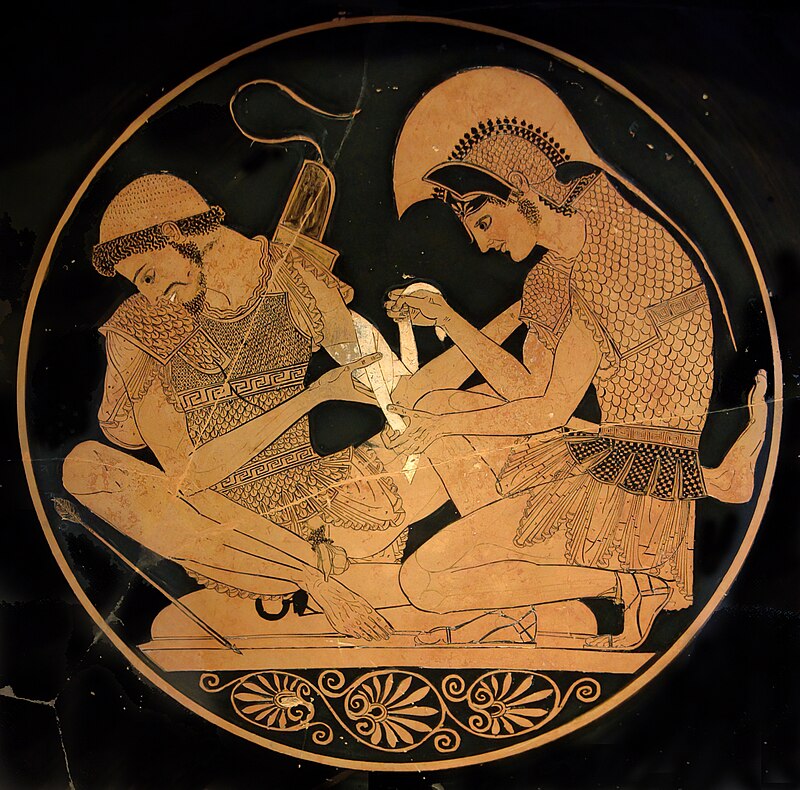
Trojan War
legendary war in Greek mythology

Odysseus
In Greek and Roman mythology, Odysseus (; , ), also known by the Latin variant Ulysses (, ; ), is a legendary Greek king of Ithaca and the hero of Homer's epic poem, the Odyssey. Odysseus also plays a key role in Homer's Iliad and other works in that same epic cycle.

Hephaestus
Hephaestus ( , ; eight spellings; ) is the Greek god of artisans, blacksmiths, carpenters, craftsmen, fire, metallurgy, metalworking, sculpture, and volcanoes. In Greek mythology, Hephaestus was the son of Hera, either on her own or by her husband Zeus. He was cast off Mount Olympus by his mother Hera because of his lameness, the result of a congenital impairment; or in another account, by Zeus for protecting Hera from his advances.

Minos
250 px|thumb|Gustave Doré's illustration of King Minos for [[Dante Alighieri's Inferno]]
thumb|Mural of Minos at the National and Kapodistrain University of Athens

Andromeda
Ethiopian princess in Greek mythology

Leto
In ancient Greek mythology and religion, Leto (; ) is a childhood goddess, the daughter of the Titans Coeus and Phoebe, the sister of Asteria, and the mother of Apollo and Artemis.

Castor and Pollux
Greek mythical siblings
Thetis
Thetis ( , or ; ) is a figure from Greek mythology with varying mythological roles. She mainly appears as a sea nymph, a goddess of water, and one of the 50 Nereids, daughters of the ancient sea god Nereus.

Laocoön
thumb|270px|right|Laocoön and His Sons in the Vatican
Laocoön (; , , gen.: ) is a figure in Greek and Roman mythology and the Epic Cycle.

Pasiphaë
In Greek mythology, Pasiphaë (, derived from the dative plural 'for all' and 'light'; , or , ) was the daughter of Helios, queen of Crete, and mother of the Minotaur. After her husband Minos failed to sacrifice the Cretan Bull to Poseidon as promised, the god cursed Pasiphaë to fall in love with the bull. She had Daedalus build a hollow wooden cow for her to hide in, which she then used to mate with the bull; afterwards, she gave birth to the Minotaur.

Giants
Giants from Greek myth

Titanomachy
thumb|300px|Cornelis Cornelisz van Haarlem, [[The Fall of the Titans, 1596–1598.]]

Zephyrus
In Greek mythology and religion, Zephyrus () (), also spelled in English as Zephyr (), is the god and personification of the West wind, one of the several wind gods, the Anemoi. The son of Eos (the goddess of the dawn) and Astraeus, Zephyrus is the most gentle and favourable of the winds, associated with flowers, springtime and even procreation. In myths, he is presented as the tender breeze, known for his unrequited love for the Spartan prince Hyacinthus. Alongside Boreas, the two are the most prominent wind gods with relatively limited roles in recorded mythology.
Cassiopeia
figure in Greek mythology; queen of Aethiopia and wife of king Cepheus
Ajax the Lesser
mythological Greek character, son of Oileus

Laomedon
In Greek mythology, Laomedon (; , Lāomédōn, "ruler of the people") was a Trojan king, son of Ilus and thus nephew of Ganymede and Assaracus.
Cretan Bull
bull in Greek mythology
Hippolytus
son of Theseus in Greek mythology

Asteria
In Greek mythology, Asteria or Asterie ( ; ) is a daughter of the Titans Phoebe and Coeus (Polus) and the sister of Leto. According to Hesiod, by the Titan Perses she had a single child, a daughter named Hecate, the goddess of witchcraft. Other authors made Asteria the mother of the fourth Heracles and Hecate by Zeus.
Cecrops I
mythical king of ancient Athens

Euros
In ancient Greek mythology and religion, Eurus () is the god and personification of the east wind, although sometimes he is also said to be southeast specifically. He is one of the four principal wind gods, the Anemoi, alongside his brothers Boreas (north wind), Zephyrus (west wind) and Notus (south wind).

Phineus
thumb|250px|Phineus with the Boreads.

Polybotes
thumb|right|Poseidon (left) holding a trident, with the island Nisyros on his shoulder, battling a Giant (probably Polybotes), [[red-figure cup c. 500–450 BC (Cabinet des Medailles 573).]]
thumb|Poseidon attacks Polybotes in the presence of Gaia, red-figure cup late fifth-century BC ([[Antikensammlung Berlin F2531)]]
Pterelaus
Taphian king in Greek legend
Nerites
Greek deity
Hyrieus
In Greek mythology, Hyrieus (; ) was the eponym of Hyria in Boeotia, where he dwelt and where Orion (see below) was born; some sources though place him either in Thrace or on Chios. Most accounts speak of him as a king, although Ovid and Nonnus portray him as a peasant.

Athos
mythical giant
Cornix
daughter of Coronaeus in Greek mythology
theomachy
A theomachy (Ancient Greek: Θεομαχία) is a battle among gods in Greek mythology. An early example is the Titanomachy (War of the Titans), in which the elder Olympian Gods fought against the preceding generation, the Titans. The war lasted ten years and resulted in the victory of the Olympians and their dominion over the world. Another case is the Gigantomachy, the battle fought between the Giants - the children of Gaia - and all the Olympian gods for supremacy of the cosmos.
Periclymenus
In Greek mythology, the name Periclymenus (; Ancient Greek: Περικλύμενος Periklymenos) may refer to: